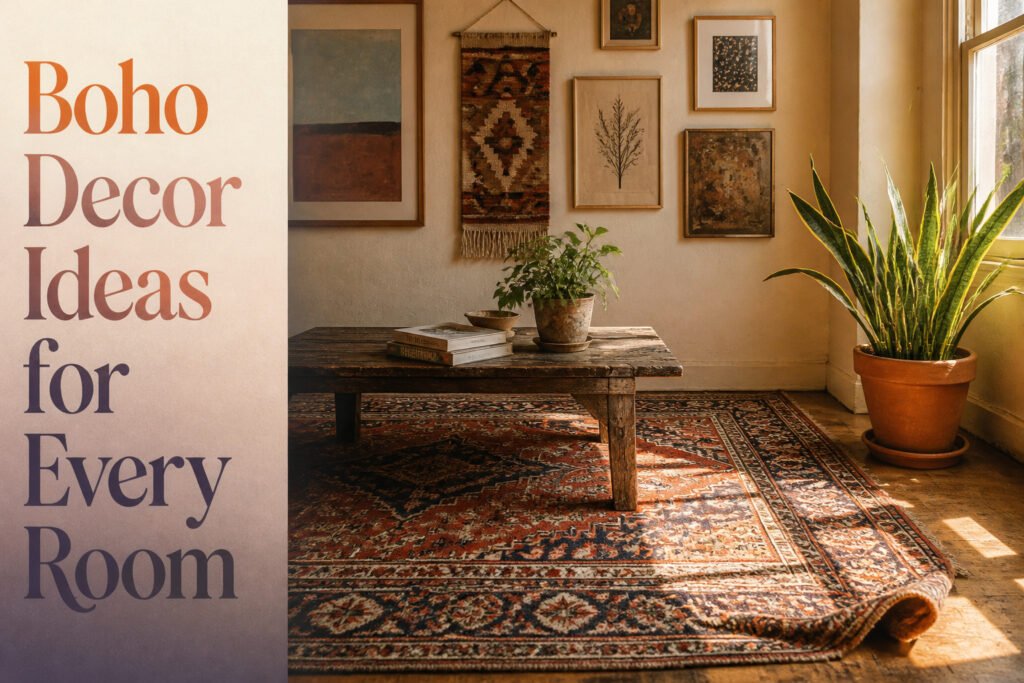
Boho decor ideas run from a $12 strand of Edison bulbs to vintage Persian rugs that demand professional cleaning, and the deciding factor is how much imperfection you can tolerate. The rugs want deliberate off-center placement and fading; the bulbs want you to cluster them unevenly and skip the overhead fixture entirely. The style only works if you stop smoothing things out.
1. Neutral Base
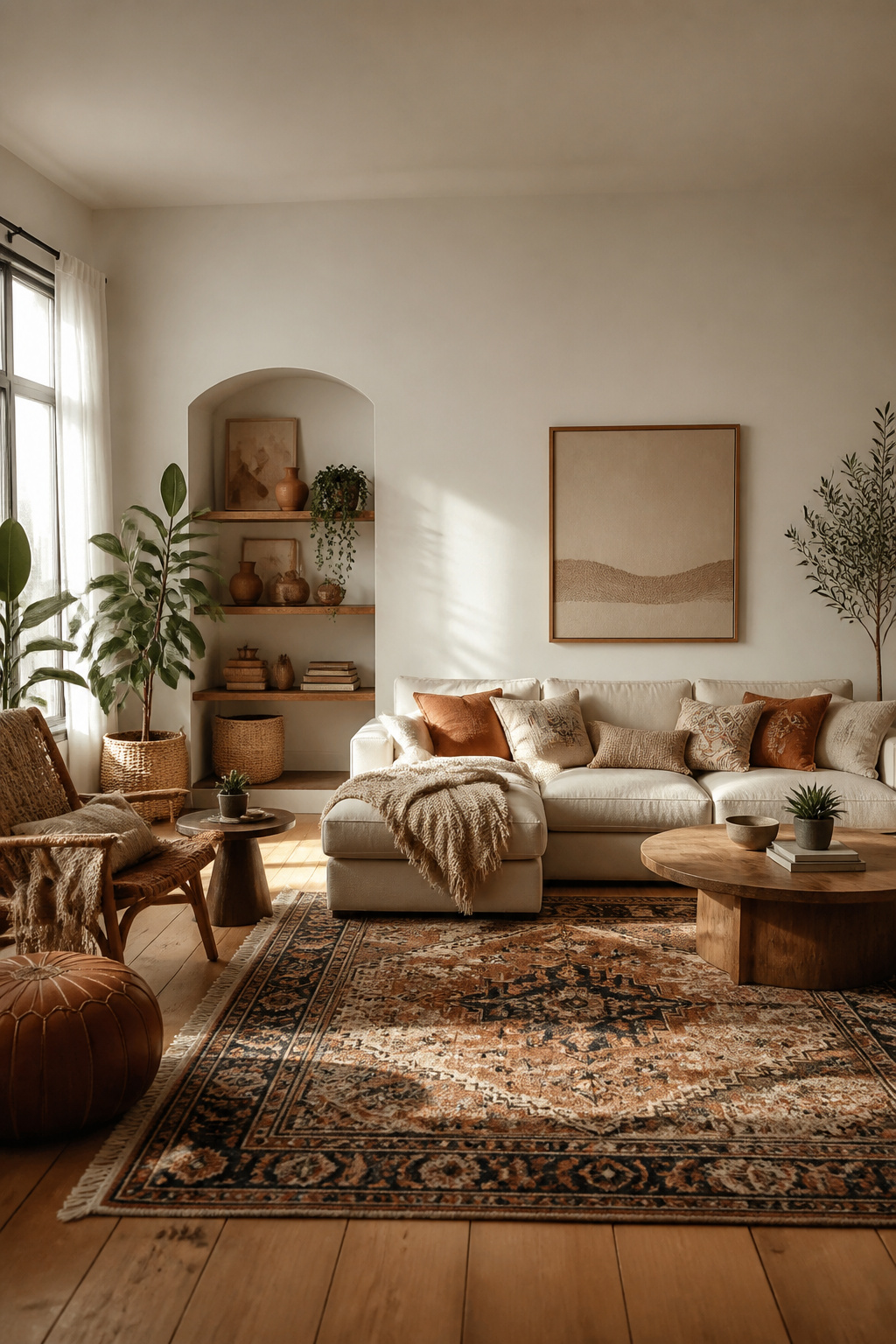
Walls painted in warm whites or soft earth tones do the heavy lifting in a space that will later hold patterned rugs, woven throws, and a dozen plants. Without that restrained base, the layers compete instead of complement, and the room closes in fast. Creams and beiges on the largest surfaces, the sofa and the walls especially, keep the eye from landing on too many places at once. I learned this after painting a rental living room a saturated terracotta, then watching every textile I added afterward fight for attention. The neutral ground does not mean boring; it means the texture work, the leather poufs and layered rugs and sheepskin, actually reads as texture rather than noise. Start with the big pieces quiet, then build.
2. Layered Textiles
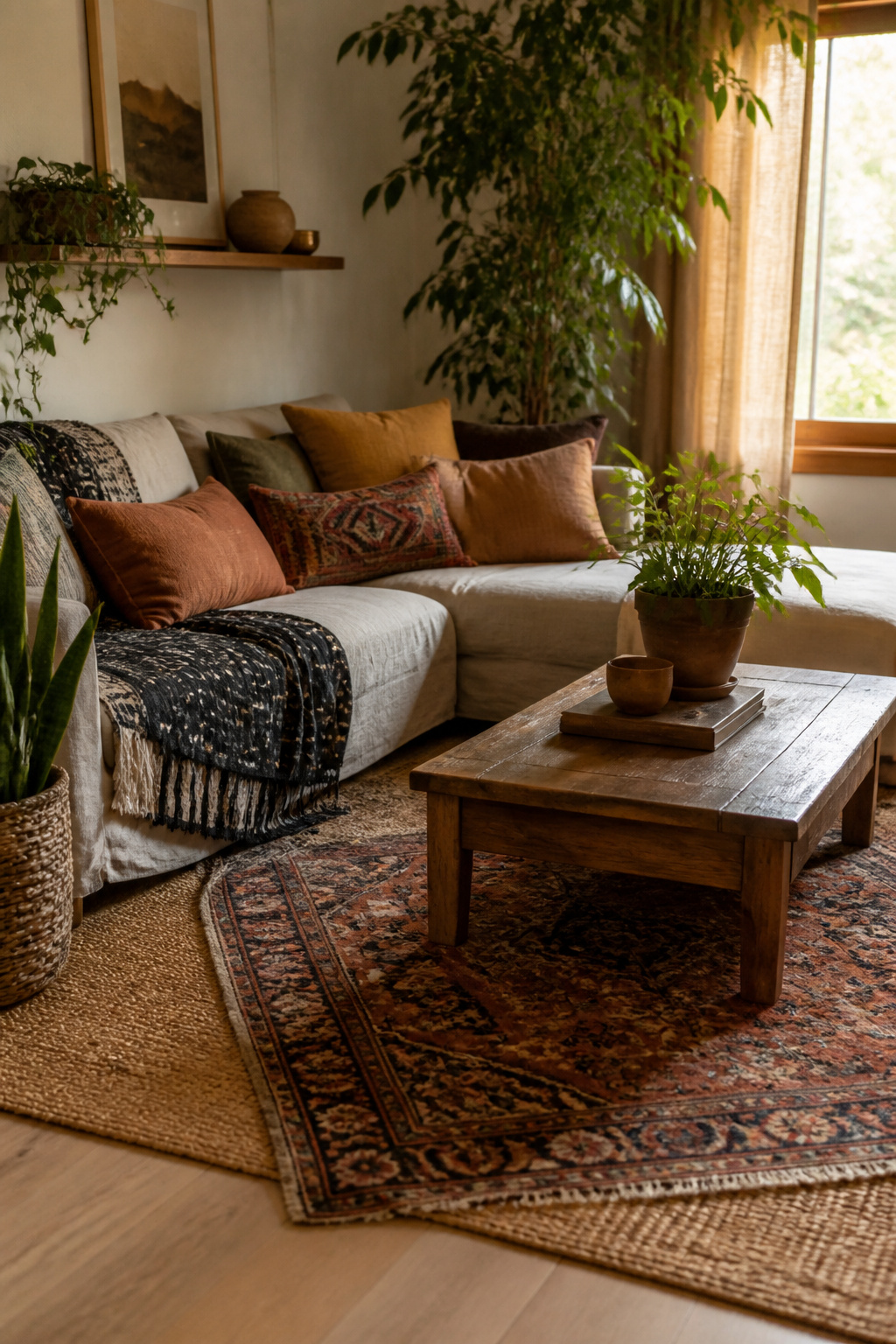
The first time I tried layering rugs, I laid a flat-weave jute base and centered a worn Persian on top like I was framing a photograph. It looked stiff, like a showroom set. What saved it was shoving the top rug six inches off-center so the jute showed unevenly at the edges. Deliberate imperfection, not matching sets, is what makes the room feel lived-in rather than staged.
Mudcloth throws over linen sofas work the same way. The rough, patterned cotton against the smooth weave creates the depth that velvet and faux fur bring to a smaller scale. I stack pillows in odd numbers, mixing terracotta jewel tones with olive and mustard, none from the same collection. The colors tie together only because they share the same dusty saturation.
For renters, this is the cheapest way to fake a collected look. Two secondhand rugs and a throw from a flea market beat a single new set every time.
3. Macramé Wall Hanging
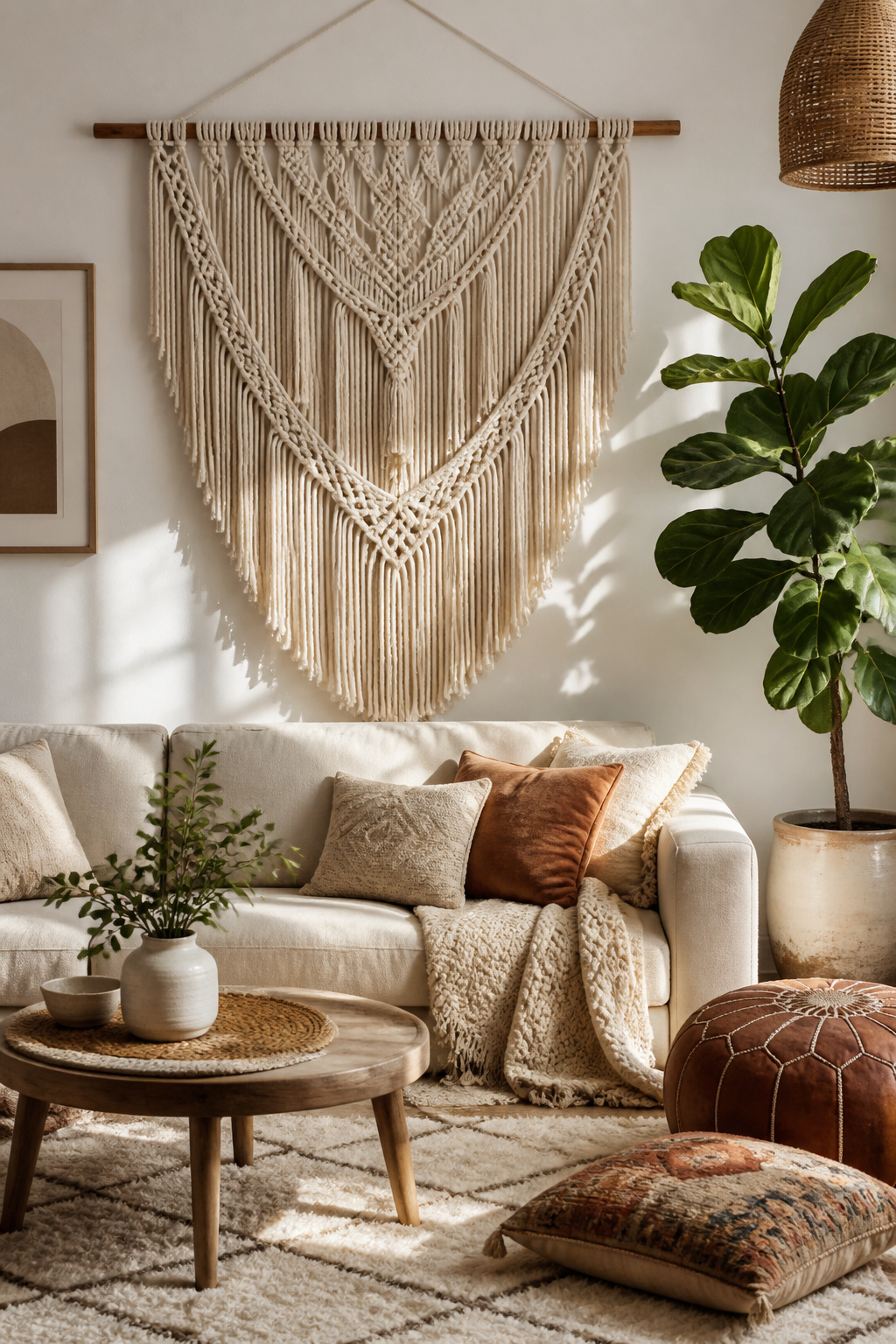
Hand-knotted fiber art fills vertical space without the weight of framed pieces. A single large piece above a bed or sofa replaces a headboard or anchors a gallery wall, and the texture reads warmer than paint alone. I bought mine for $18 at a flea market and dyed it in a bucket of tea when the white looked too bright against my cream wall. The tannin turned it a soft ivory in about two hours, and the unevenness actually helped it look older than it was.
A piece that reaches 20–24 inches wide works over a full bed without crowding the sides. Much smaller and it floats; much larger and the knots sag under their own weight unless the rod is substantial. Cotton cord is the standard and the cheapest, but jute and wool blends hold their shape longer and shed less lint onto whatever sits below them. Wall hooks or a simple nail through the hanging loop is enough; macramé is light even at three feet long. The real decision is whether you want open, lacy knots that cast shadows or dense ones that read almost solid from across the room. Open knots need a pale wall behind them or the effect disappears.
4. Rattan Furniture
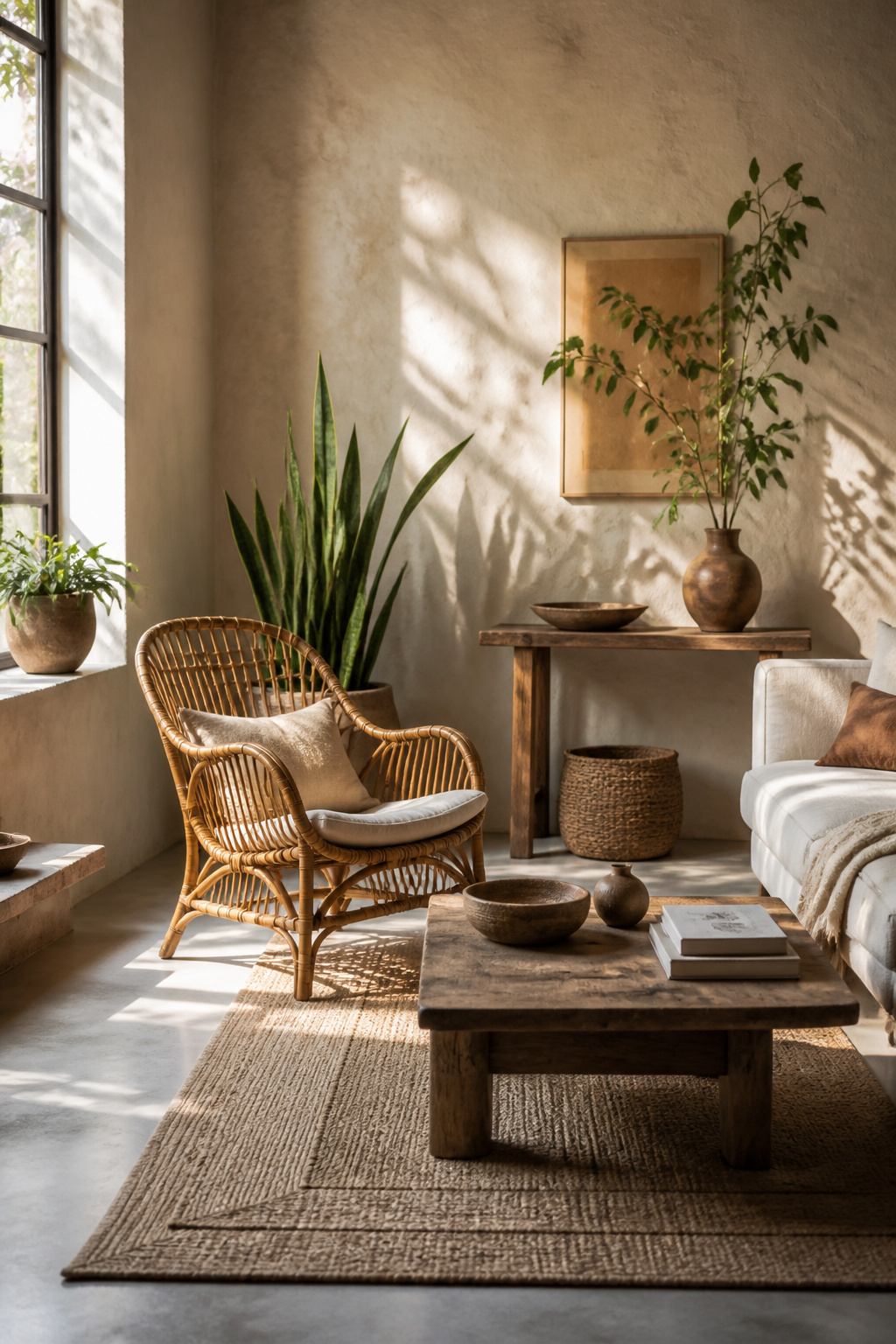
Woven cane and rattan add a warmth and airiness that solid wood simply cannot match. A 1970s peacock chair in the corner, a rattan headboard behind the bed, or even a simple side table beside the sofa carries a room toward that greenhouse-living-room feeling without a single plant in sight. The material lets light through, keeps visual weight low, and somehow looks collected rather than decorated.
Check vintage stores and estate sales first. New reproductions from mainstream retailers run surprisingly high, and the old pieces come already broken in with the patina that manufacturers now try to fake. The frames are usually sturdy; what frays is the caning, which can be rewoven by hand for the cost of a few hours and a hank of rush. I have passed on chairs with perfect frames because the seat was shot, then kicked myself later when I realized the repair was straightforward. A $40 find plus an afternoon of work beats a $400 catalog version that still smells like the shipping container.
5. Plants Everywhere
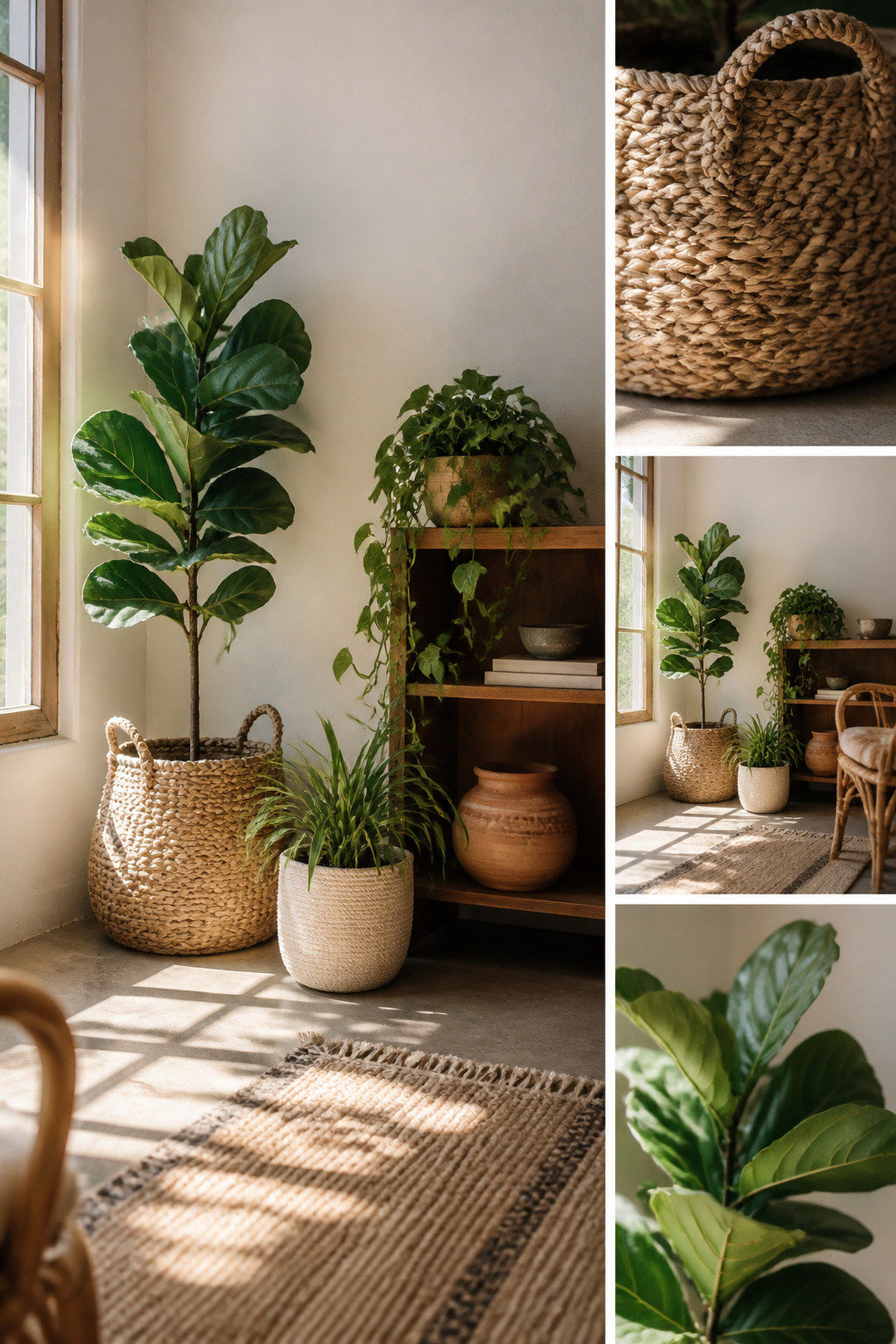
A fiddle-leaf fig in the corner does more for a room than most accent chairs costing ten times as much. The leaves are large enough to catch light and cast shadows that move through the day, which softens the straight lines of furniture in a way no lamp or pillow manages.
Snake plants and trailing pothos work the same trick at different heights. Cluster three heights together rather than spacing them evenly; the uneven group reads as one found moment, while matching distances look like a waiting room. A dark apartment will kill a bird of paradise no matter how good the window looks in photos. A ZZ plant surviving that same light is the better boho choice. Use what grows where you actually live.
6. Vintage Kilim Pillows
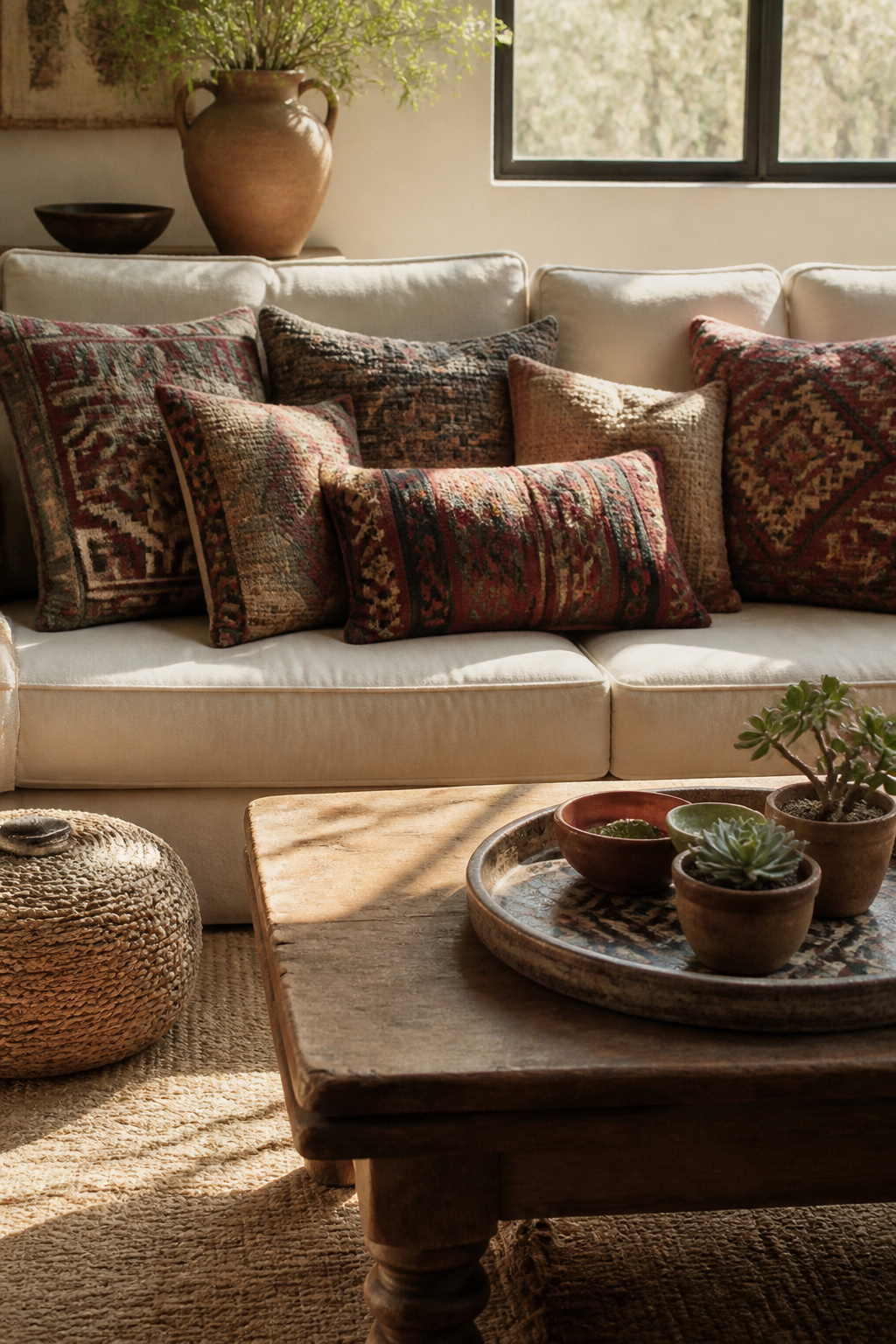
Flat-woven kilim pillows from Turkey and Persia carry a saturation and geometry that printed cotton never quite reaches. The wool dyes sit deeper in the fiber, and the hand-woven irregularities keep the pattern alive when you move across a room. They arrive stiff, almost board-like, which puts some buyers off. Three weeks of leaning into them breaks the weave open; six months gives you something that molds to the small of your back.
I rotate a small stack seasonally, and the ones that spent two summers fading in a south-facing window have been demoted to the window seat where direct sun never lands. The color loss happened faster than I expected, maybe eight months of strong light to shift a rust to a washed coral. Faded kilims still read as vintage, but if you are buying for the original punch, placement matters more than with almost any other textile in the room. Newer pieces go where the sun hits; the sun-bleached ones get the shady corners and still pull their weight.
7. Low-Profile Seating
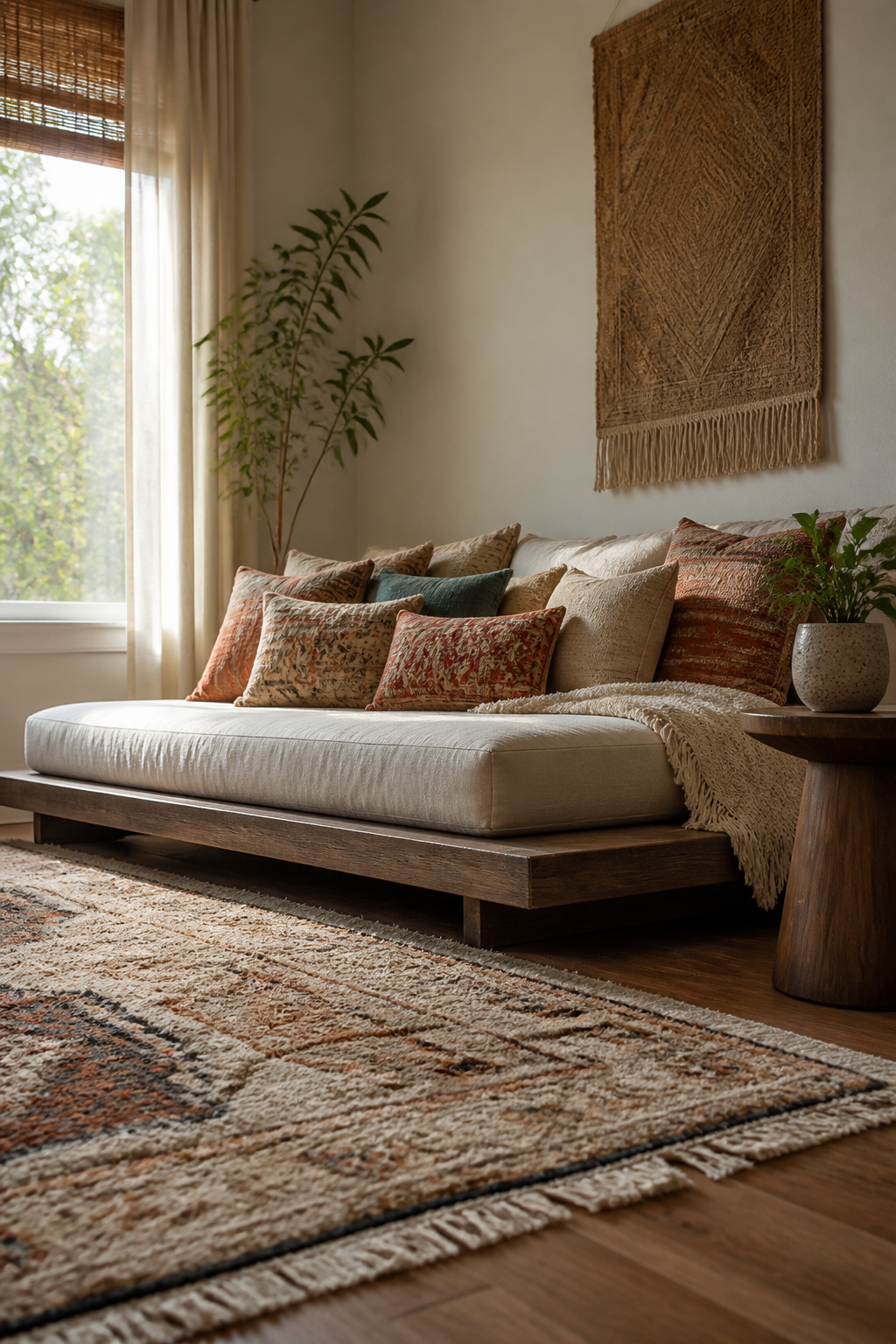
Floor cushions and poufs pull the eye down to where conversation actually happens, and that lower sight line reads as relaxed the minute you walk in. I tried the mattress-on-pallets setup in a first rental and learned fast that anything sitting directly on the floor becomes a dust magnet by Wednesday; the horizontal line worked, but the maintenance wore me out. A 6-inch mid-century daybed gets you the same stretched-out, grounded feeling with a frame that lets air circulate and a vacuum slide underneath. For renters, the daybed also leaves when you do, no holes, no commitment. Pile the back wall with pillows in varying sizes and textures, and the look holds even if the upholstery itself stays neutral.
8. Eclectic Art Gallery
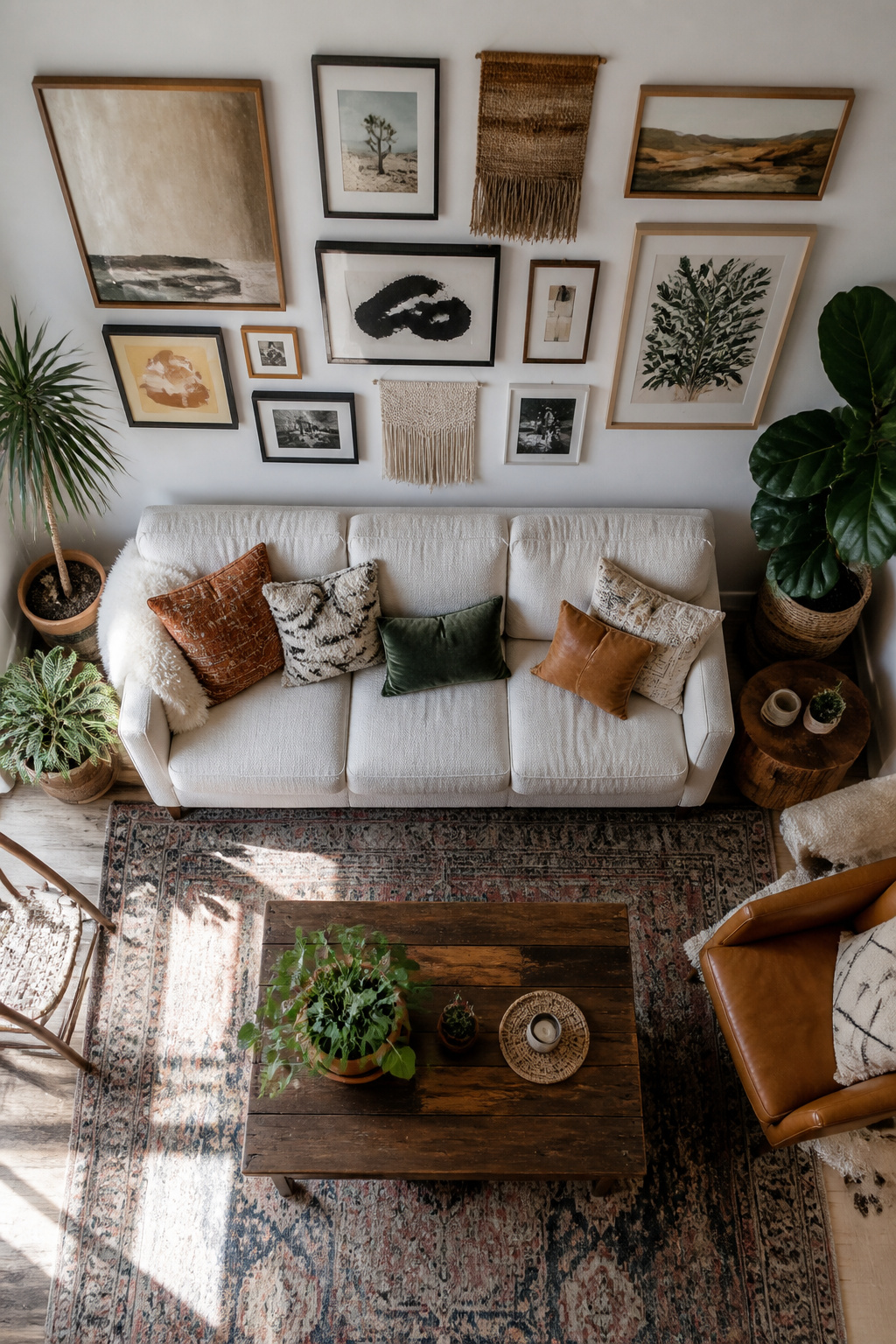
A single wall in a boho space should look collected over years, not ordered from one catalog. Mix the frame finishes, let the sizes stagger, and let the subjects argue a little: a flea-market oil portrait next to a woven wall hanging, a postcard from some trip wedged beside a pressed fern in a thrifted frame. The tension is the point.
Lay the whole arrangement on the floor first and photograph it before you touch a hammer. My first gallery wall climbed uphill to the right because I eyeballed it from two feet away, and the photograph on my phone caught the slant in seconds. The floor gives distance the wall denies you. Start with the largest piece slightly off-center, not dead middle; everything else anchors to it instead of floating in equal spacing. Command strips work for lighter frames if you are renting, though anything with real glass still needs a nail.
9. Warm Lighting
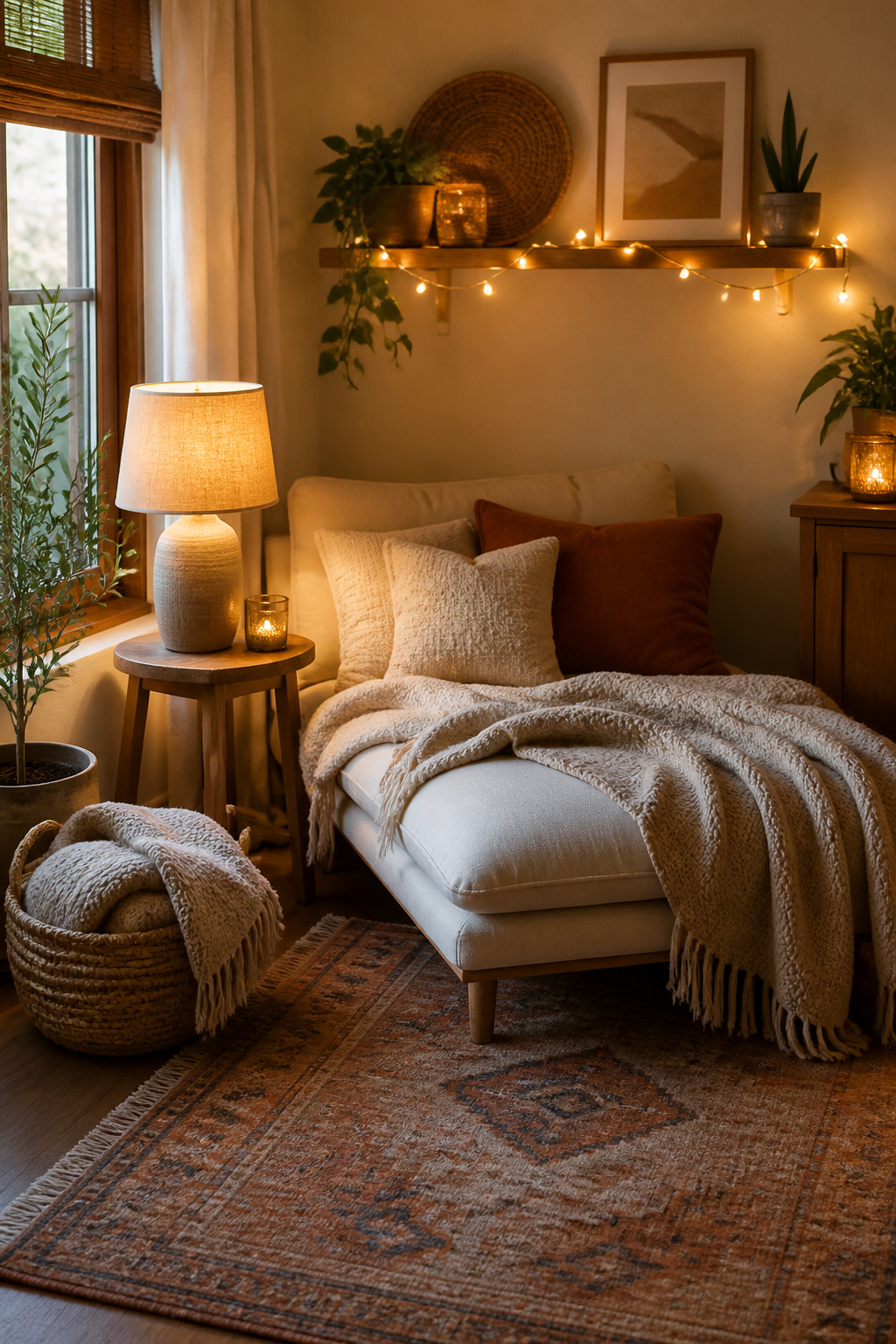
Overhead fixtures flatten a room into one flat wash of light, and boho needs the opposite. String lights, Moroccan lanterns, candles, and table lamps at varied heights build pools of amber light that shift as you move through the space. A $12 strand of Edison bulbs behind my bookshelf has outlasted two floor lamps, and the wiring hides so completely that renters can take the whole setup along at move-out. Skip the ceiling where the landlord controls it; cluster instead on surfaces you own. Low-hanging pendants work only where you can install them, so for most of us the table lamp and the strand of bulbs do the real work after dark. Moroccan-style lamps cast the patterned shadows that make a dinner corner feel collected rather than staged, and a lantern with dried flowers and Mod Podge takes an evening to make if the store-bought options run high. The mistake is buying one bright source and calling it done. Three dim ones, uneven, read as intimate; one strong bulb reads asinterrogation.
10. Colorful Area Rug
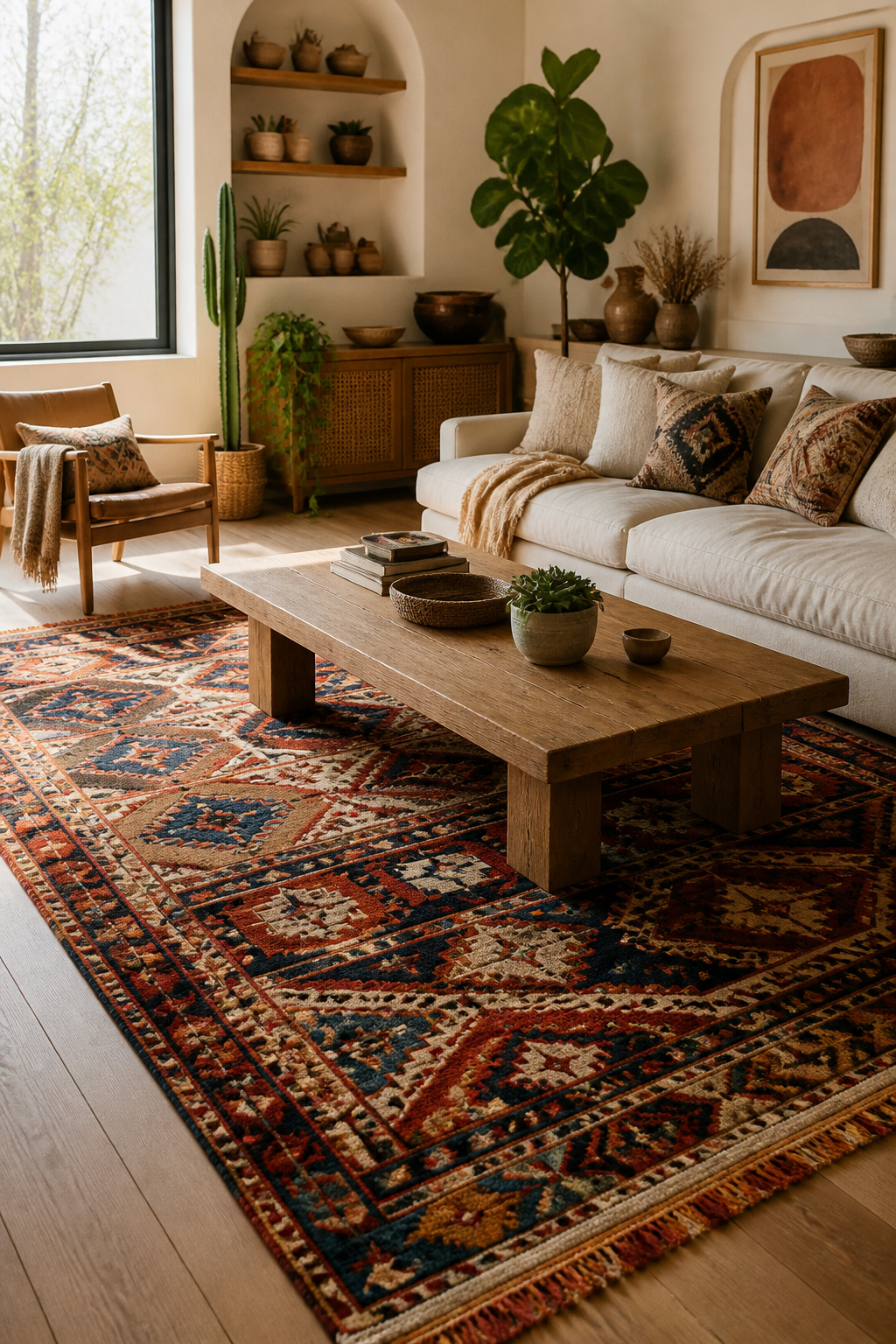
A single bold rug underfoot does the heavy lifting in a boho room, especially where the living and dining areas share one open floor plan. The pattern sets the palette and the edges draw the boundary your furniture arrangement needs.
Vintage Moroccan or Persian rugs carry the most authentic character, with the hand-knotted texture and bold geometric patterns that read as collected over time rather than bought in a set. Those come at a cost, and the cleaning is not weekend-friendly.
For tighter budgets and easier maintenance, flat-weave cotton dhurries work. They still bring the color and pattern mix that defines the style, but they shake out and spot-clean without the drama of a full wool wash. Layer one over a solid, inexpensive rug if the floor underneath needs more coverage; the slight shift between layers adds the eclectic, lived-in look that polished single-rug rooms miss.
11. Woven Wall Baskets
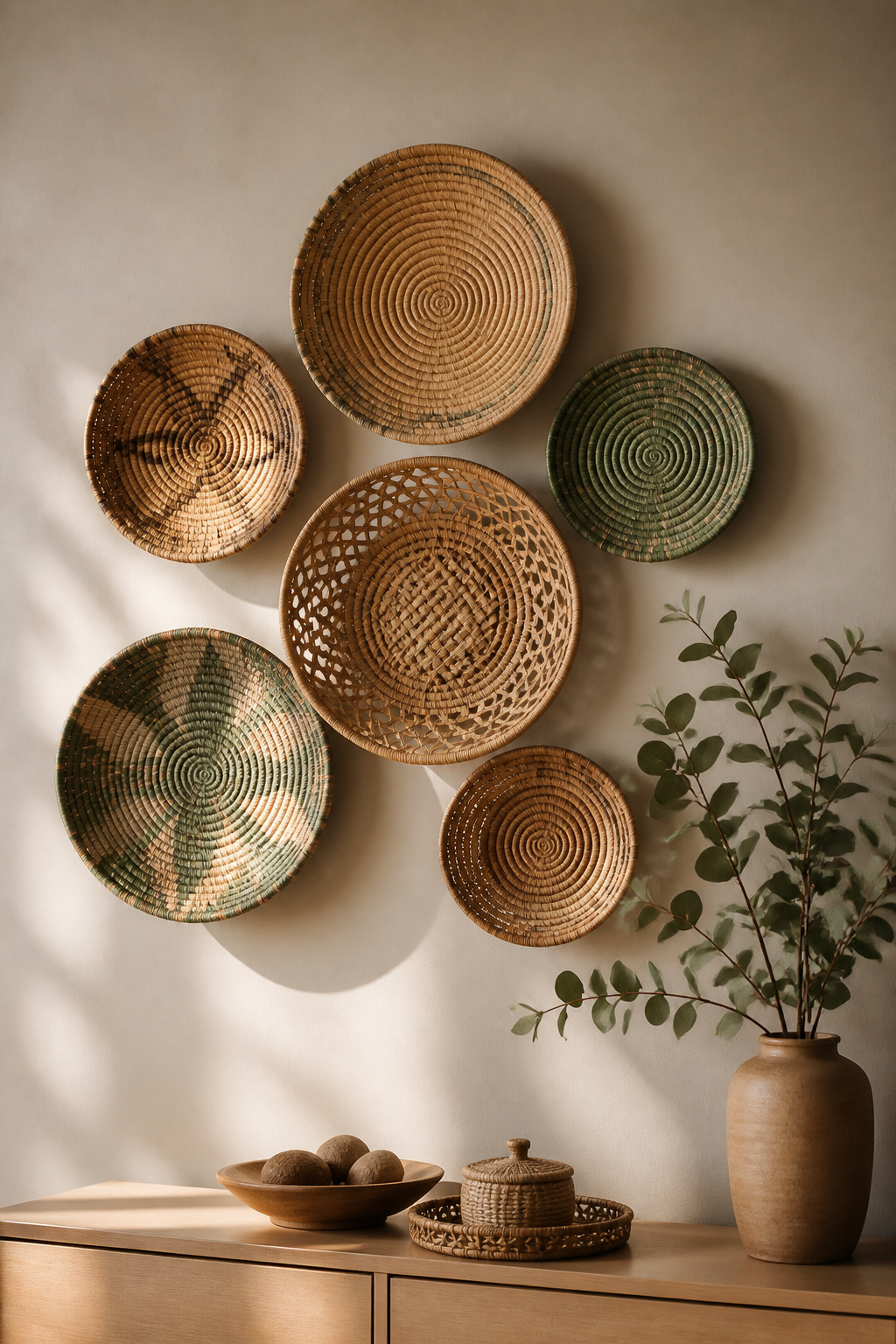
African sweetgrass or Bolga baskets hung in a cluster add three-dimensional texture that flat art cannot. The wall catches light and shadow through the weave in a way a framed print never manages, and the slight bow of a well-used bottom gives the whole arrangement movement.
Hunt estate sales and import shops for irregular sizes and patinas. The new ones are too even; you want the one that sat in a kitchen for decades and darkened where hands touched it. That uneven color is what makes the grouping feel collected rather than purchased as a set.
Arrange the largest basket slightly off-center and build outward with smaller pieces, keeping two to four inches between rims so each shape reads on its own. A dozen sounds like a lot until you hold them against the wall and see the gaps. Start with five or six and add as you find them; the hunt is half the point, and the cluster should look like it grew over time rather than arrived in one afternoon.
12. Fringe Details
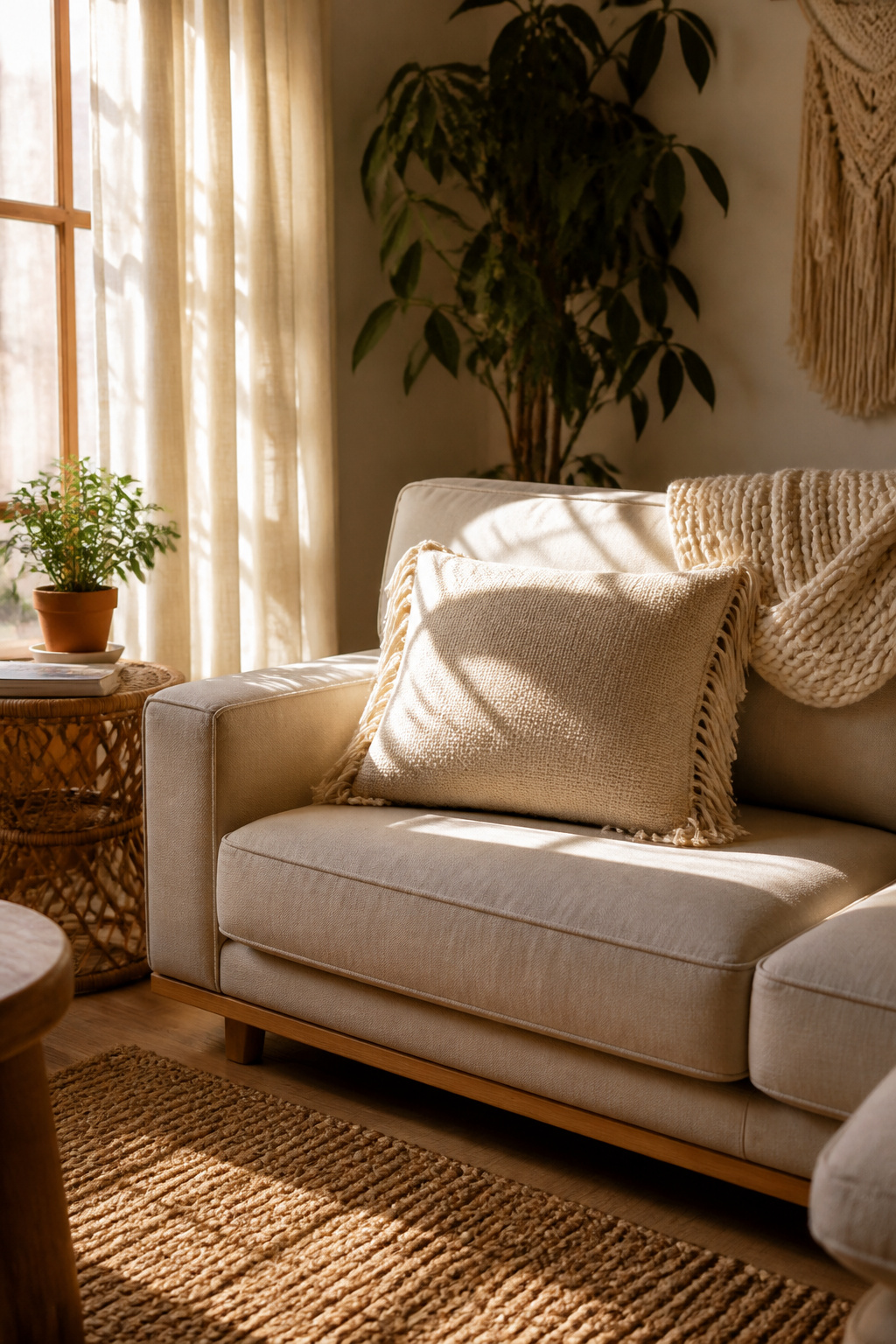
Fringe catches light in a way nothing else in a room does. Trim it along a lampshade rim, a curtain hem, or the edge of a single throw pillow and you get movement every time someone walks past. The mistake is treating it like more is more. One piece with fringe is texture; three in the same sightline starts looking like a set dresser went overboard.
I learned the hard way with a long-fringed throw that seemed perfect draped across the sofa. By day three the tassels had tangled in every zipper, phone charger, and dog collar in reach. One or two fringed pieces per room is the limit, and even then, placement matters. A lampshade fringe is safe because nobody leans against it. A throw you actually use is not. Some details are better admired than lived with daily.
13. Global Accessories
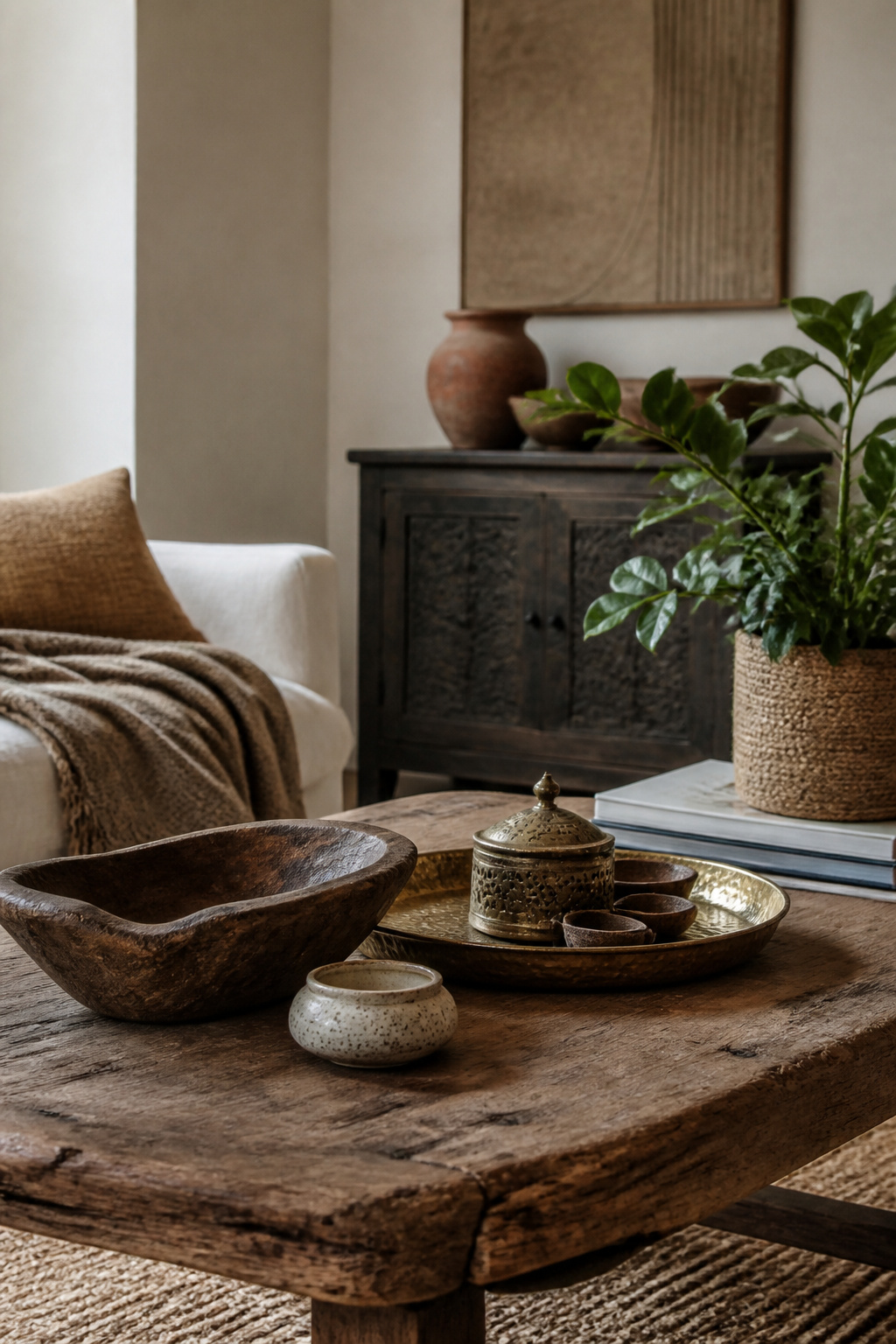
The best brass tray I own came from a shop in Jaipur, bought thirdhand at a garage sale in Tucson. Its base is pocked with hammer marks that catch afternoon light differently than anything factory-stamped. That unevenness is what separates a lived-in room from a staged one.
Carved wooden animals, hand-beaten copper, ceramic bowls with the glaze worn thin at the rim: these pieces carry weight because someone handled them before you did. The mistake is walking into one import store and buying the whole look at once. Three brass elephants, two matching trays, and a set of nested bowls from the same shelf read like a catalog, not a collection. Your eye lands on nothing because everything competes.
Spread the hunt across months. Let a carved box sit on your dresser for a year before you find the bowl that answers it. The brass darkens, the wood takes oil from your hands, and the room starts to look assembled over time rather than ordered in a single afternoon.
14. Layered Window Treatments
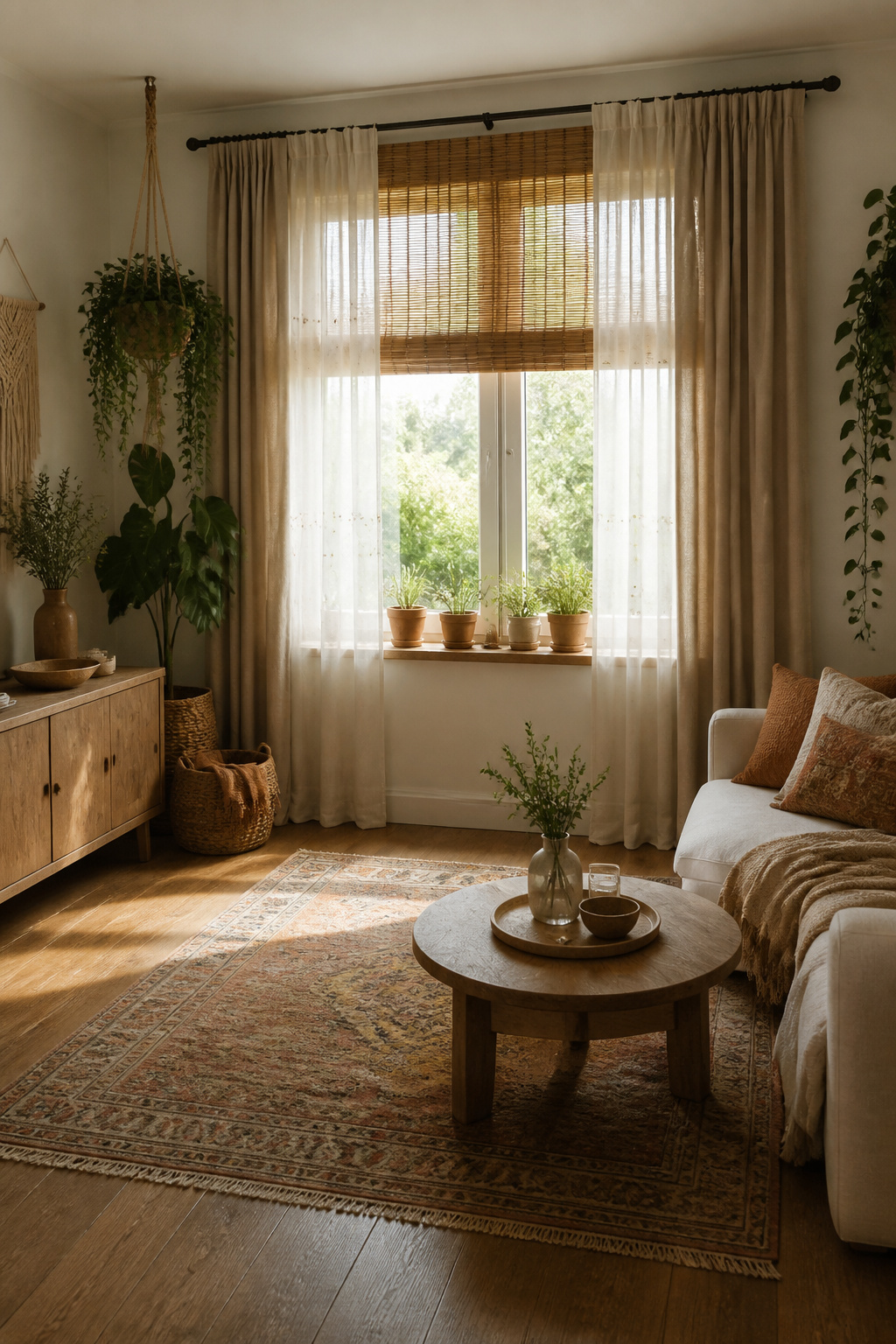
Three layers of window treatments sounds like overkill until you watch a room shift from morning to evening. Sheer curtains filter the daylight without turning the space into a cave, heavier drapes close off the street after dark and keep the room from bleeding heat, and a woven shade in between gives the wall something tactile that plain drywall never will. The cost stays reasonable if you build it over time. My own stack came together piecemeal: a bamboo shade from the hardware store, unbleached muslin panels I cut and hemmed one Saturday, and a heavy brown velvet pair that sat in a garage-sale bin marked $8. The velvet was faded in one panel, but facing the worn sides toward the wall hides the flaw entirely. What sells the look is the slight unevenness, the way the fabrics don’t match too neatly. That mismatch reads as collected rather than staged, which is the whole point of boho in the first place.
15. Hanging Chairs
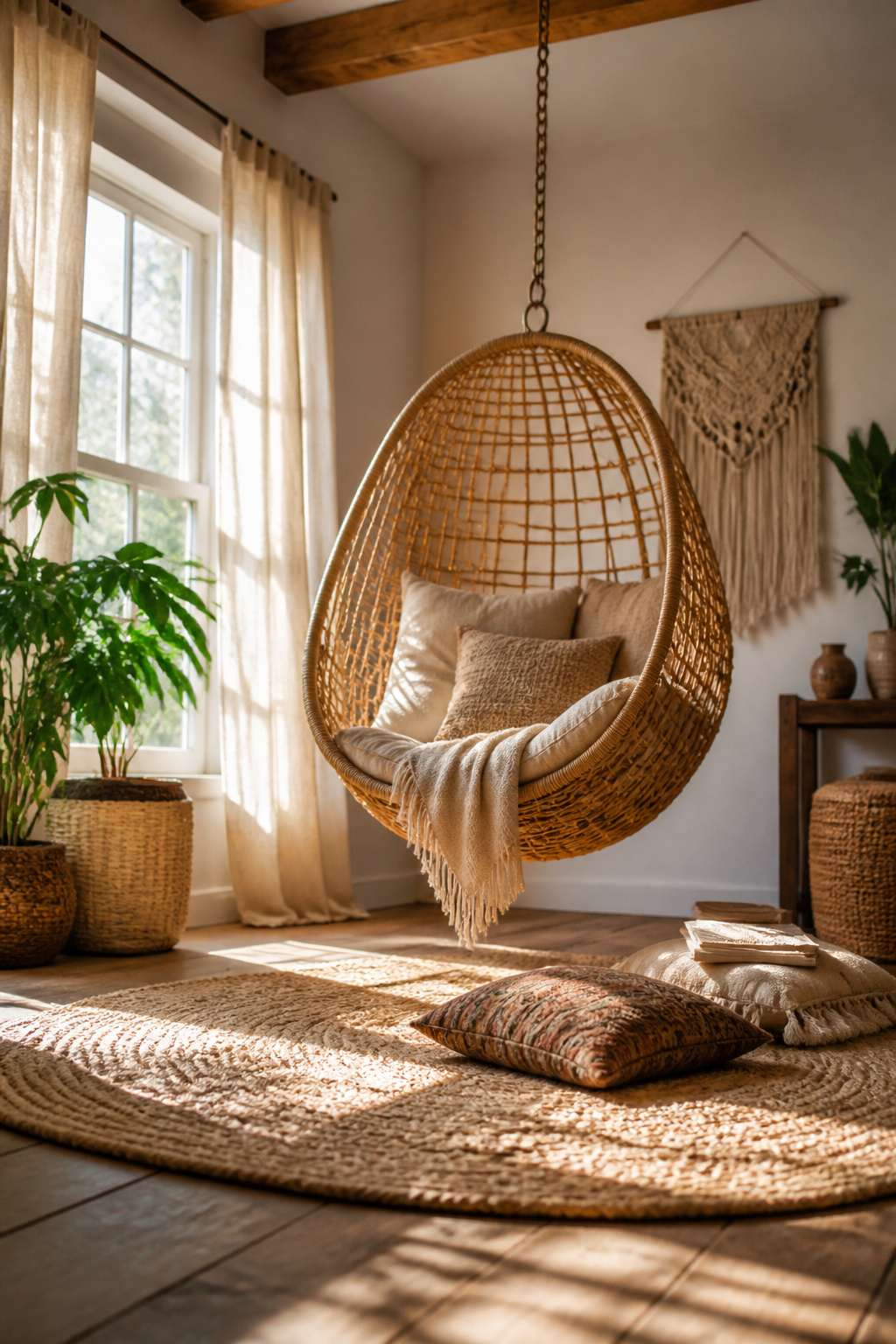
A single suspended rattan chair gives you a reading nook and a focal point in one, and it never asks for the floor space a framed armchair would eat up. The trick is where it hangs. A drywall anchor will not hold a chair and a person, full stop. I learned that from a handyman who patched my first attempt after the ceiling let go. Before you drill, find a joist and check that it can take the load, or use a properly rated ceiling mount tied into the framing. The chair itself can run from a simple woven pod to something with more cushion and spread; either works if the hardware underneath is right. For renters, a doorway-mounted pull-up bar with a hanging kit is sometimes the safer play, since it leaves no holes to fix later.
16. Colorful Throw Blankets
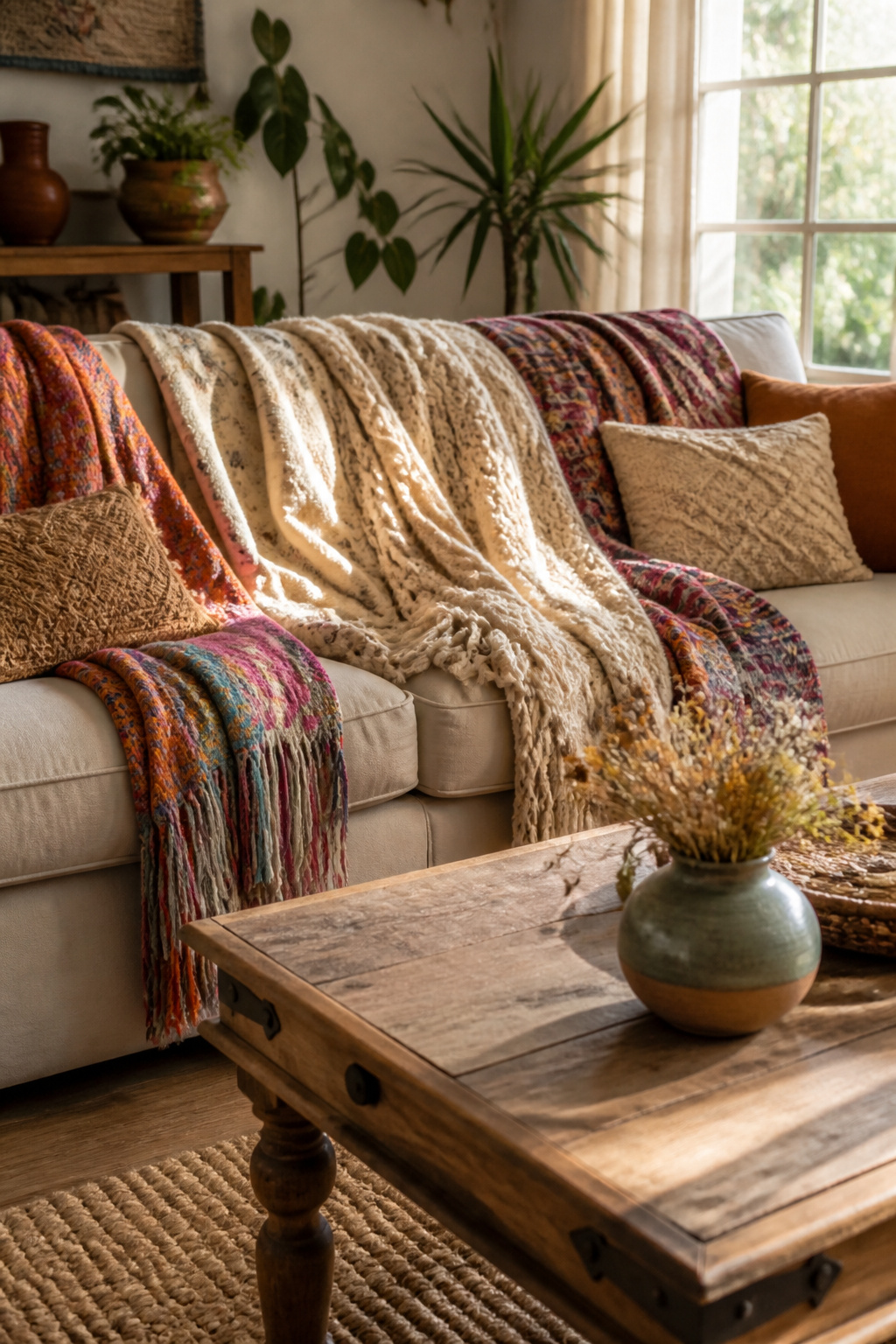
A stack of two or three throw blankets within arm’s reach of every seat does more to sell the boho look than almost anything else on this list. The mix matters: a chunky knit for cold evenings, a block-printed cotton that stays breathable, and something with real history like a reclaimed sari silk. Each one invites someone to actually use it, and that lived-in softness is what separates boho from a catalog shoot.
I keep mine visible, draped over the back of the sofa where the colors layer against each other. Folding them into a basket looks tidier, but tidiness misses the point entirely. The slight rumple from someone pulling it loose last night is what makes the room feel occupied rather than arranged.
17. Natural Fiber Accents
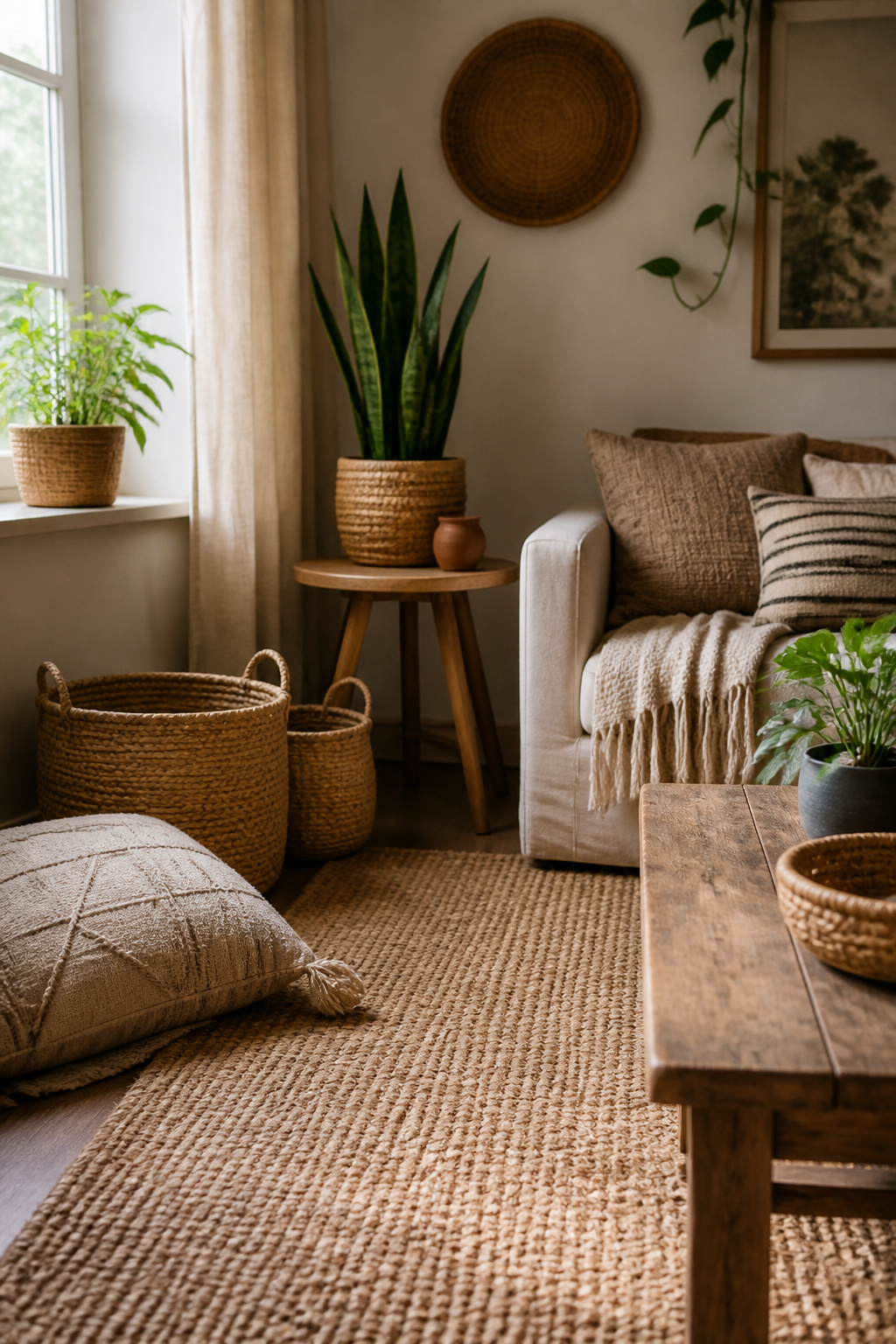
Jute, sisal, seagrass, and unbleached cotton all share one trait that factory-perfect materials fight against: they get better as they wear. A jute rug underfoot develops a soft, flattened nap where people walk most. Seagrass baskets relax out of their tight shipping coil and settle into looser shapes that actually hold logs or magazines better. Raw cotton napkins soften through washes and keep their flecks of seed hull that bleaching would have stripped away.
The irregularity is the point. Machine finishing sands out the slub, the color shift, the slight unevenness in weave. These fibers keep it, and that visual noise is what stops a room from feeling staged.
They stain more easily than synthetics, and that is part of their character. A coffee ring on a jute rug or a water mark on seagrass is not a failure; it is documentation of use. Fighting it with aggressive cleaning usually damages the fiber more than the spill did. Spot-clean gently, accept the patina, or plan to rotate pieces that take heavy use.
18. DIY Boho Projects
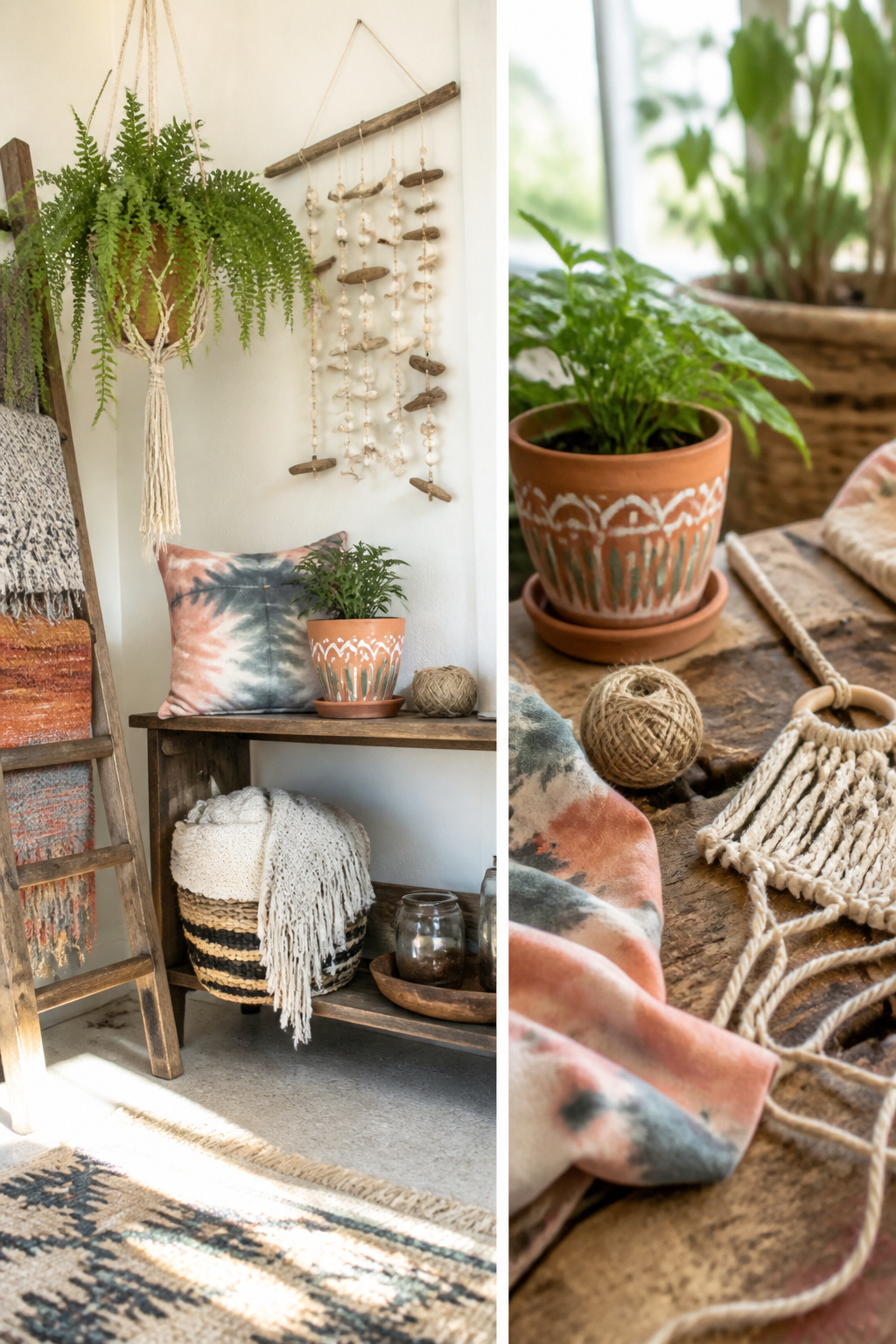
The boho look carries more weight when your hand actually made it. Macramé plant hangers, tie-dyed pillowcases, driftwood wall hangings, and painted terracotta pots all cost less than store-bought versions and carry the slight unevenness that proves someone touched them.
My first macramé piece had knots that tightened at different tensions and a cord that twisted no matter how I held it. I hung it anyway, and now that lopsided shape is how I remember learning the pattern. The mistakes are what make it yours, not flaws to hide.
A weekend and about twenty dollars in cord or dye gets you most of these projects. Painted terracotta pots need only leftover acrylic and a sealant coat so water does not bubble the finish. Driftwood is free if you live near water; otherwise, a weathered branch from any yard works once sanded smooth. The tie-dye method that mattered most for pillowcases was soaking the fabric in soda ash first so the color locked in without bleeding muddy edges.
What failed harder was trying to make everything match. Two pillows in the same dye bath looked identical; three looked like a set from a catalog. The better move was starting each batch at different dilutions so nothing repeated exactly.
What Boho Actually Means
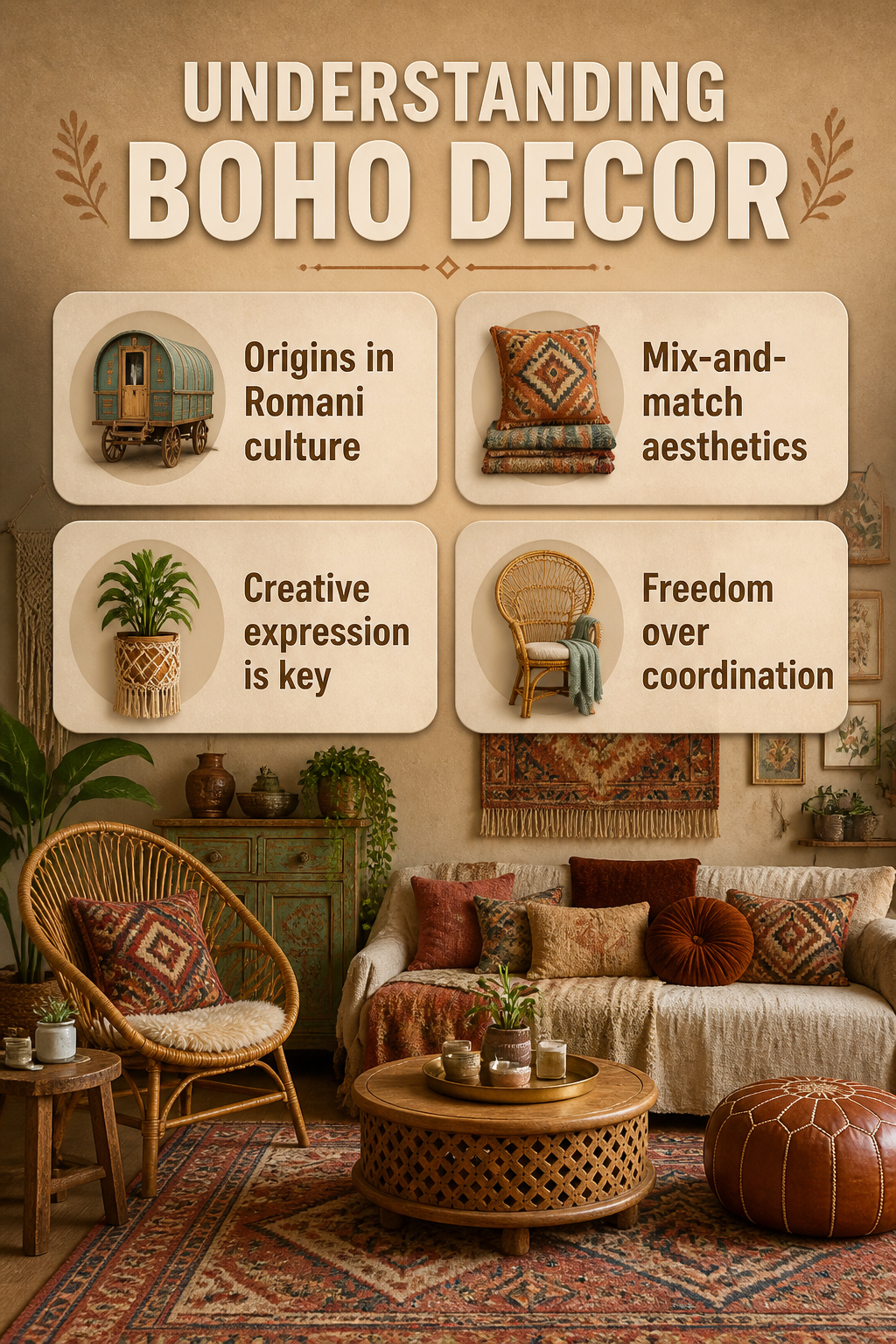
The term boho decor ideas gets thrown around so loosely that it helps to know where the style actually comes from. It traces back to 19th-century Romani communities and the artist quarters of Paris, where people mixed whatever they had or found without worrying about period, provenance, or whether things matched. That freedom is the whole point. A rattan chair from the 1970s sits next to a textile picked up somewhere else entirely, and neither apologizes.
What convinced me, reading back through how this style gets described, is that nobody agrees on the exact ingredients. Some sources lean into macramé and bamboo, others into bold rugs and floor cushions. The only common thread is creative permission: if a piece speaks to you, you find a place for it. Self-expression matters more than coordination. The space should feel curated, yes, but not too designed. A weekend project with a few hundred dollars and a flea market trip will get you further here than a matching set ever would.
Boho in Small Spaces
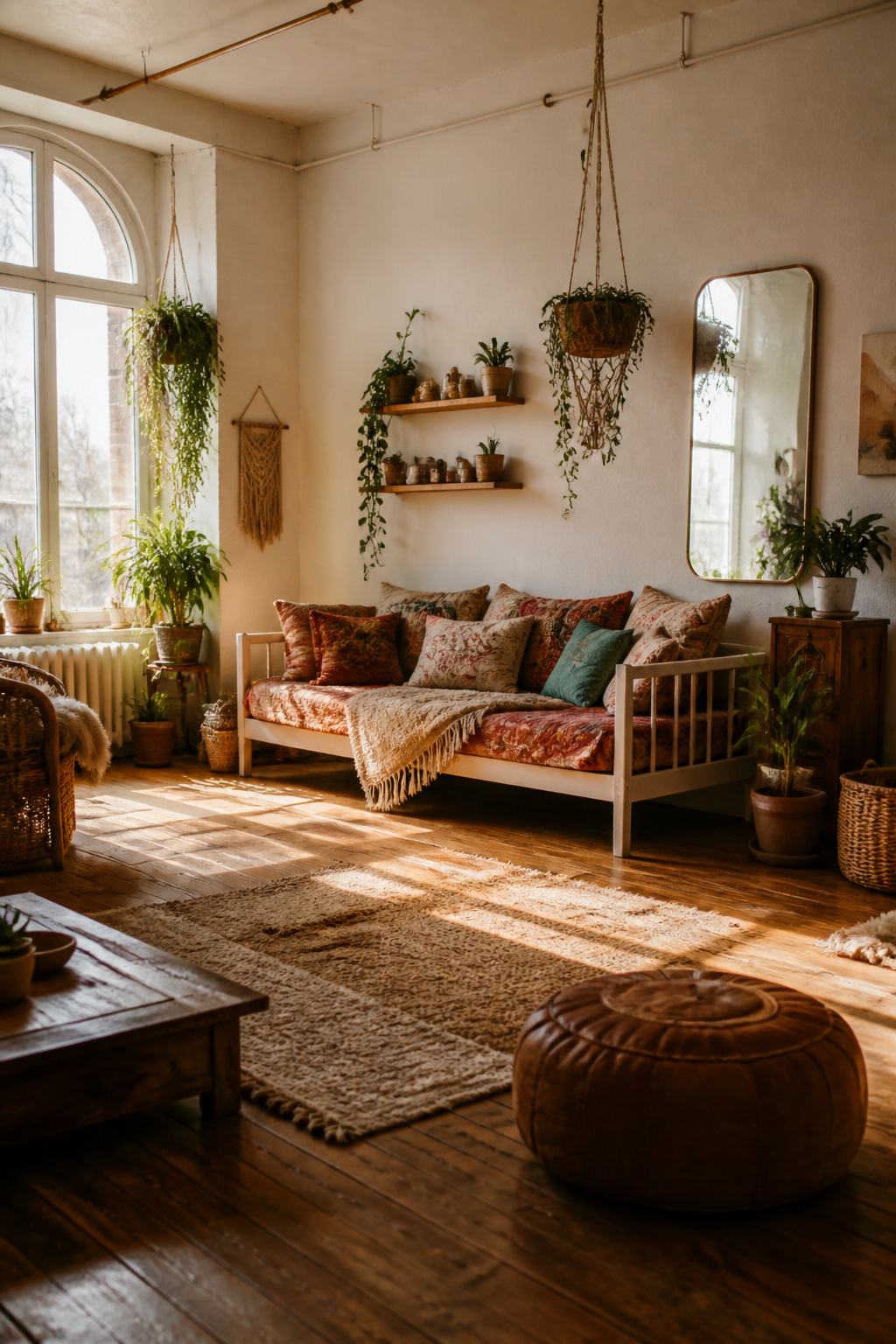
A low daybed in a studio or spare room earns its square footage by working as a sofa by day and a guest bed when someone stays over. The frame stays neutral, maybe a warm white or natural wood, and the boho personality comes from the pile of pillows and a throw that can swap out in ten minutes. Concentrate color in textiles and plants that can move; a renter’s security deposit survives better when the bold choices are not built in.
Vertical plant hangers keep floor space open and draw the eye up, which helps a small room feel larger than it is. Floating shelves do the same for trinkets and mirrors, and a mirror placed to catch light will stretch the space more than any paint trick. I have watched rooms read as cramped until the plants went vertical and the surfaces cleared; the change is immediate and costs less than a new piece of furniture.
Mixing Boho With Modern
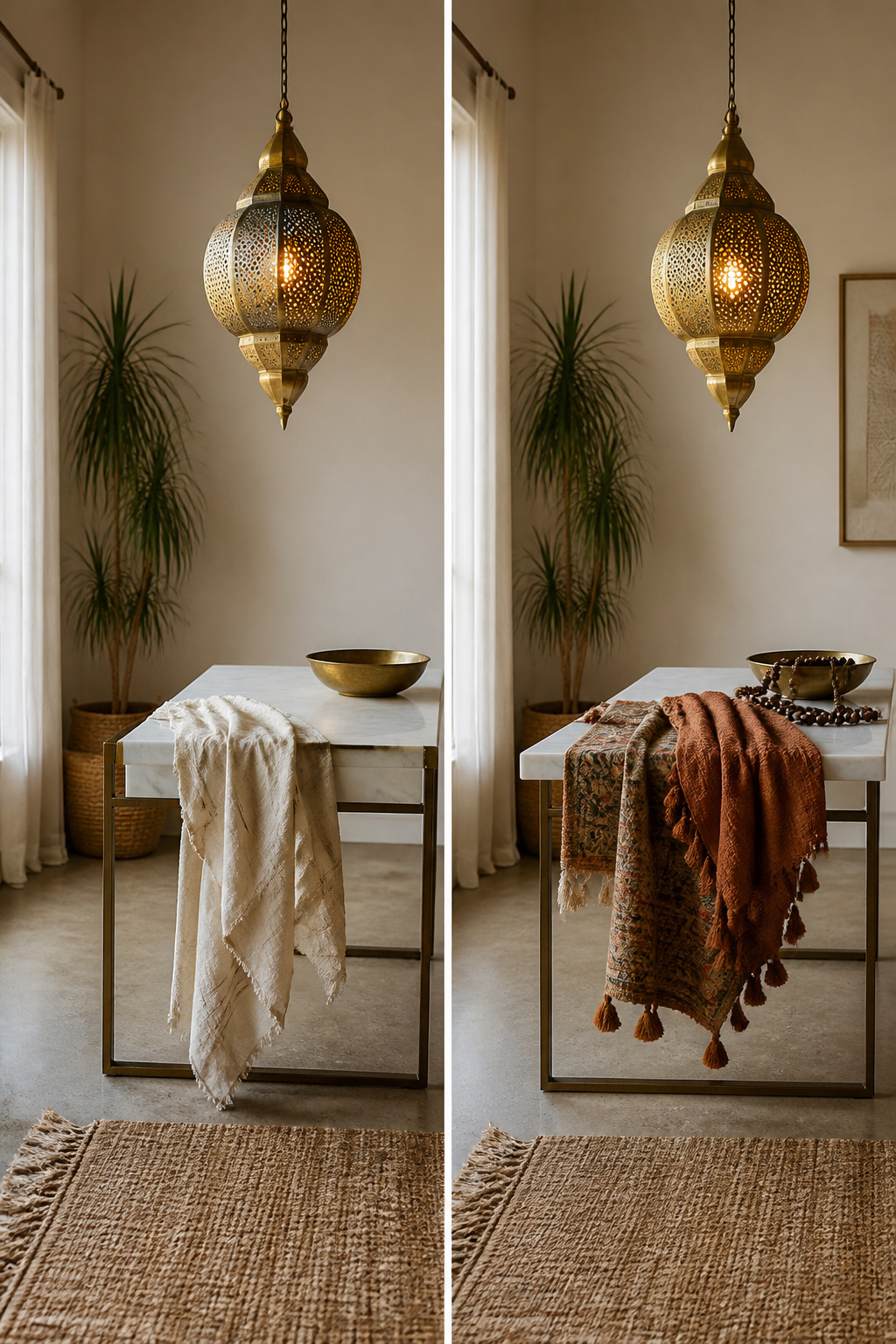
Clean-lined modern furniture does the heavy lifting in this pairing. One or two boho textiles, or a single large plant, do the rest. The modern piece needs to be the majority; the boho element, the accent. Reverse that ratio and the room starts to look like a catalog threw up in it.
Scale matters more than pattern. A low Saarinen table under a heavy Moroccan lantern works because neither is shouting. The table is quiet geometry; the lantern gives it somewhere to go visually. Both pieces get space to read as themselves.
I learned this the hard way with a woven wall hanging I loved too much. Hung it over a mid-century credenza, added a macramé throw on the sofa, stacked some rattan boxes. Three boho accents against one modern silhouette, and the room felt like it was trying to sell me something. Took everything down but the wall hanging. Suddenly the credenza looked intentional again.
The boho element has to earn its place by being the one thing that breaks the line. Two breaks, and it is a style clash. One, and it is a conversation.
Boho Bedroom Specifics
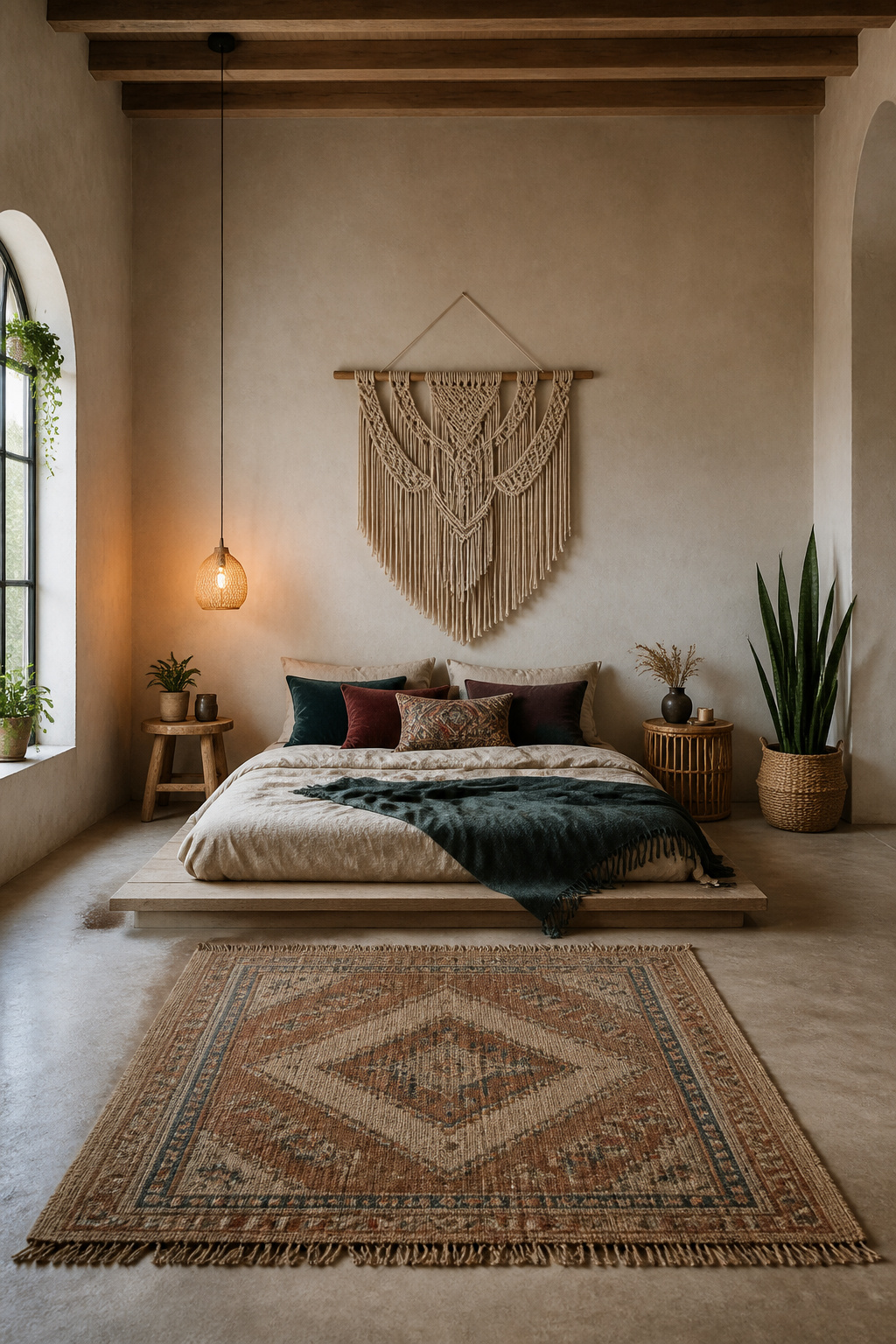
A low platform or pallet bed sets the foundation, and from there the real work is in the bedding. Linen layered with velvet cushions in rich tones builds the mixed texture that keeps the room from reading flat. The headboard is where most people overspend. A macramé or textile piece mounted on the wall delivers the same visual weight at a fraction of the cost, and it travels with you if you rent.
Nightstands should not match. One can be a wooden stool, the other a small rattan table. The asymmetry is the point, not a stage to get through on the way to buying a pair.
For lighting, skip the bedside lamps entirely. One low-hanging pendant light centered over the bed gives the soft, ambient glow that defines the space after dark. String lights work if the ceiling is too high for a pendant, but one fixture keeps the look cleaner.
Plants belong at floor level. A tall snake plant or trailing pothos in a woven basket beside the bed reads intentional; a crowded windowsill reads like you ran out of surfaces.
DIY Project Starter List
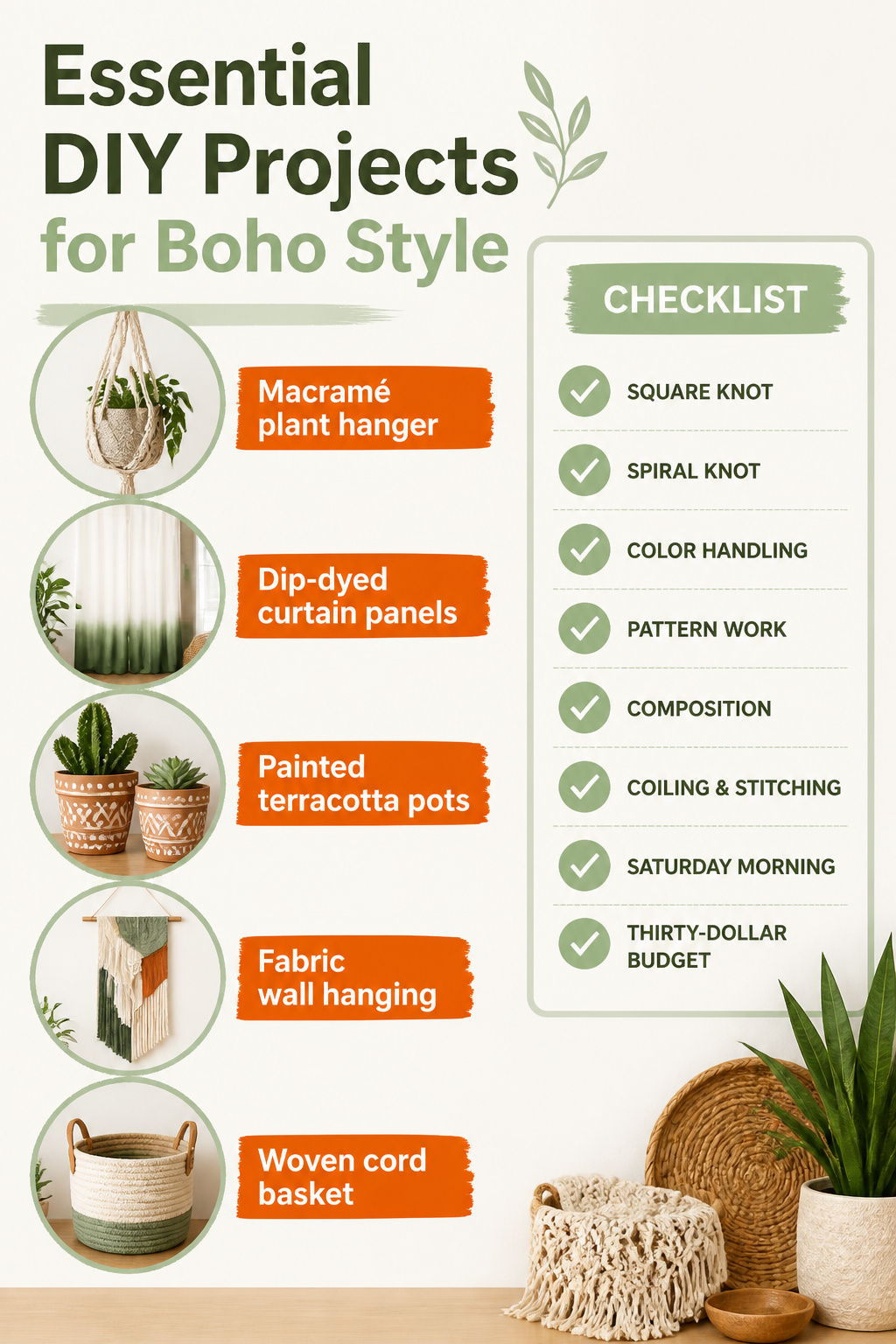
A macramé plant hanger takes about two hours and teaches you the square knot and spiral knot, the same two you will use in almost every rope project after. Cotton cord runs cheap, and a single finished hanger makes a corner feel finished without any furniture. Dip-dyed curtain panels ask for an hour of active work plus drying time, and the skill is color handling: how much dye to mix, when to pull the fabric, and how to keep the line from creeping upward while it sets. Painted terracotta pots run forty-five minutes once you factor in base coat dry time, and the payoff is pattern work, freehand or masked, at a scale where mistakes are easy to hide or lean into. A fabric wall hanging from a dowel needs an hour and teaches composition, because you are arranging scraps or a single textile in a frameless format where balance has to carry the whole piece. The woven cord basket runs longest at three hours, and the skill is coiling and stitching flat work into a vessel, which feels slow until the walls start to stand on their own. Any of these five fits a Saturday morning and a thirty-dollar budget, and none requires tools you do not already own or cannot borrow.
Frequently Asked Questions
What is bohemian style decor?
Bohemian style decor is about freedom and self expression, combining elements from different cultures and eras without worrying about whether they match. It traces back to 19th century Romani communities and the artist quarters of Paris, where people mixed whatever they had or found. The only common thread across all boho spaces is creative permission: if a piece speaks to you, you find a place for it.
How do I incorporate boho decor into a small space?
Concentrate color in textiles and plants that can move rather than built-in choices, and keep larger pieces like the daybed frame neutral. Vertical plant hangers and floating shelves draw the eye up and keep floor space open, while a mirror placed to catch light stretches the room more than any paint trick. This approach lets you build the boho personality without touching walls or permanent fixtures.
Can boho decor work with modern furniture?
Yes, but the modern pieces need to outnumber the boho accents. One or two handmade textiles or a single large plant against clean-lined modern furniture creates visual interest; reverse the ratio and the room starts looking like a catalog. The boho element earns its place by being the one thing that breaks the line. Two breaks becomes a style clash, but one is a conversation.
How do I decorate a boho bedroom?
Start with a low platform or pallet bed, then build mixed texture through linen bedding layered with velvet cushions in rich tones. Use a macramé wall hanging or a cluster of woven baskets instead of a traditional headboard, and add a vintage kilim pillow or two where they will not sit in direct sun for hours daily. The goal is layers that look collected over time rather than bought in a single afternoon.