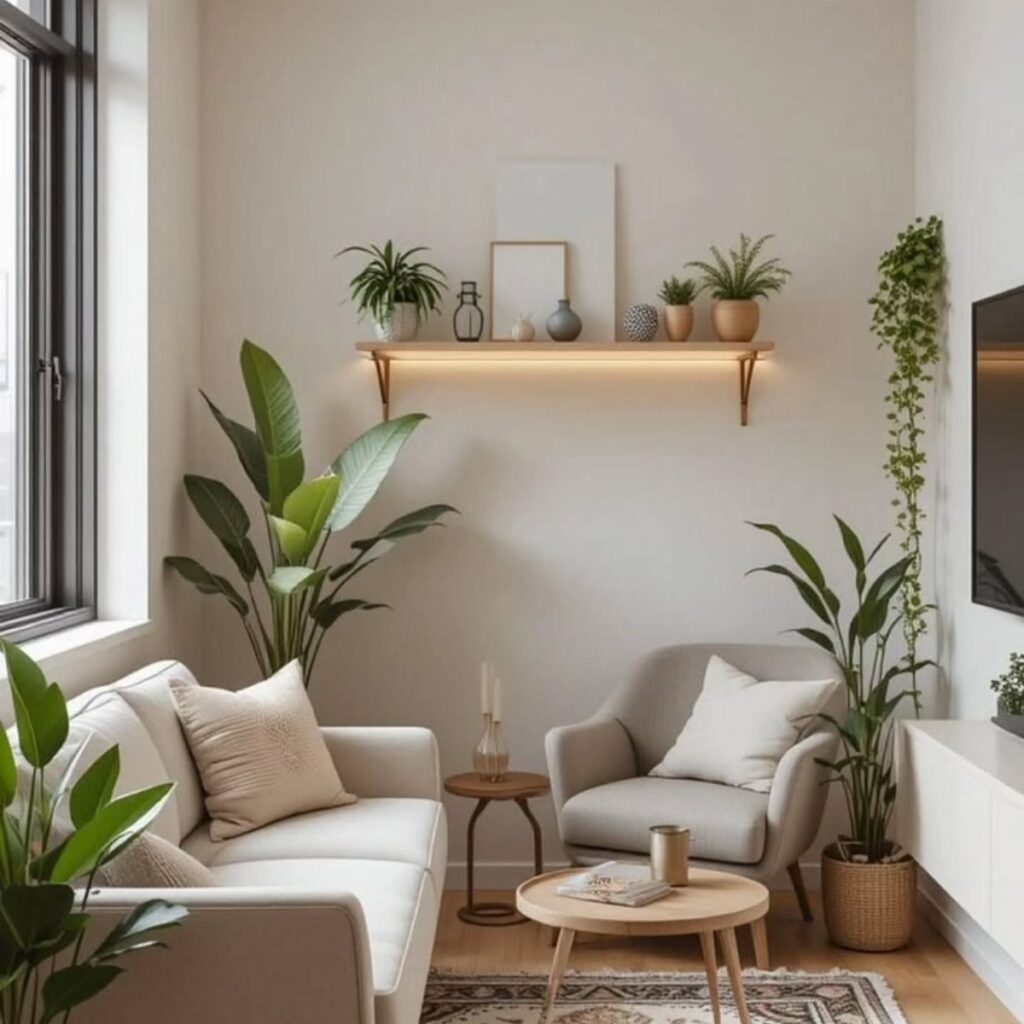
Some of these ideas need a drill, some need nothing but a free afternoon, and a few need both: a tension rod for curtains, a mounted TV, storage built into a coffee table, and that modular sofa that costs more than a standard one but earns it back in rearrangements.
A 225-square-foot Brooklyn studio makes the case for pieces that split apart: two halves of one sofa faked separate seating zones, and the cat took the backless one.
1. Create a Gallery Wall
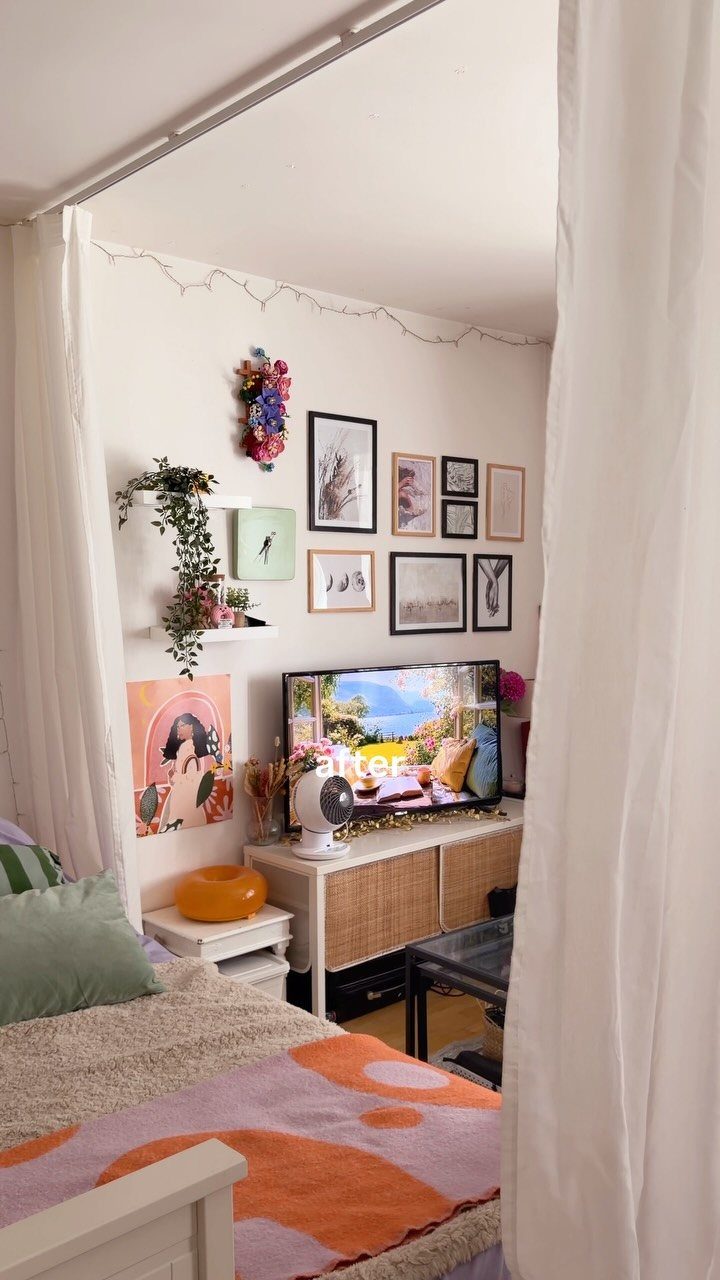
A gallery wall turns a blank stretch into the room’s anchor point, which matters when your living area shares walls with the kitchen and the front door.
In a studio, that visual weight carves out "living room" without a single divider.
Start with one piece you love dead center at eye level, then build outward in a loose grid rather than a tight rectangle; the gaps matter as much as the frames.
Mix in a shallow shelf for a small plant or a ceramic you picked up somewhere, so the wall has depth, not just flat pictures. String lights woven through the frames stretch the glow after sunset.
This works best when you rent and can’t paint; it puts all the color on hardware you take with you.
Decision fatigue sets in fast, and the fix is buying frames in one finish, then letting the art inside clash all it wants.
2. Mount Your Television
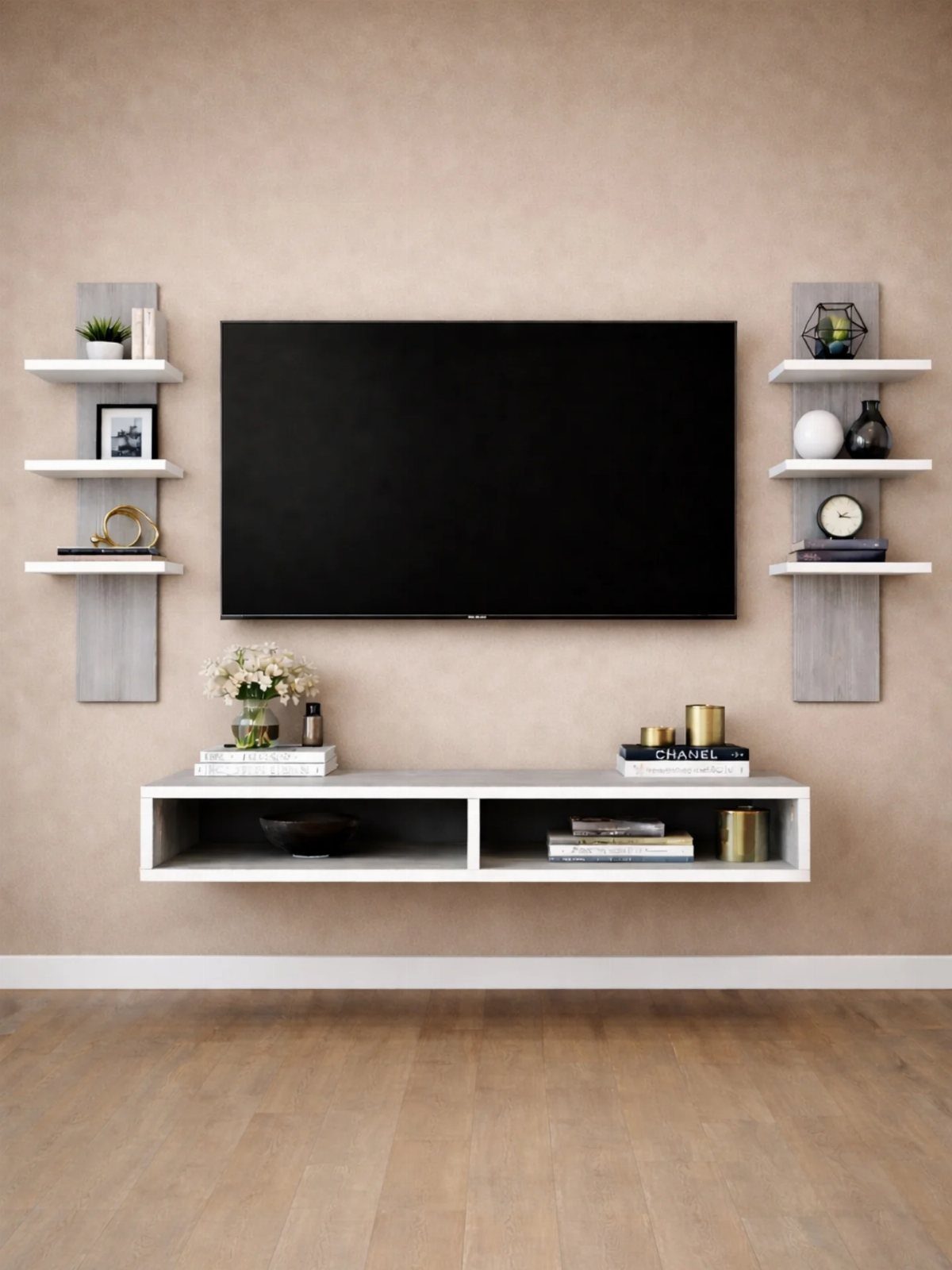
Floor space in a small apartment is borrowed space; the TV eats it standing on furniture. Mounting the screen on the wall returns that footprint to you, and the room reads cleaner for it.
A floating console underneath, white or light wood, holds what you actually need: a router, a small speaker, maybe three books.
Flank it with vertical shelves only if you own enough objects worth displaying; otherwise the wall starts feeling like a storage unit.
The height matters more than most people think: center the screen at seated eye level, not up near the ceiling where your neck pays for movie night.
I’d go this route if your square footage is under 500 and your seating hugs one wall. The install is where it goes wrong; a toggle bolt through drywall alone won’t hold, and a stud finder is non-negotiable.
If your lease forbids holes, a tall, narrow media stand pulled tight to the wall fakes the same effect without the patch job later.
3. Use Low-Profile Furniture
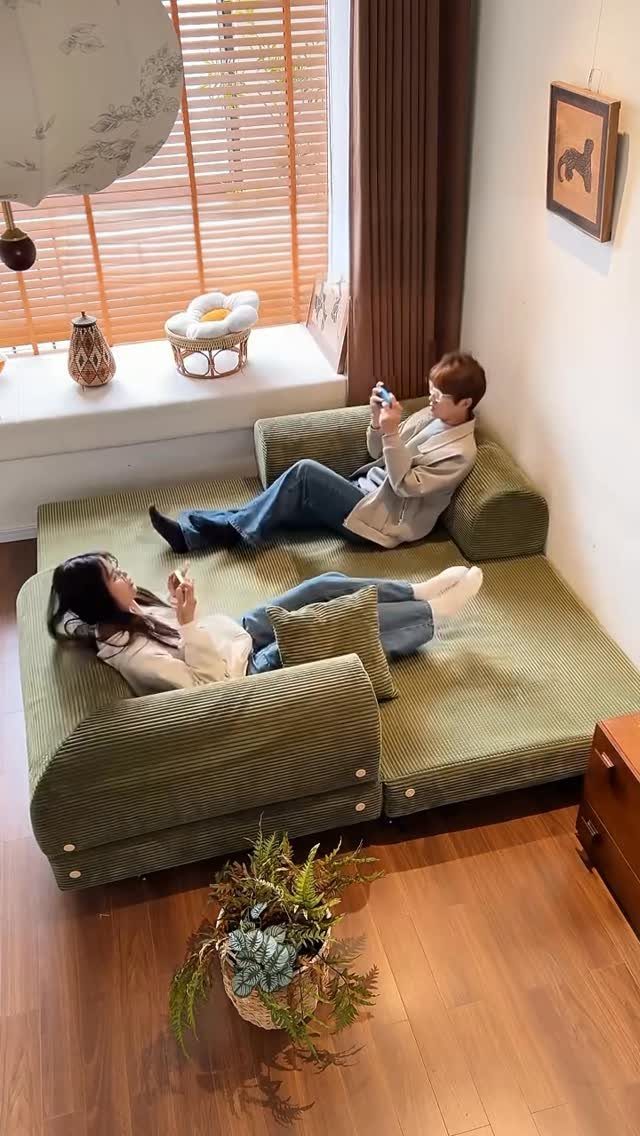
Low-profile furniture sits closer to the floor, and that extra visible wall above it tricks the eye into reading more height than the room actually owns.
In a space where the ceiling is the one dimension you cannot change, this is free square footage.
A corduroy floor sofa, green or otherwise, works when you lounge more than you entertain formally; the modular pieces let you push one section against the window for reading, pull another forward for conversation.
Keep the coffee surface equally low, a mat or a slab on short legs, so the sightline from doorway to window stays uninterrupted.
This suits renters who move often and hate wrestling a standard sofa up stairs. What you trade is the upright support for long sits; anyone with back trouble should test a floor model before committing.
Add one firm throw pillow behind you and the posture problem mostly solves itself.
4. Rethink a Coffee Table to Include Storage
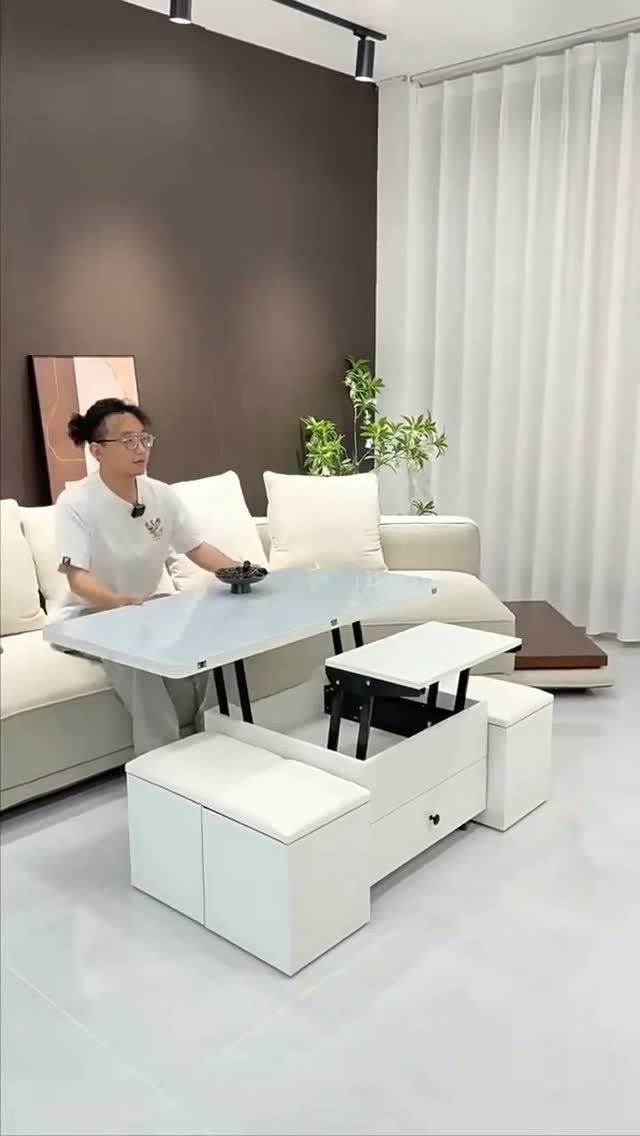
A coffee table that opens up and swallows clutter is the piece you didn’t know you needed until you’ve lived with nowhere to stash the remotes, the coasters, and the blanket you only use in winter.
The lift-top version turns the surface into a desk for laptop work, then drops back to holding drinks when you’re done. Nested stools underneath pull out for extra seating in a pinch, which beats dragging chairs from the kitchen.
If lift mechanisms feel fussy, a vintage trunk with a flat lid does the same job with more character and no hardware to fail.
I’d pick the trunk for a studio where the living room is also the office; the lid stays up while you work, closes over the mess when someone visits.
The ottoman-with-fringe option trades storage depth for softness, better if you mostly need a footrest and occasional guest seating.
Either way, measure your sofa height first; the table should sit close to the cushion edge or the reach feels wrong every single time.
5. Decorate with Greenery
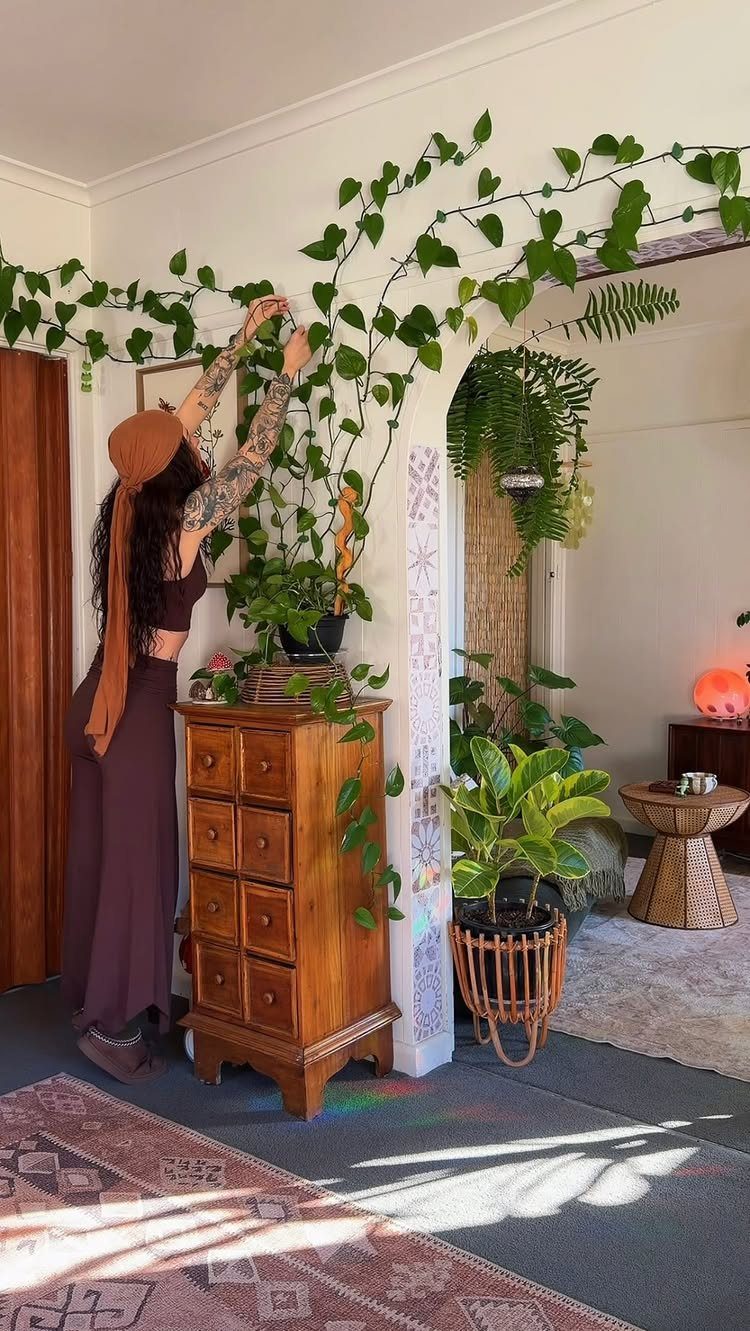
Plants do what paint and furniture cannot: they shift a little every day, growing toward the window or trailing a new inch, so the room feels inhabited rather than decorated.
In a small apartment, that sense of life keeps the walls from closing in.
A climbing vine trained along an arch or door frame uses vertical space no furniture could claim. Start with one vigorous trailer and small clear hooks; the plant does the rest once it settles in.
For lower commitment, cluster three potted plants at different heights beside the sofa: a floor snake plant, a medium ZZ on a stool, a small succulent on the table. The mix of heights reads as intentional, not leftover.
This idea fails if you travel weekly or face north with no grow light; snake plants and ZZ plants survive that neglect, but a climbing vine wants consistent light and someone to water it.
Check your window hours before you buy the drama of a trailing plant; the quiet survivors are often the better roommates.
6. Choose Minimalist Design
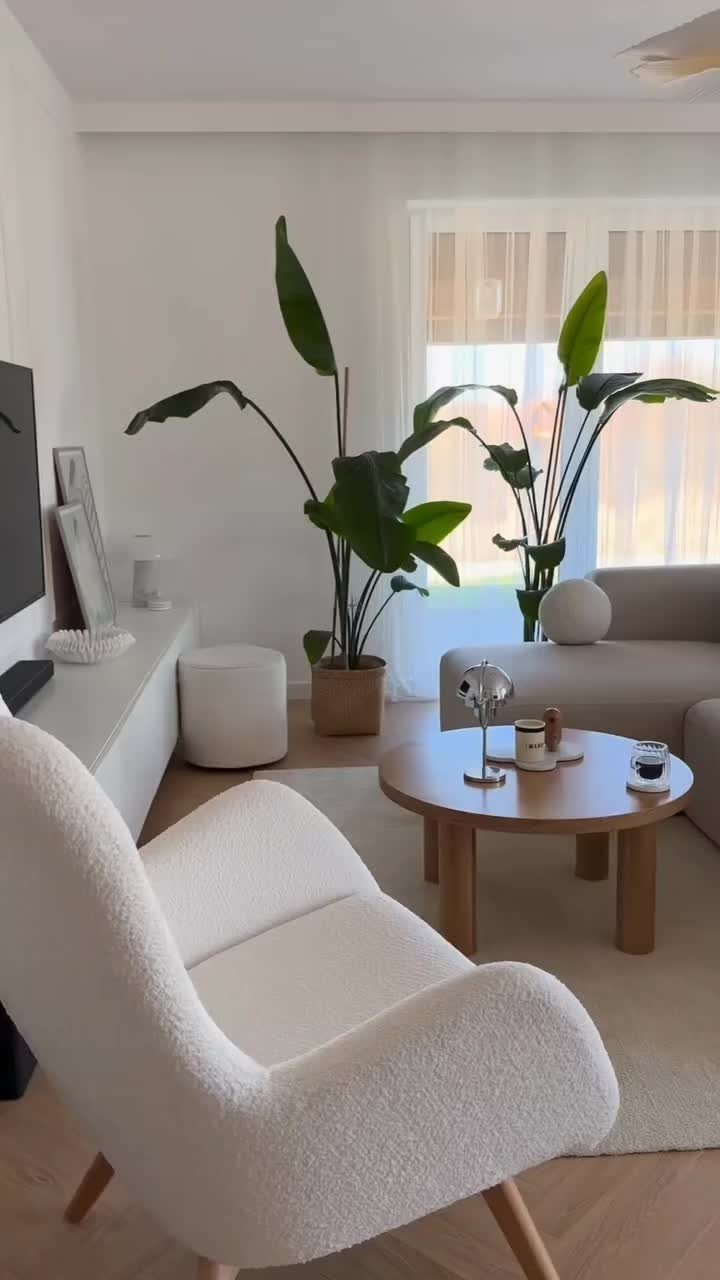
Minimalist design in a small space is not about owning nothing; it is about every object earning its place through use or through the calm it brings when you look at it.
The white bouclé chair, the round wood table, the single large plant: each one has a job, and none compete for attention.
Start with the largest piece, usually the sofa, in a neutral you won’t tire of. Add texture, not color: the nub of bouclé, the grain of ash, the sheen of a single ceramic vase.
The room stays warm because the materials vary, not because the palette shouts. One large plant reads as sculpture; three small ones read as clutter.
This approach suits people who tidy daily and feel the mess before they see it. If you are someone who drops the mail on every surface and feels fine, minimalism becomes a prison of your own making.
In that case, skip ahead to the vignette idea; contained chaos beats sparse regret.
7. Layer in Pattern and Texture
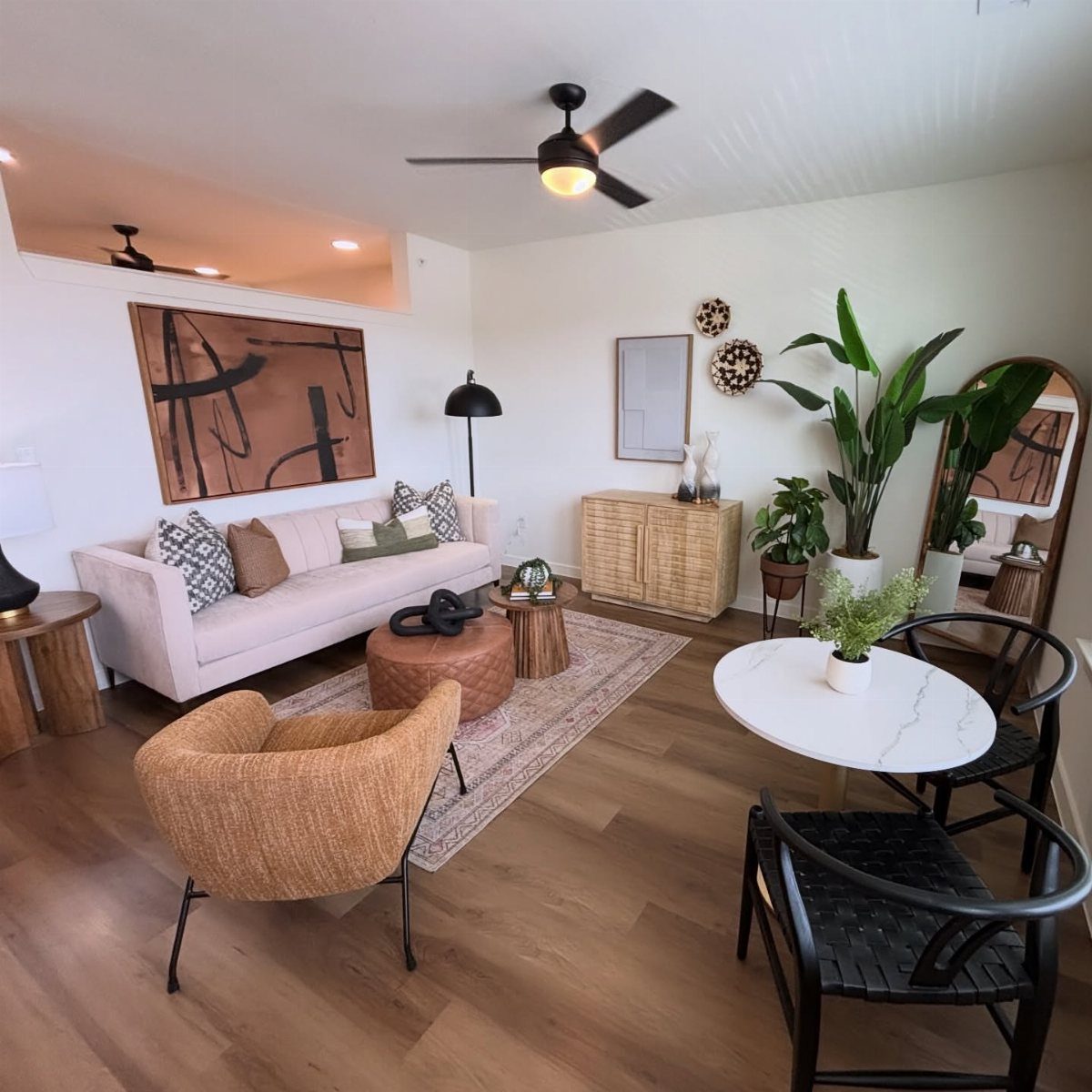
Pattern works in a small room when you treat it as layering rather than matching.
A woven chair, a nubby ottoman, and printed pillows against a plain sofa let each texture read as its own zone without demanding extra floor space.
Start with your largest neutral piece, then add two patterns at different scales, one rough texture, and one smooth. The risk is busy-ness, so I keep the wall and floor quiet when the seating carries the interest.
8. Hang Curtains High
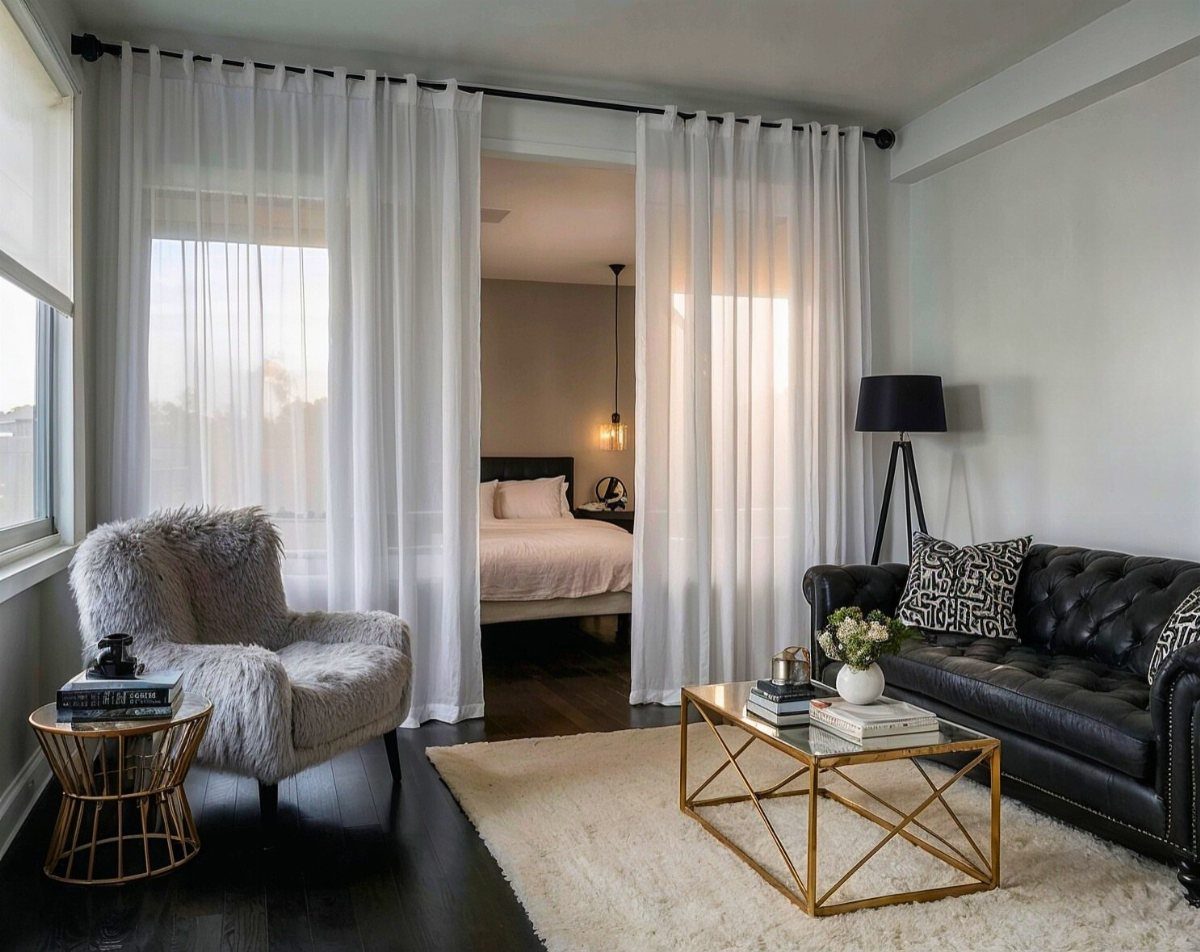
A curtain rod mounted a foot above the window frame draws the eye upward and buys back some vertical space you didn’t know you had.
Sheer white panels hung from ceiling height divide the living area from the bedroom behind it; light still passes through, so the room keeps its openness.
For renters, a tension rod wedged tight at the ceiling line works if you patch the holes later.
These sheers don’t block sound or fully separate the spaces, so this suits someone who wants suggestion of division rather than a real wall.
9. Turn an Ottoman Into a Coffee Table
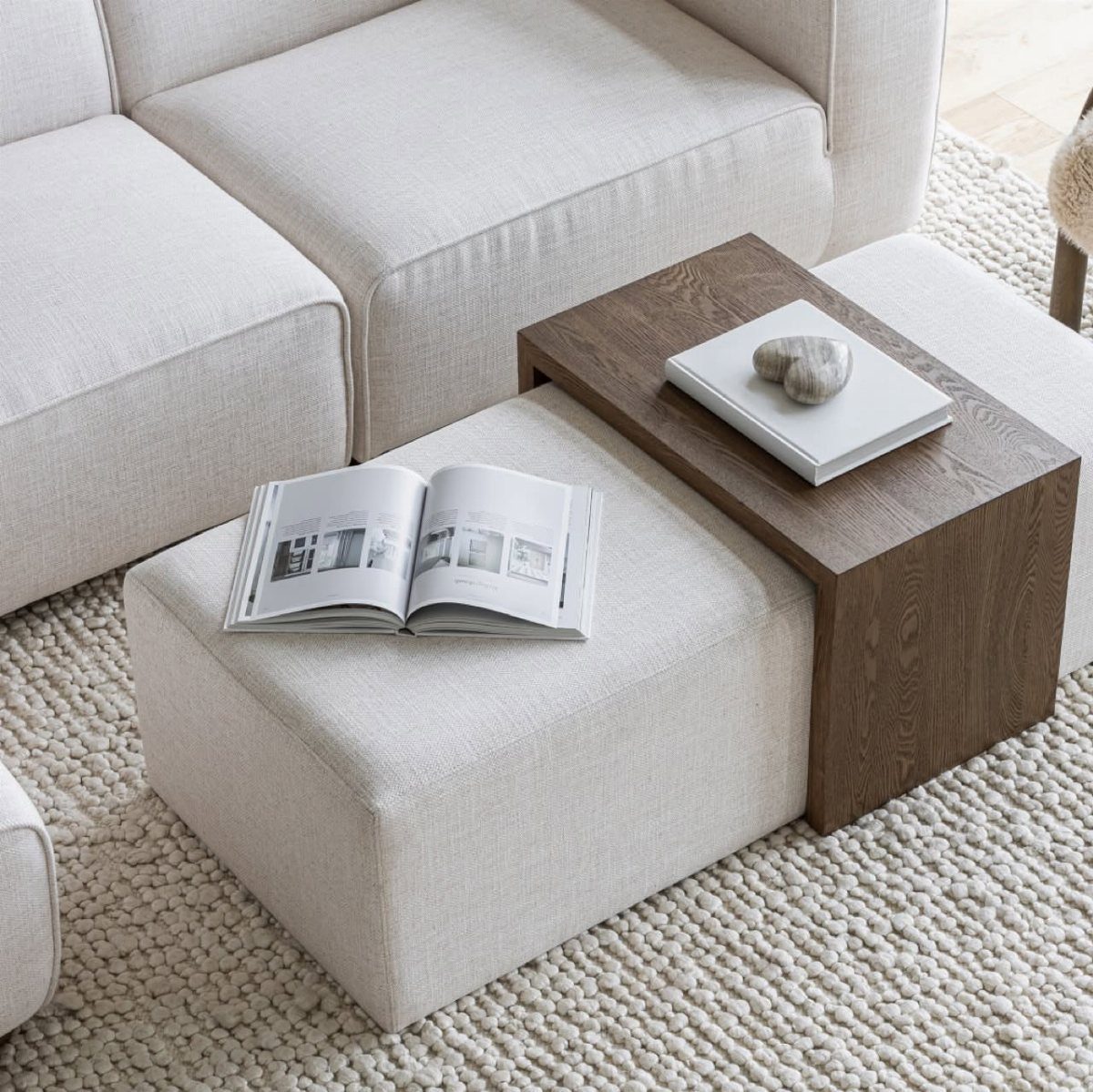
An upholstered ottoman with a tray on top handles drinks, remote controls, and the occasional dinner plate while staying soft enough to prop your feet on.
A light fabric base with a dark wood bridge piece works, though I’d go with a leather or tight-weave fabric if you actually plan to kick your shoes up.
Storage ottomans hide throw blankets and spare pillows inside, though the hinged lid means clearing the top each time you open it.
A vintage trunk or hollow bench does the same job with more character and a place to stash bedding.
10. Face Seating Toward Each Other
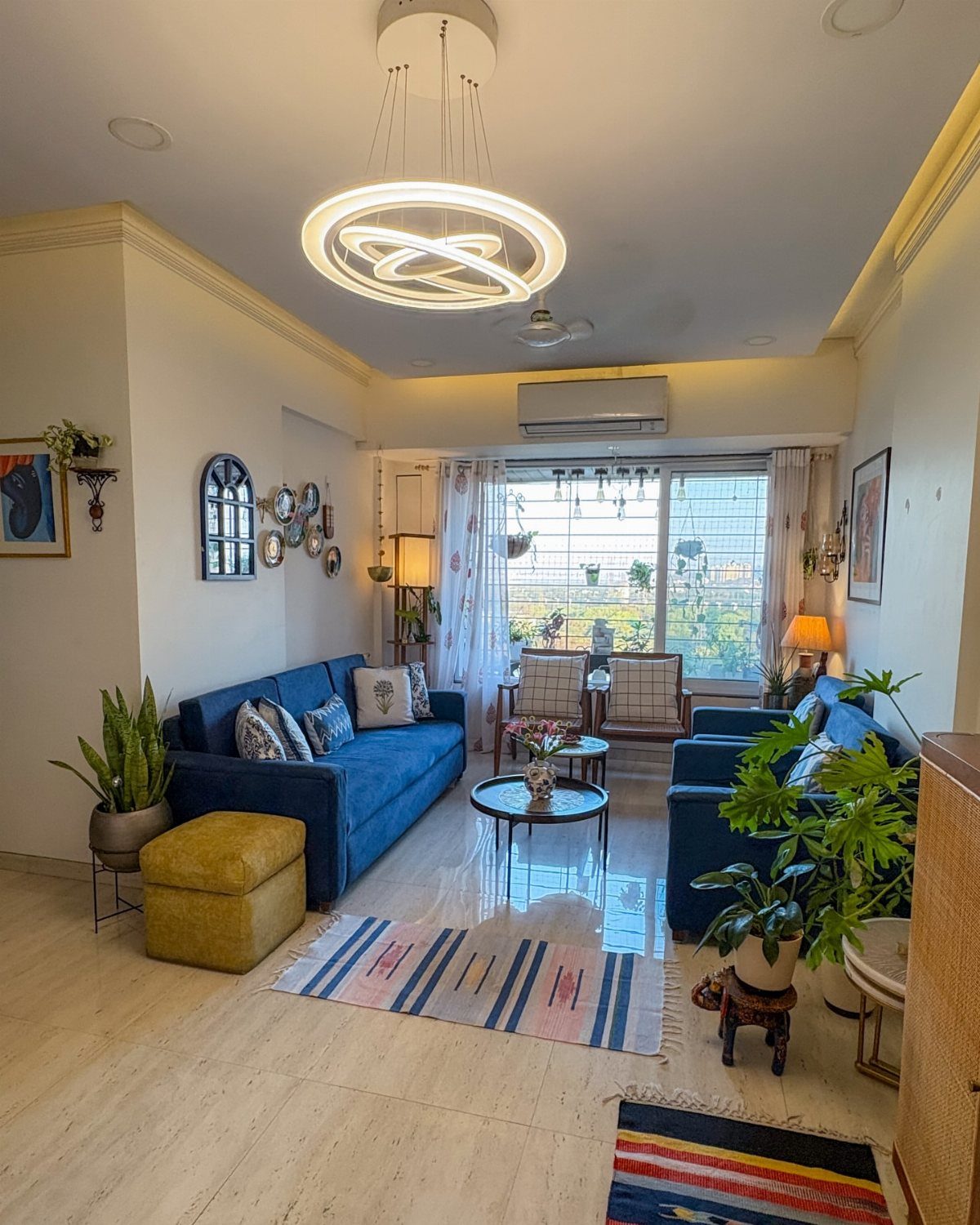
Two sofas facing each other across a narrow coffee table turns a tight room into a real conversation spot instead of a TV viewing angle.
Keeping the sightline open toward the window and balcony lets the seating bank on human connection rather than a screen.
I like this for anyone who entertains in pairs or small groups; the arrangement loses its point if you need to seat a crowd regularly, since the corners go empty.
Push the pieces closer than feels natural at first and the room still flows around the edges.
11. Introduce Pops of Color
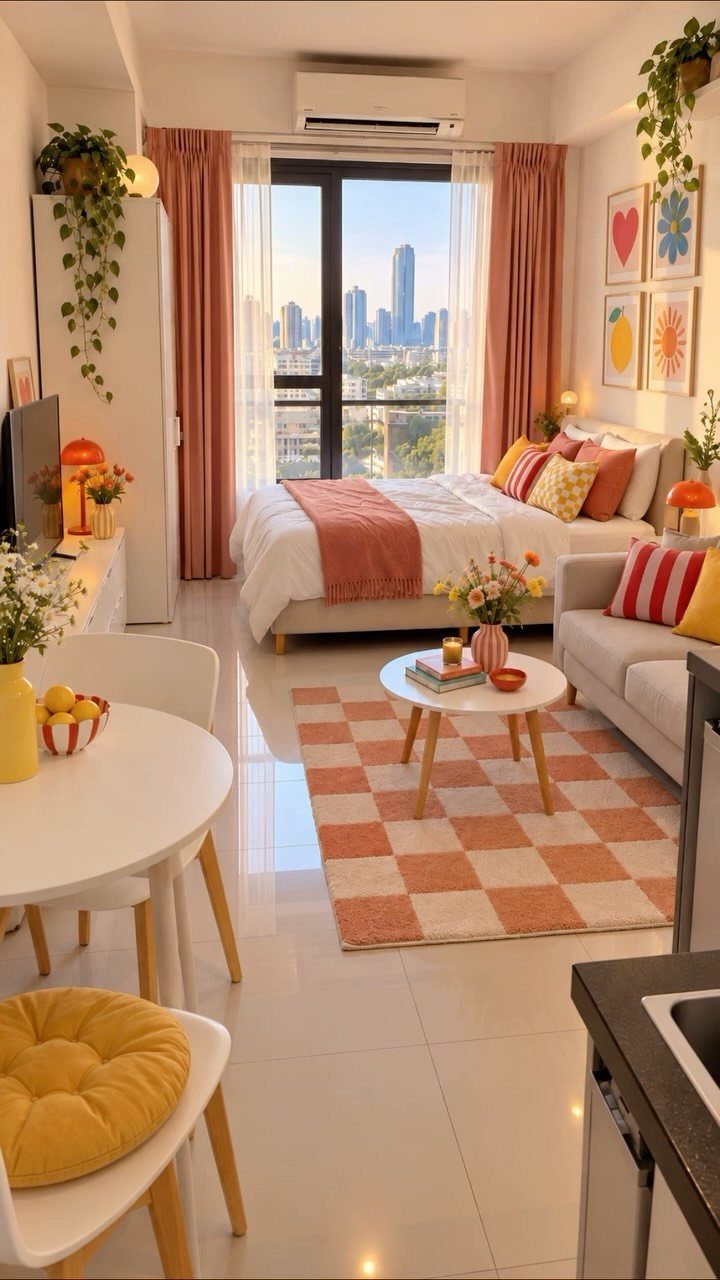
One bold piece of color does more in a small room than a scattering of small bright objects that read as clutter.
A checkered peach rug and yellow pillows against a grey sofa build the look; the pink bedding in back echoes rather than competes.
I’d pick a single anchor, either a rug or a sofa in a color you can live with for years, then let the smaller items rotate cheaply.
A green velvet sofa works the same way in a neutral shell, tied to the rest with prints that pick up the same tone.
12. Choose an Oversize Sectional
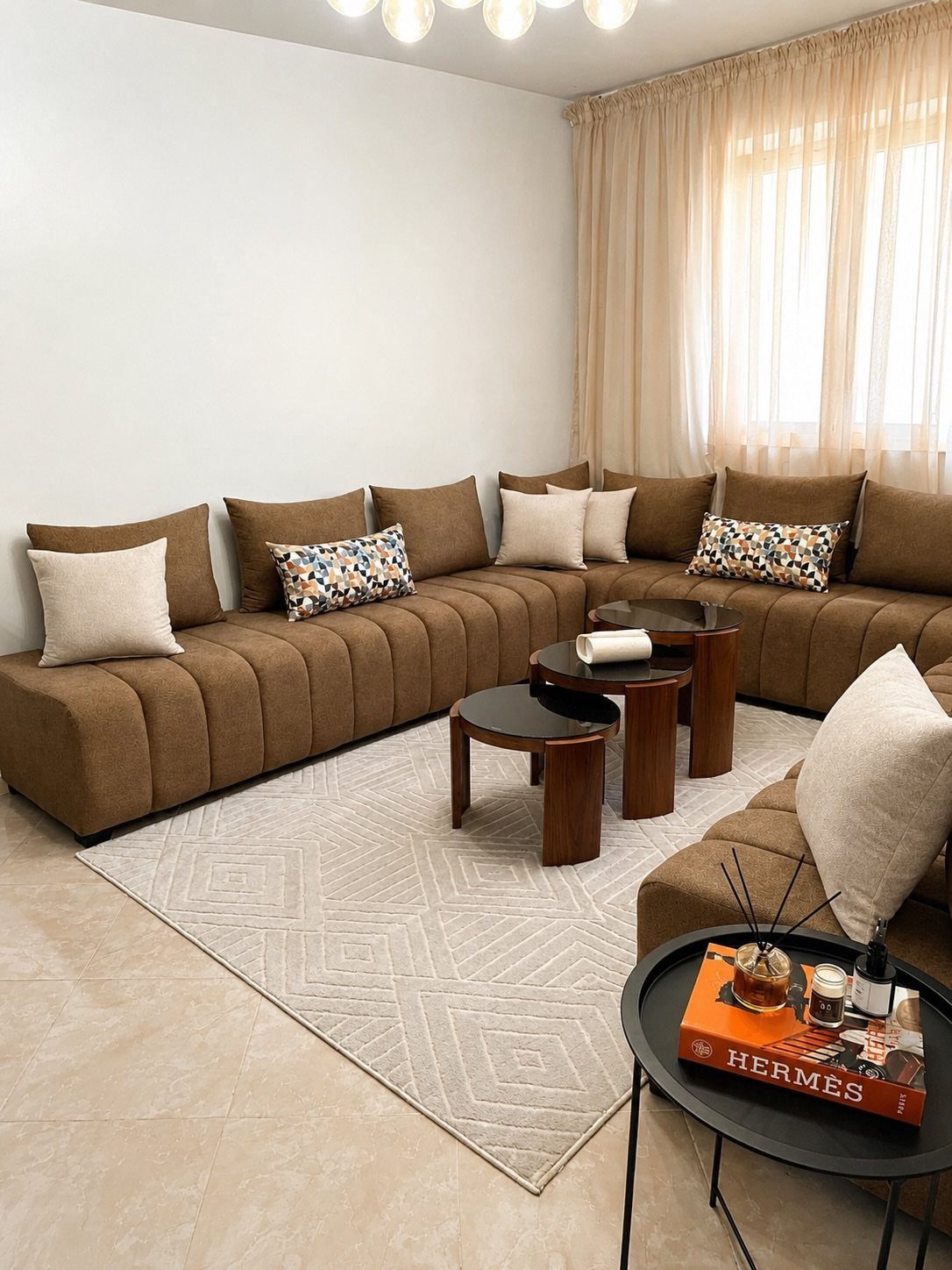
A single large sectional that hugs the walls often seats more people than a sofa plus two chairs that fight for the same footprint.
A ribbed brown sectional running the perimeter uses pillows for back support and nested tables that tuck away when you need floor space.
Measure your wall lengths carefully; a deep blue velvet reads modern, while a ribbed or boucle fabric warms up a cooler room. The risk is commitment, since sectionals don’t rearrange easily for a party or a move.
I’d buy modular pieces that clip together if your lease turns over every couple years.
13. Invest in a Modular Sofa
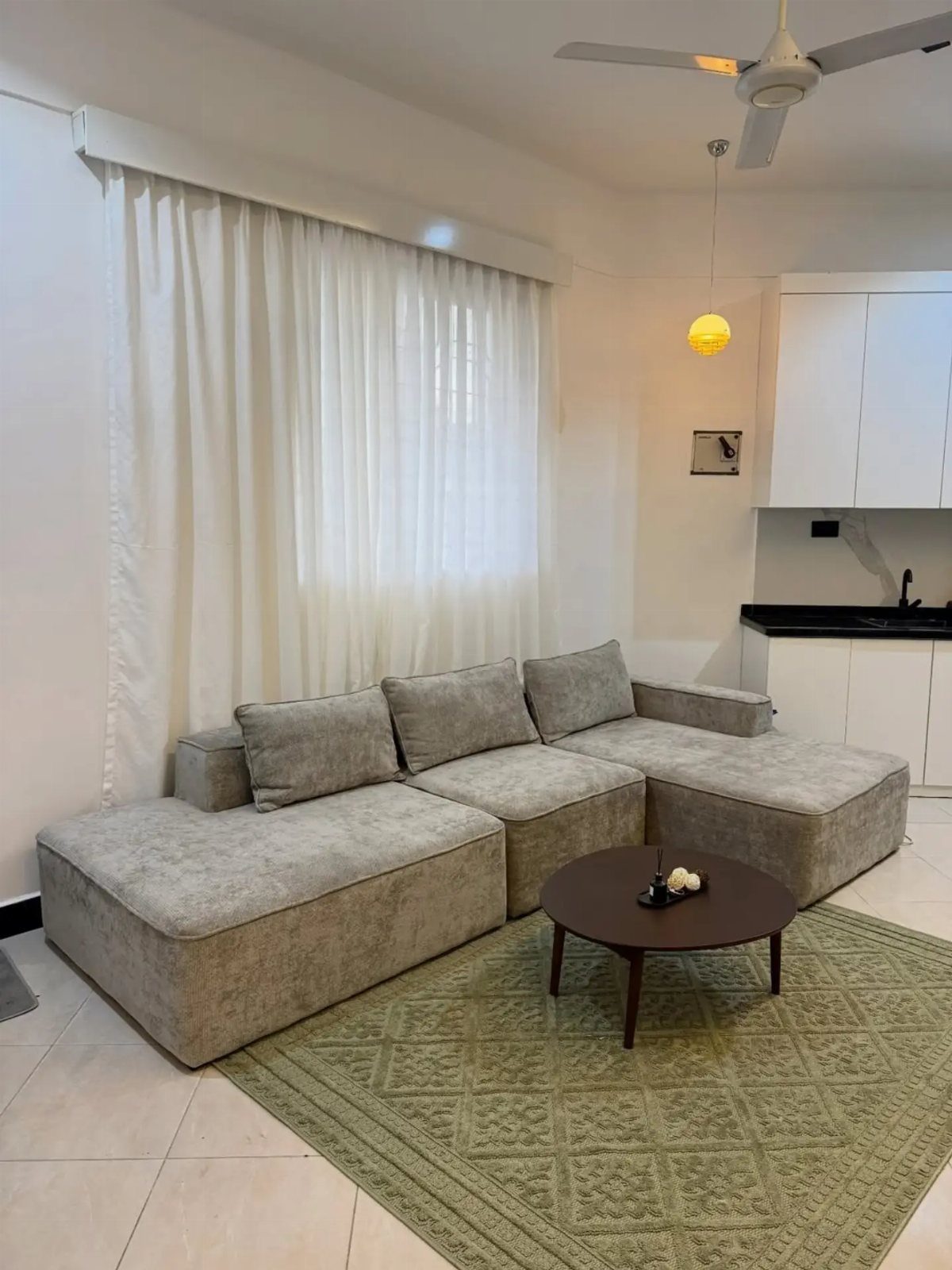
A modular sofa breaks into pieces that rearrange when your needs change. Half a loveseat can become a settee against a wall; the other half works as an oversized pouf without its back attached.
That flexibility matters in a studio or a rental where the floor plan is fixed but life keeps shifting.
Look for units with individual seat sections, not just a chaise that bolts on one end. Brands now make micro-options that span a whole apartment: one piece by the window, another pulled out for guests.
In a 225-square-foot Brooklyn studio, a couple split a two-piece unit to fake separate seating zones. Their cat claimed the backless half.
Cost runs higher than a standard sofa of the same size. The trade is longevity through adaptability.
I’d pick this for anyone who moves often or expects to reconfigure the same room twice a year.
14. Bathe the Room in Relaxing Hues
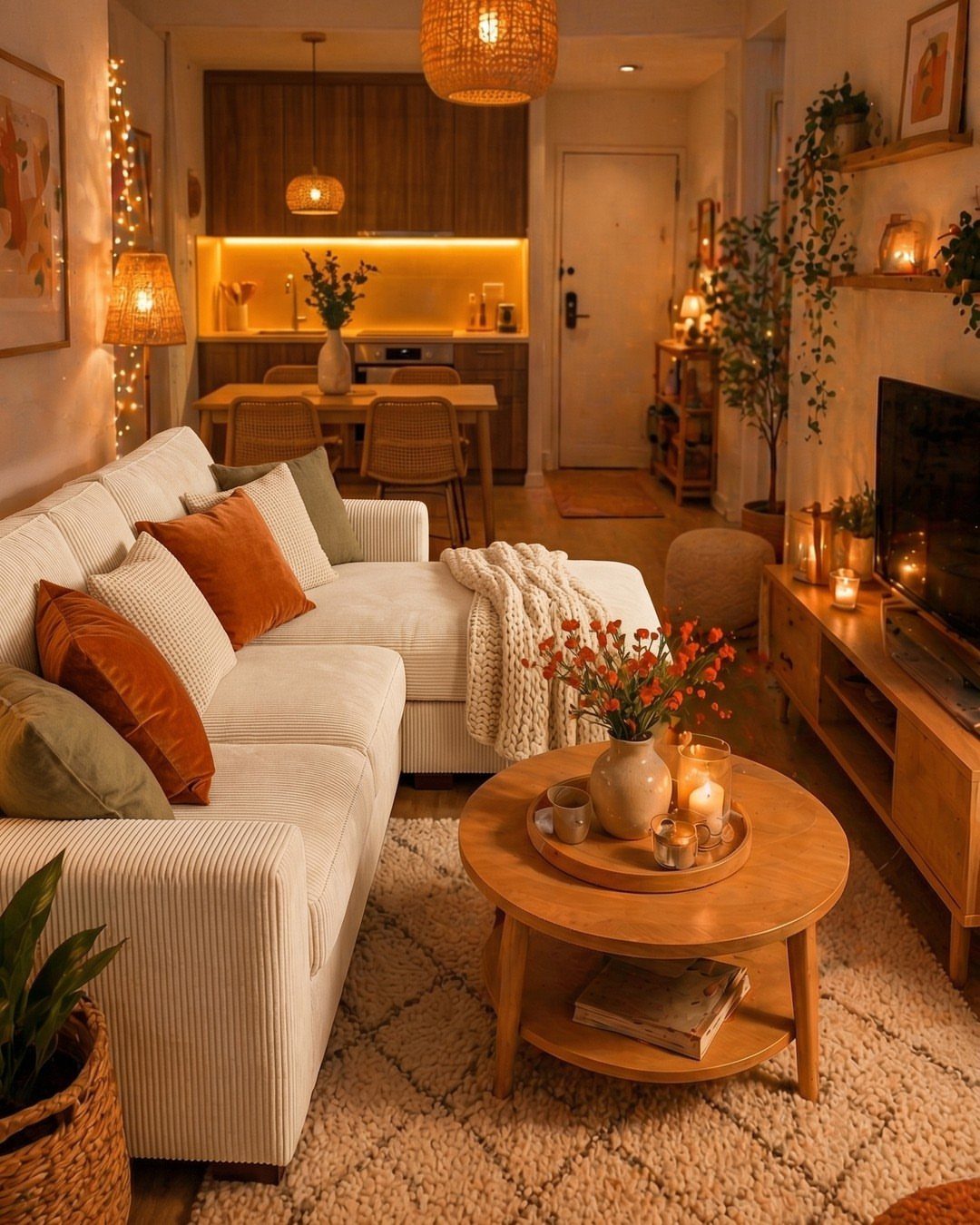
Color sets mood faster than furniture layout does. In a small living room, a single calming hue across walls and textiles can shrink the visual noise that makes tight quarters feel tighter.
Warm amber light against white and soft orange does the work of a bigger palette without crowding the room.
For a more subdued version, a dark sage green across walls and upholstery turns a tiny TV room into something unexpectedly enveloping.
One color decision, done right, can make a small room feel larger than the square footage says it is.
Start with paint or a large textile: a rug, a sofa cover, curtains. Add two tones at most, both quieter than the base.
A room that lowers your shoulders when you walk in comes from color that quiets down instead of shouting.
This suits renters who can paint and anyone who finds open white rooms too stark. Skip it if you love high contrast or collect colorful objects; the palette will fight you.
15. Find Unique Storage Solutions
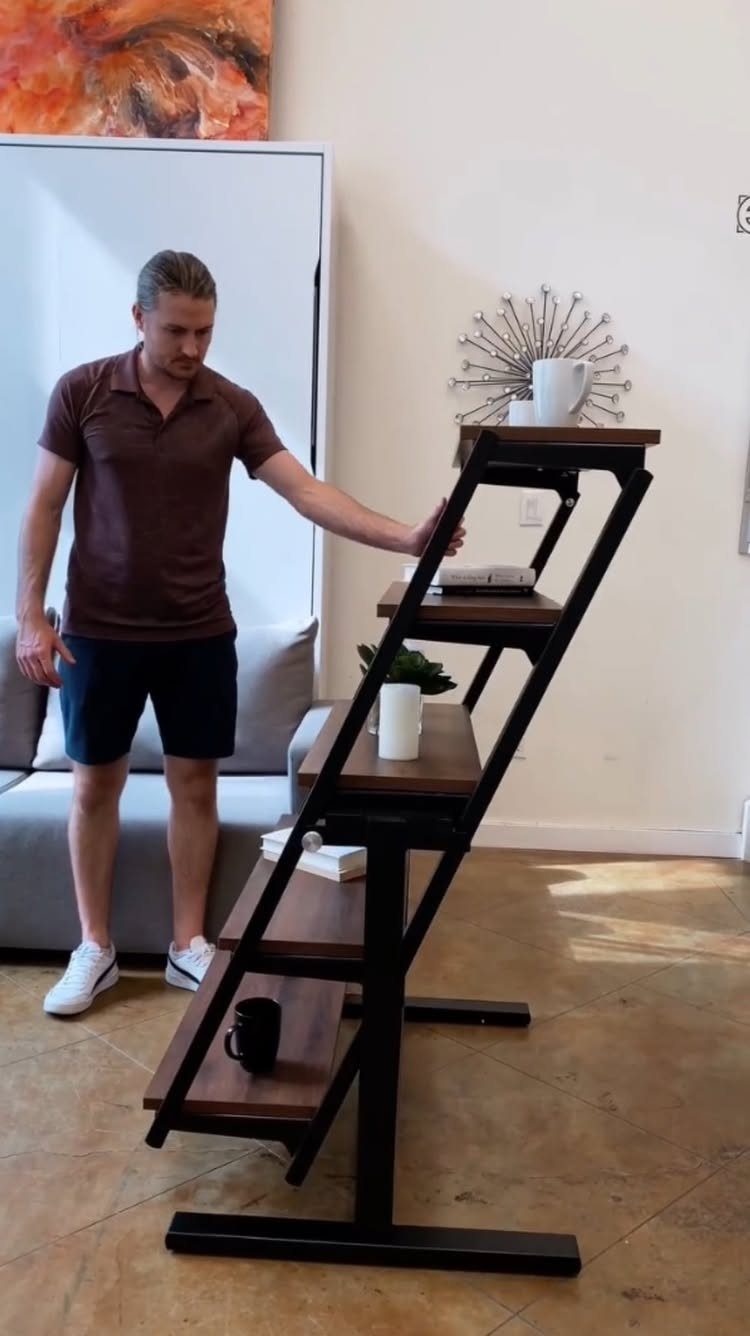
Storage built into furniture beats storage added on top. A low coffee table with clearance underneath holds books stacked flat.
A side table sized for one drink per person keeps surfaces clear without demanding a separate ottoman or tray.
Tiered open shelving in wood and black metal lets cups, books, and a plant share the same air without fighting for it. That openness works when you own good-looking objects; closed storage hides what you don’t want to display.
For tight paths, measure walking clearance before buying. A piece that blocks flow undoes itself.
Keeping walls nearly bare and paths open, then storing vertically only where traffic already stops, keeps a small room moving.
Cost varies widely. A simple low table with shelf space underneath costs less than you’d think; custom built-ins run far higher.
I’d spend less and replace sooner if the apartment is temporary.
16. Create Distinct Vignettes
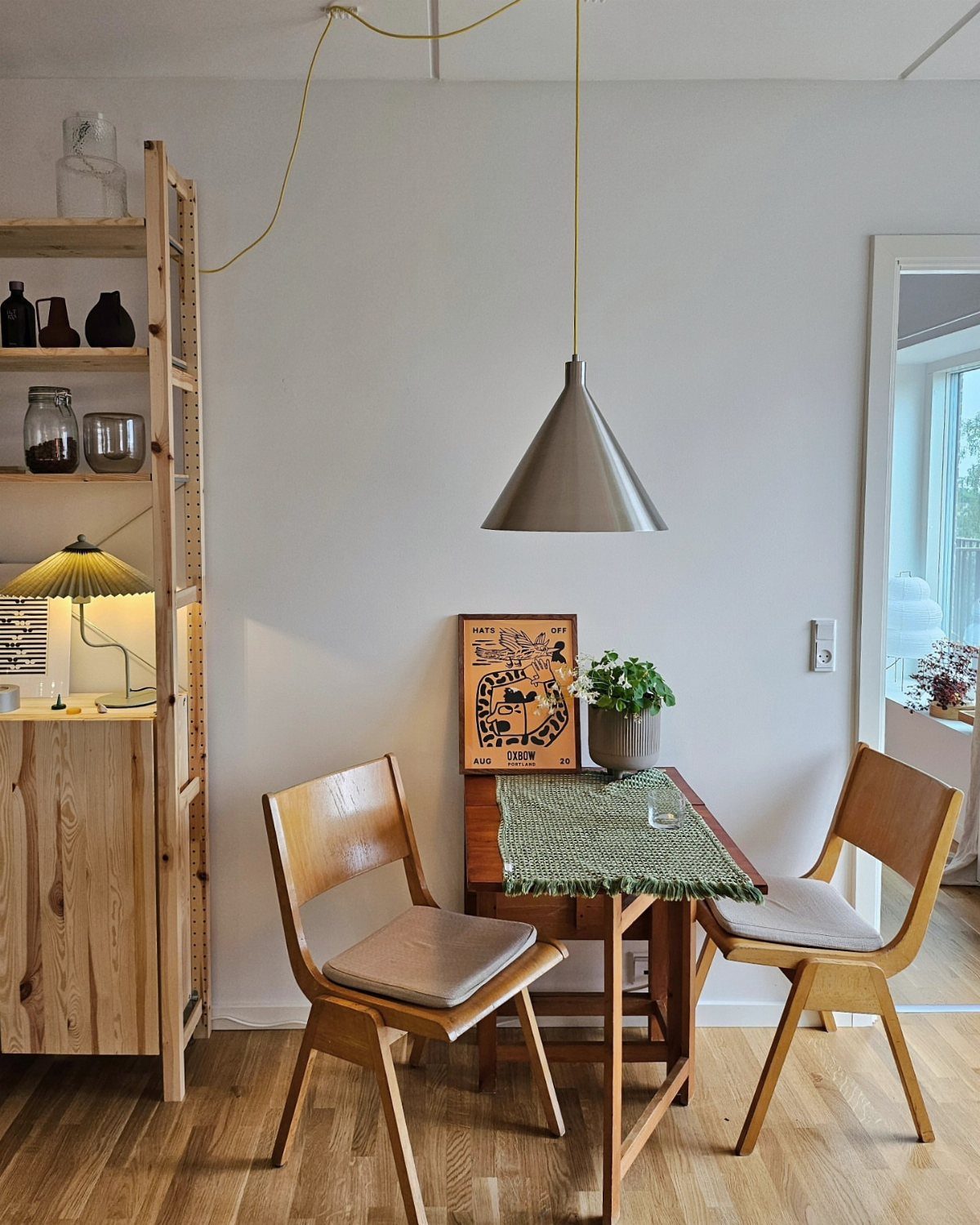
A vignette is a small, deliberate grouping that signals "this spot has a purpose." In a small room, two or three tight groupings read as separate zones without walls or screens between them.
Each item earns its place; nothing drifted there by accident. The restraint matters.
A Denver designer I follow stocks end tables with stacked books and one personal object, never more. More only works when each piece earns its spot and the eye has somewhere to rest between them.
Build yours around a single surface: a narrow console, a windowsill, a corner shelf. Anchor with one larger piece, layer in two smaller, stop.
The palette stays calm so the objects can vary.
This takes practice. Start with one vignette, live with it a week, adjust.
Rushing produces clutter that reads as failed intention.
17. Embrace the Small Size
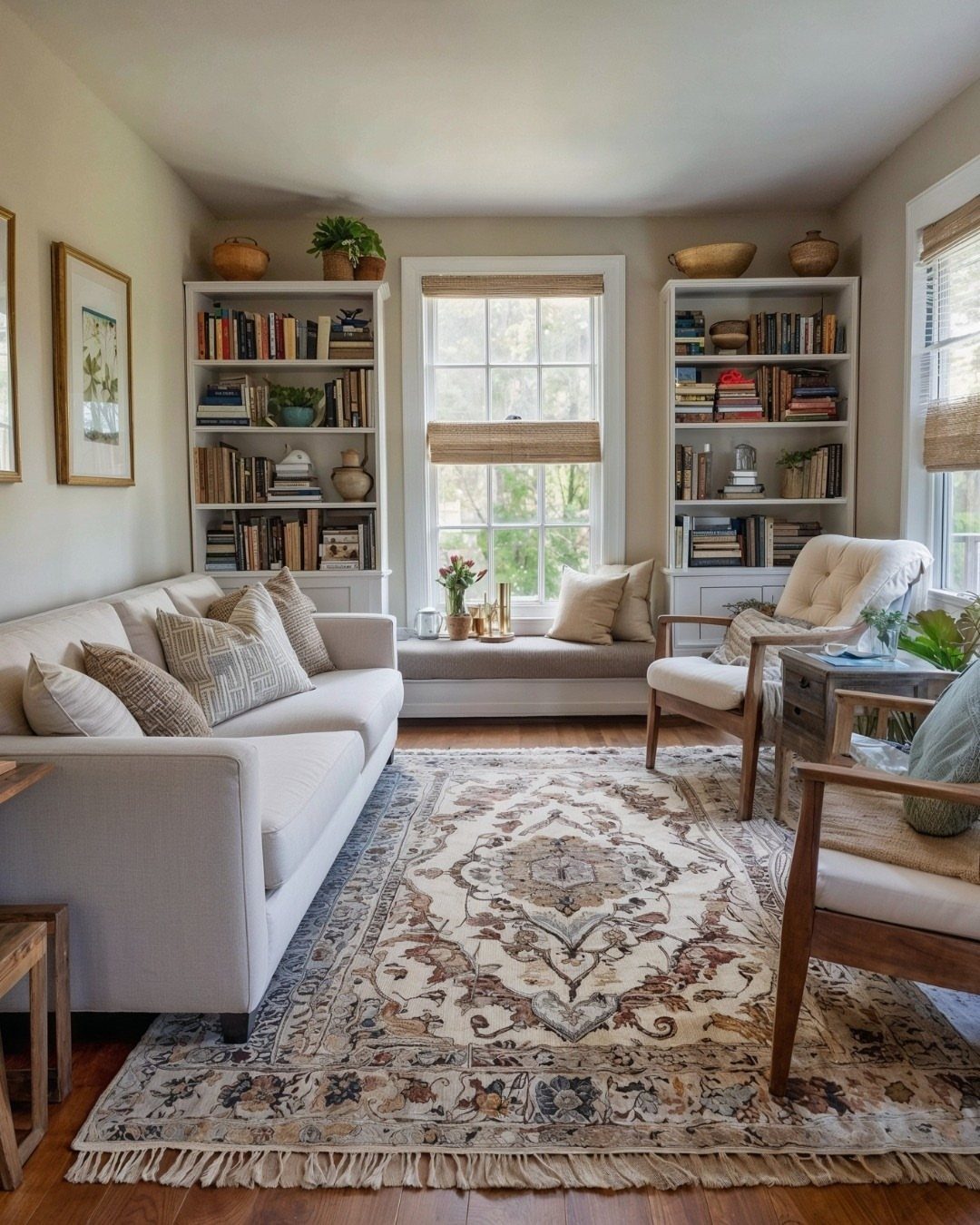
Small rooms warm up faster than large ones. A gas fireplace and stove fit where a grand hearth would not; built-in shelves flank a window seat that would look skimpy in a bigger space.
The coziness is the point, not a consolation prize.
Cream, wood, and neutral pattern run together without a hard line between them, which is how a small room keeps its breath. Nothing competes for attention because nothing needs to fill excess space.
That restraint is easier here than in a room that swallows furniture whole.
Renters can fake the built-in look with two narrow bookcases bracketing a bench or a storage ottoman beneath the window. The architecture matters less than the enclosed feeling.
I’d aim for this if I wanted a room that felt finished at 8 p.m. with a lamp and a book. The trade is entertaining: a few guests fill the space warmly, a crowd breaks it.
Know your usual crowd.
18. Use a Bookshelf Room Divider
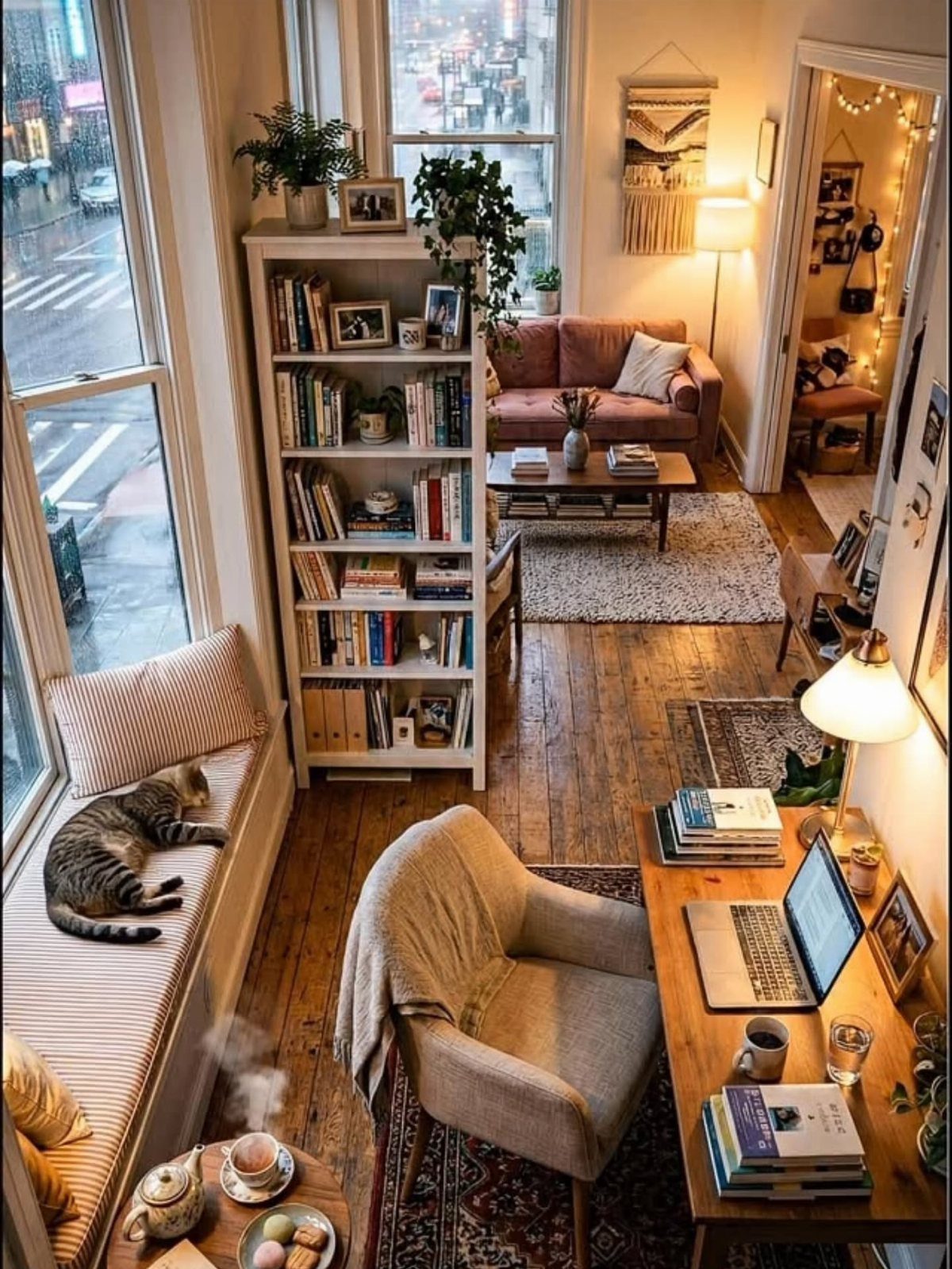
A tall open bookshelf splits one room into two without the cost or commitment of a wall. A tall white unit between a desk area and the sofa lets light through while still giving each zone its own address.
I like backless or partially open styles for this, since a solid back blocks the borrowed light that makes both sides feel larger.
Cube shelves work well; you get display space facing both directions and a natural place for baskets on the lower rows where clutter hides.
Leave enough width for a comfortable walkway, and anchor tall units to the wall if a cat or a kid might climb it.
Skip this if you need real sound privacy. For that, a ceiling-mounted curtain on a hospital track costs less and seals better.
19. Combine Living and Work Spaces
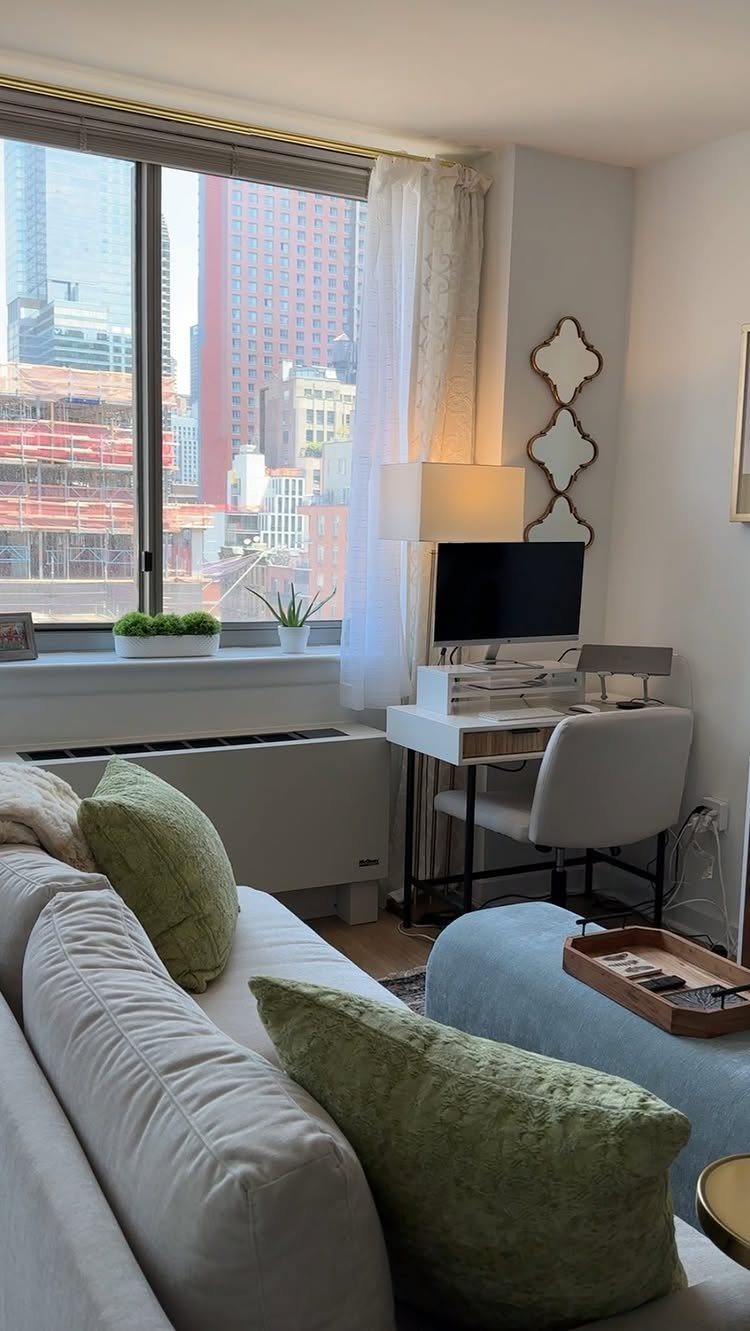
The desk tucked beside the sofa here faces a window, which matters more than the desk itself. Natural light behind the monitor reduces glare and keeps the work corner from feeling like a punishment post.
I have seen this fail when the desk becomes a dumping ground for mail and charging cables. A shallow desktop preserves walking room, and one drawer for the laptop hides the job when the evening starts.
Green cushions on the sofa give a color cue that this is still living space, not an office that swallowed it.
If your work involves video calls, position the camera so the room behind you reads as home, not bedroom. A bookcase or a plant at your back fixes that.
20. Open-Plan Living and Dining
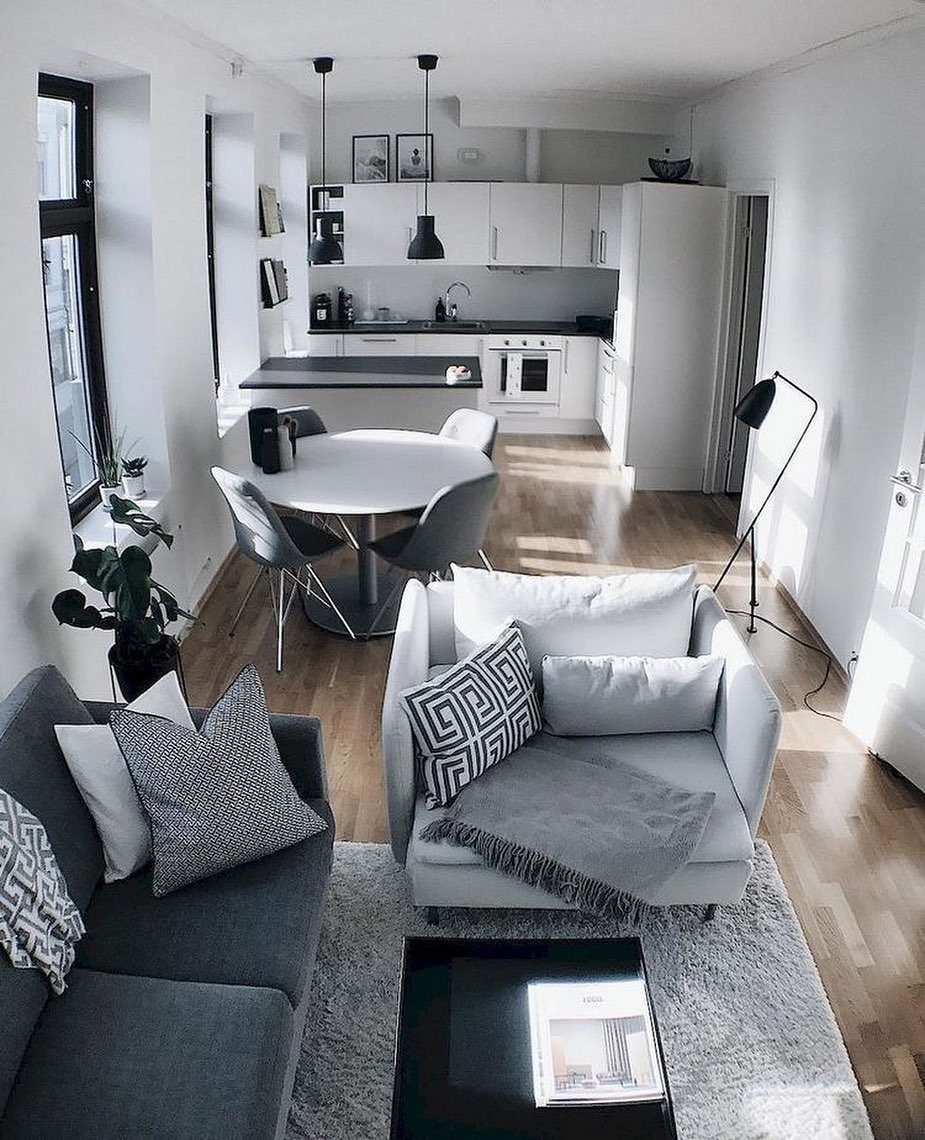
One open stretch of floor carries living, dining, and kitchen, connected by pale wood and white walls that let the eye travel.
A round dining table sits where a rectangle would have blocked the path; the right size seats a small group without claiming territory.
The grey sofa has no high back, so someone at the table still sees the window and the room keeps its breath.
I would keep the dining chairs low-profile too, and match one tone from the living area in the kitchen if the finishes allow it.
The trade is noise and smell; cooking dinner while someone watches television means neither of you gets full separation.
Daybed-style seating, open on both sides, works better here than a traditional sofa if you entertain often and want to turn toward either zone.
Maximize Functionality
A single piece that does two jobs earns its footprint twice over.
Choose the Right Scale
A large sofa in a small room seems wrong until you see it work. One sweeping curved piece, low to the ground, hugs the walls and creates a single sculptural anchor rather than breaking the room into fragments.
Curved edges and a low silhouette let your glance travel without hitting a wall of furniture; the room feels bigger than the square footage would suggest.
The same logic runs through shorter furniture of all kinds. The illusion costs nothing but the choice.
“Scale and proportion are essential to living well in small spaces. Every piece of furniture should serve a purpose, if not several,” says Ellie Christopher of Ellie Christopher Interior Design.
Incorporate Personal Touches
Furniture that ages with you turns a small room from a stopping place into a home you keep.
A piece that gets better at year five than it looked at year one rewards the initial outlay and stops the cycle of replace-and-regret.
A sun-drenched room helps; light shows material honestly and forgives what darker corners would hide.
If your windows face another building, a single lamp with a warm bulb on a dimmer does some of the same work, letting grain and patina read as character rather than wear.
The objects you live with daily deserve that second look.
Create Visual Interest
Boring walls are the renter’s standard issue, which makes what you hang matter more. Colorful artwork and patterned fabrics do the heavy lifting when paint is not an option.
One large piece reads as intentional; a scatter of small frames reads as clutter you haven’t edited yet.
A standout window can carry the room without much help. Keep the palette quiet around it, add texture where you touch it, a faux fur throw, a woven shade, and let the light and the view beyond do the rest.
Comfort holds up when textures mix, not when hues compete for attention.
Frequently Asked Questions
What is the 2/3 rule for living rooms?
The 2/3 rule means furniture should take up about two-thirds of the room’s floor space, leaving the rest open for walking and breathing room. In a small apartment, this keeps the room from feeling packed tight.
I’d rather leave a little extra clearance than hit the full two-thirds and lose the sense of space.
What are some good ideas for a small living room?
Modular sofas, low-profile furniture, and plants that climb or trail work well because they adapt to tight footprints and draw the eye upward.
A gallery wall or curtains hung high above the window frame also stretch the room vertically without costing floor space.
What are some common small living room mistakes?
Overcrowding with furniture and ignoring vertical space are the big ones. People also mount TVs too high, near the ceiling, which ruins your neck for movie night; center it at seated eye level instead.
Another miss is buying a coffee table without measuring sofa height first; the reach feels wrong every time if the gap is off.