Breeze blocks are decorative concrete blocks, usually about one foot square, with patterned openings that let air pass through while screening light and sightlines. The catch is that they are non-structural: meant for looks and airflow, not for holding up weight, so a low garden wall or patio screen works fine but a load-bearing wall does not. A single block runs heavier than it looks, and a stack in a truck bed adds up fast.
What Breeze Blocks Actually Are
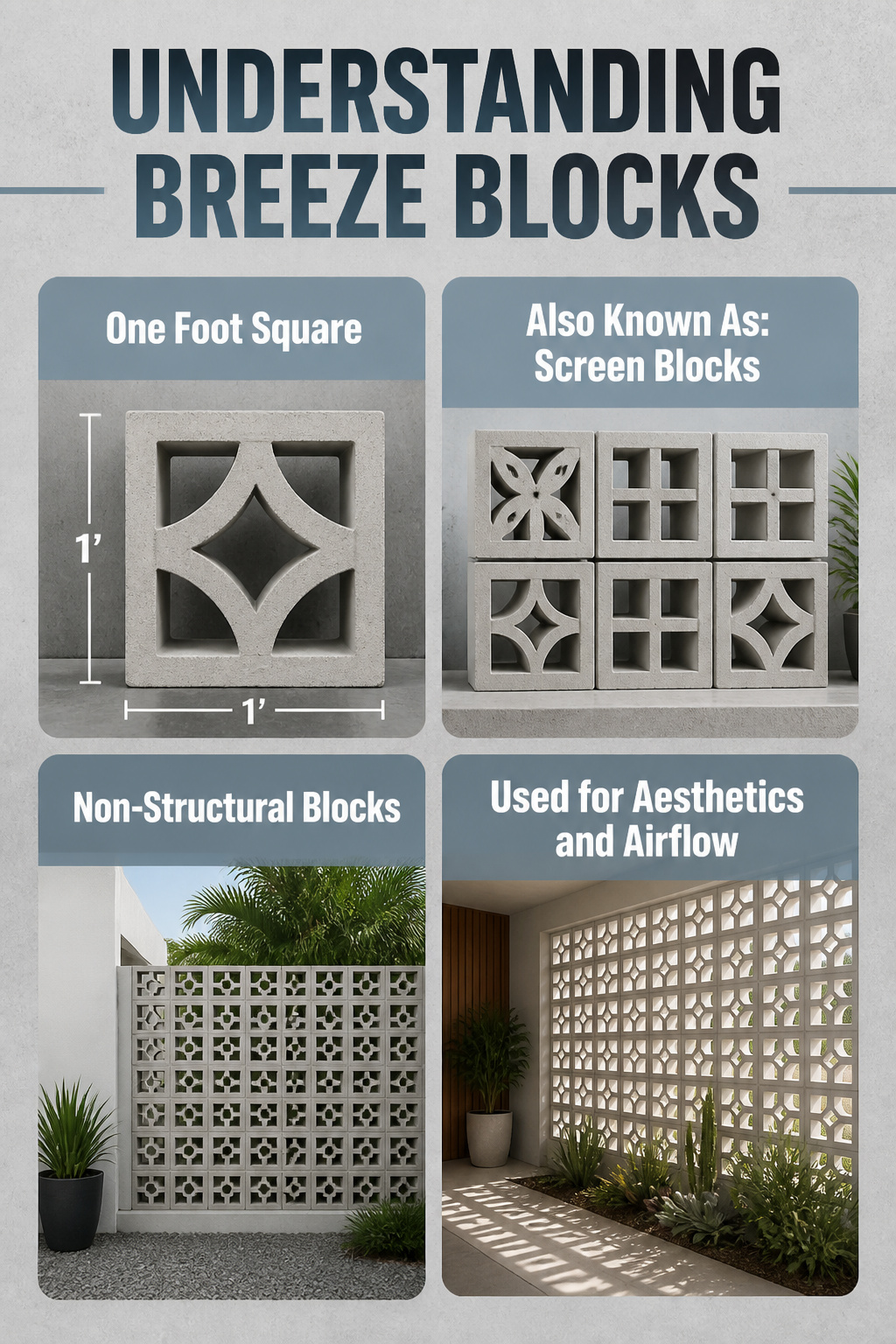
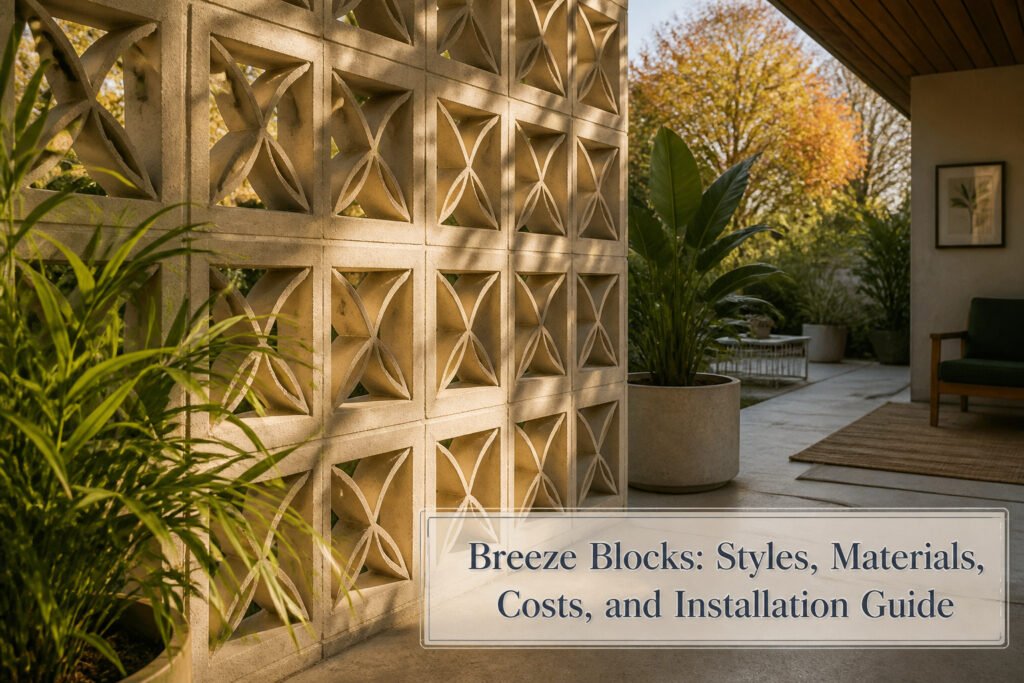
Breeze blocks are decorative concrete blocks, usually about one foot square, with patterned openings that let air pass through while screening light and sightlines. If you have driven past a mid-century house with a perforated privacy wall or a louvered entryway screen, you have seen them; you may just not have known the name.
The same block goes by enough alternate names to complicate any search. Screen blocks, solar screen blocks, decorative concrete blocks, fence blocks, and architectural blocks all point to the same thing, as do pattern blocks, screen bricks, and vented blocks. Even "perforated grilles" turns up in older writing. The term "breeze block" itself seems to come from the French brise soleil, or sun break, though a 1959 patent by Edward Durell Stone simply called them wall blocks.
What matters practically is that these are non-structural blocks. They are meant for looks and airflow, not for holding up weight. A low garden wall or a patio screen is fair game; a load-bearing wall is not.
Decorative Concrete Blocks
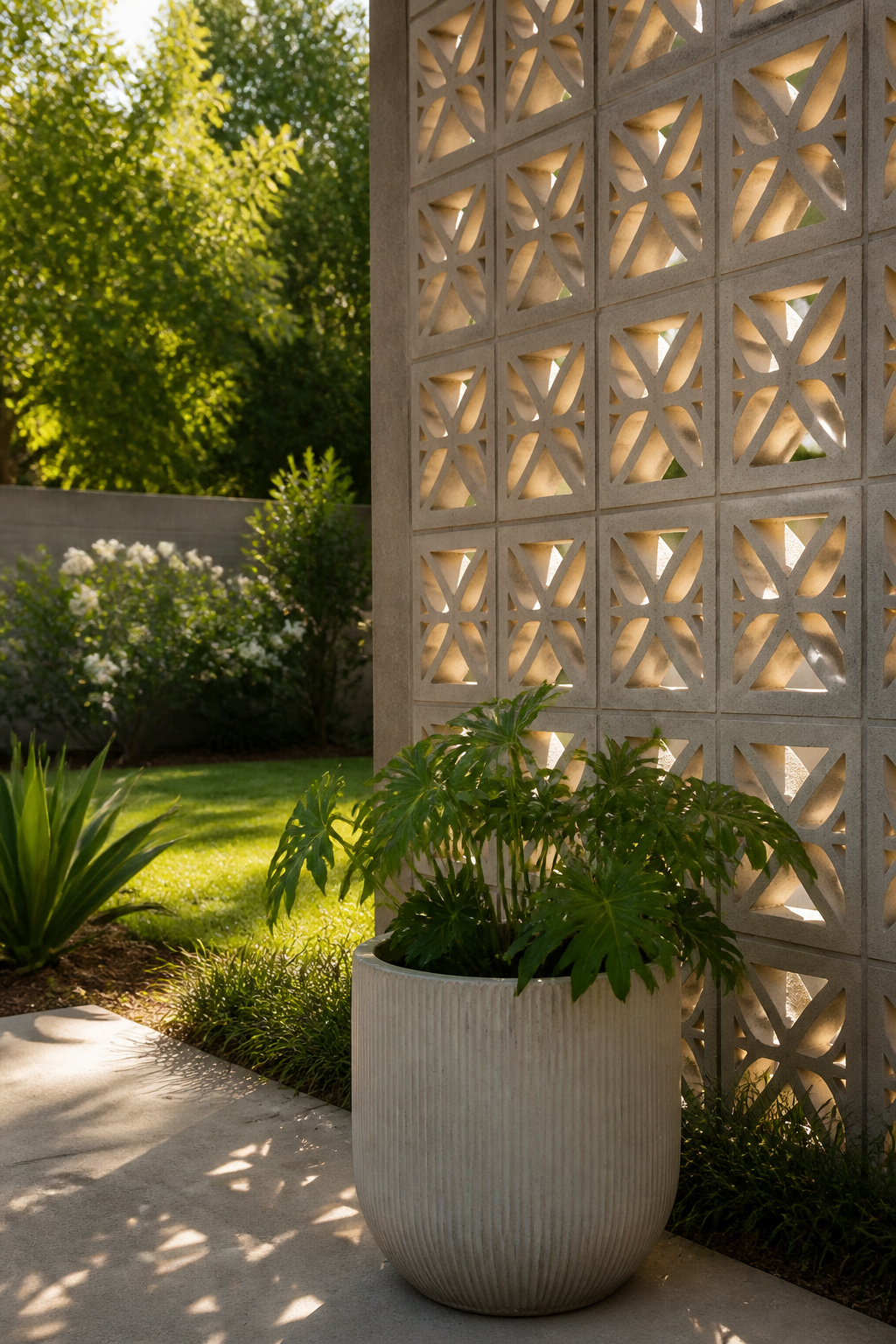
Decorative concrete blocks are what most people picture when they hear "breeze block." These are the solid or lightly patterned concrete blocks designed to catch light and cast shadow, turning a privacy wall or garden feature into something that reads as architecture rather than just a barrier.
Concrete dominates the material here. While you will occasionally find these blocks in ceramic, glass, brick, terracotta, or even foam, the ones that have lasted since the 1950s, 60s, and 70s are almost always poured concrete. That weight matters if you are hauling them yourself in a weekend project: a single block runs heavier than it looks, and a stack in the bed of a truck adds up fast.
The pattern itself is the point with this type. The holes are not primarily for ventilation; they are for the shadow line they throw at different times of day. In a garden wall or patio screen, that shifting geometry does more visual work than any paint color could. If your project is about privacy, the density of the pattern matters more than the name on the style: a tighter lattice reads as more solid from a distance, while a more open design gives you air and light at the cost of true seclusion.
These blocks are nonstructural, meant for freestanding or veneered walls rather than load-bearing work. That distinction saves money on the block itself but means you will need to plan the footing and framing separately, not pile them up and hope they stay.
Screen Blocks
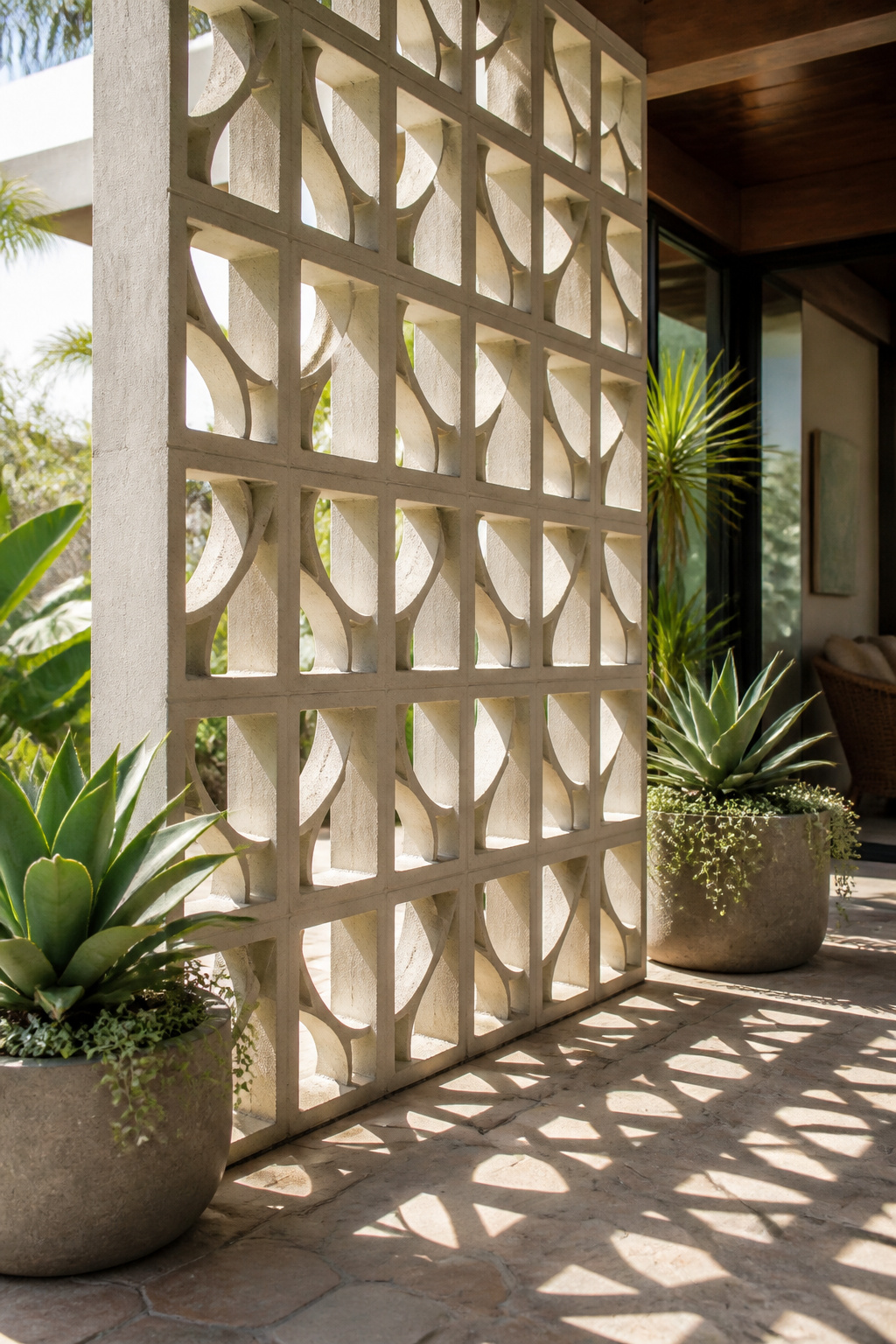
Screen blocks are the openwork cousins of solid breeze blocks, built with larger geometric cutouts that block sight lines while letting air pass straight through. The design solved a specific problem in warmer climates: how to shade a patio or carport without trapping heat against the house. Stagnant air turns a shaded corner into an oven, so the holes matter as much as the wall itself.
By the 1950s and 1960s these had become the standard screen for mid-century carports and backyard patios across Florida and California. The pattern casts moving shadow through the day, which reads as decoration now but started as temperature control. You will still see the originals on ranch houses from that era, sometimes painted, usually grayed with decades of sun.
The same block works as a patio wall or a carport screen because the job is nearly identical: define a space without sealing it. What changes is the pattern density. A tighter cutout gives more privacy, a looser one moves more air, and the catalogs from that period offered dozens of geometries to balance the two.
Solar Screen Blocks
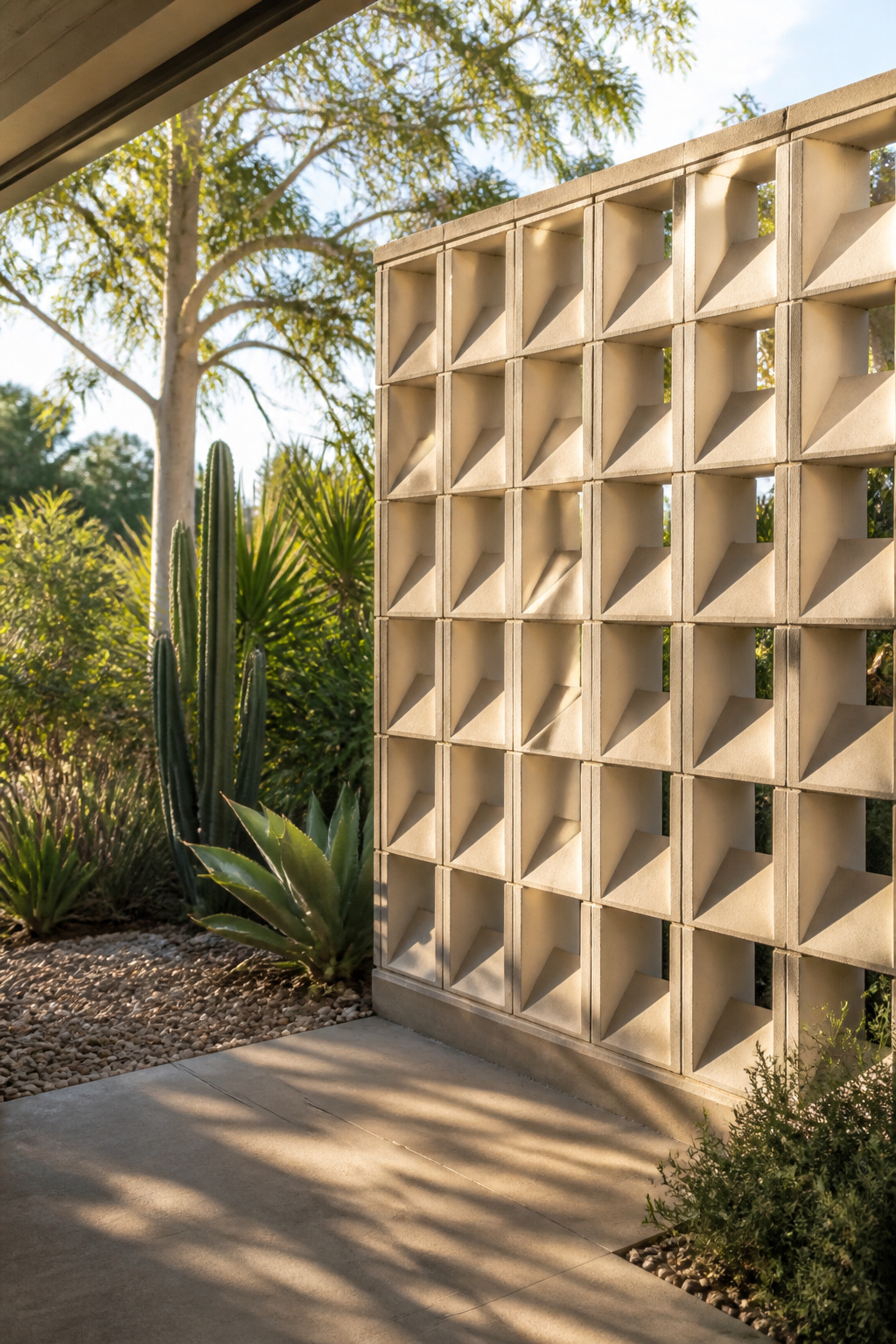
Solar screen blocks take the basic idea of a screen wall and add a deliberate angle to the openings, usually sloped to catch high morning light while blocking the lower, hotter afternoon sun. The geometry matters more than the pattern: a block that reads as simple rectangles from the street can still function as a solar filter if the cavities inside are cut on a bias. In practice, that means the wall reads differently depending on the time of day, and the room behind it shifts from bright to shaded without any moving parts.
These were more common in mid-century commercial projects than in residential work, and the pool of suppliers has shrunk since the 1970s. What stock remains tends to command a premium over standard decorative blocks, and lead times stretch longer than you would plan for a weekend fence project. If the sun angle problem is real for your site, measure whether a standard screen block wall, planted with something deciduous, solves most of the same problem at half the chase. Solar blocks reward the effort only when the geometry is exact; a few degrees off in the casting angle and you have paid extra for a wall that performs like any other.
Architectural Blocks
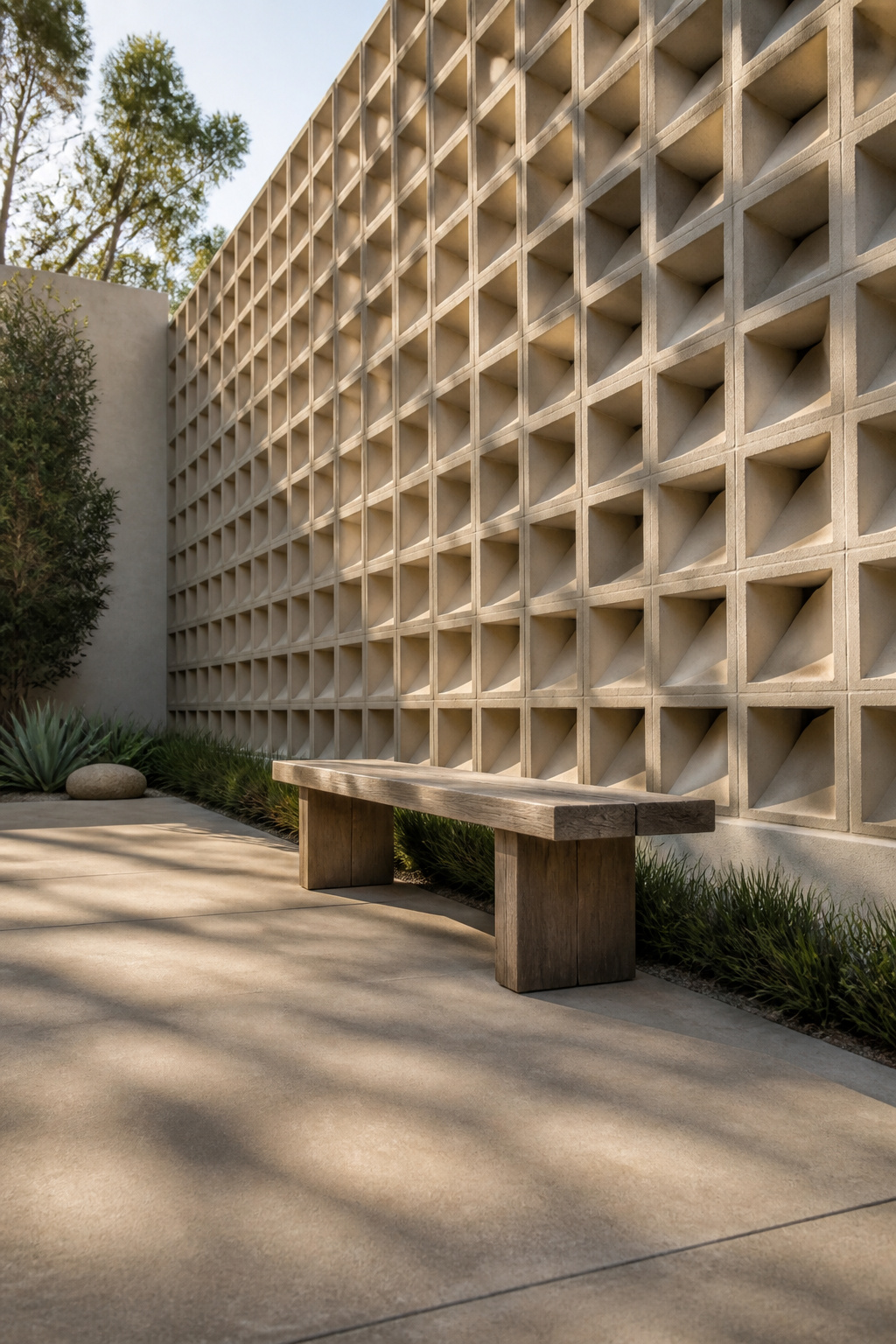
Architectural blocks sit at the top of the price and pedigree range. Edward Durell Stone’s "Empress" design remains the pattern most collectors recognize, and for good reason. His 1954 U.S. Embassy in New Delhi wrapped screen blocks across the entire facade, turning a functional screen into something monumental. Stone had already tested the concept on his own Manhattan townhouse before the embassy was finished, and the resulting publicity pushed the idea into mainstream American architecture.
By the late 1950s, concrete block manufacturers across the country were producing decorative patterns for suburban homes, not just embassy walls. The look peaked in the 1960s, showing up on California and Arizona houses, commercial buildings, and eventually crossing into territory that reads, in hindsight, closer to kitsch than cutting edge. That saturation explains why the style faded by the 1970s, and why revival interest only picked up again in the 2010s alongside broader mid-century modern nostalgia.
Pattern Blocks
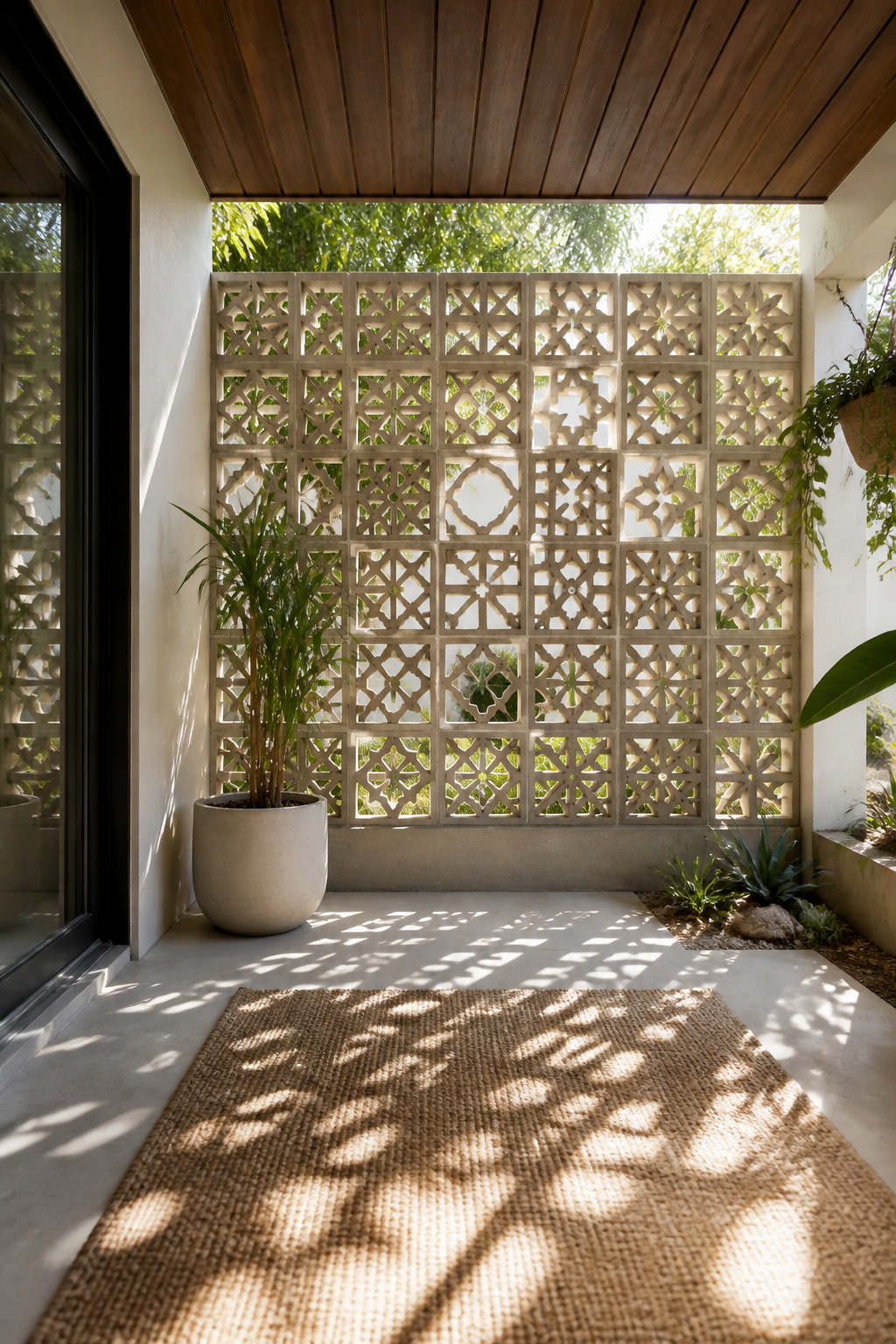
The cutouts are what make breeze blocks worth looking at twice. Villa Lagoon Tile stocks more than forty patterns across seven colors, and the range runs from tight geometric grids to cloverleaf and floral motifs that read almost lace-like from a few feet back. Pattern density is the choice that matters: the tighter the cutout, the more privacy you keep and the less air moves through. A loose floral block on a south-facing patio looks almost solid at noon and turns into a shifting shadow play by four o’clock, something the product photos never quite capture.
Manufacturers now use finer sand aggregate and hydraulic presses rather than the coarse castings of the original mid-century runs, so the edges come out thinner and cleaner. The effect is more refined than the blocks your grandparents might have had, but the physics stay the same. If you are building a screen for a spot that bakes all afternoon, plan for the hour-by-hour change rather than the one moment you saw on Pinterest.
Ventilated Blocks
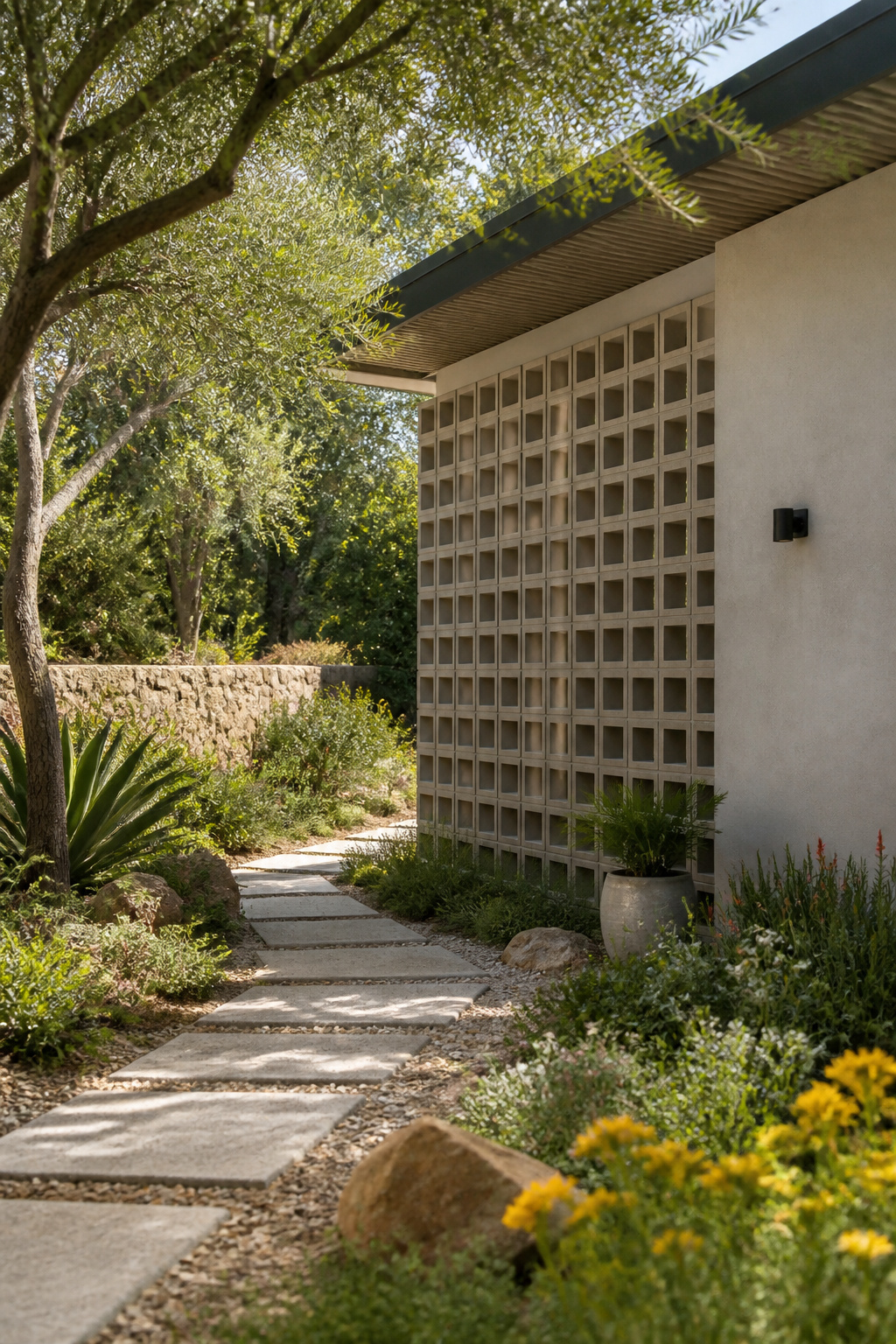
Ventilated blocks carry the most open pattern of any breeze block style, with some designs running as much as seventy percent empty space to solid. That extreme ratio is the point. Agricultural buildings in hot climates used them first, not for looks but as the wall itself in a passive cooling system. Warm air rises inside a barn or storage shed and pulls fresh air through the block openings, dropping interior temperatures without any mechanical help. The same principle later showed up in factory walls and equipment screens where machinery needed constant airflow to stay running.
What separates ventilated blocks from decorative screen blocks is that structural job. Screen blocks divide space or block sightlines while still looking good from both sides. Ventilated blocks are doing active work as part of a building’s climate control, even when the pattern happens to look striking. Mid-century residential architects noticed that functional gap and started borrowing the industrial form for carports, clerestories, and whole exterior walls in desert and subtropical climates.
The agricultural roots still show in sizing. Many ventilated blocks come in larger units than standard decorative patterns, and the openings run bigger too. A residential installation using them for cooling needs to think about what passes through those gaps: driving rain, insects, or the neighbor’s view into a bedroom. Some builders pair them with a secondary screen or operable panel behind the block wall, which adds cost but keeps the airflow benefit intact.
The openings run large enough that insect screening or a secondary panel behind the block is usually worth the extra step.
Fence Blocks
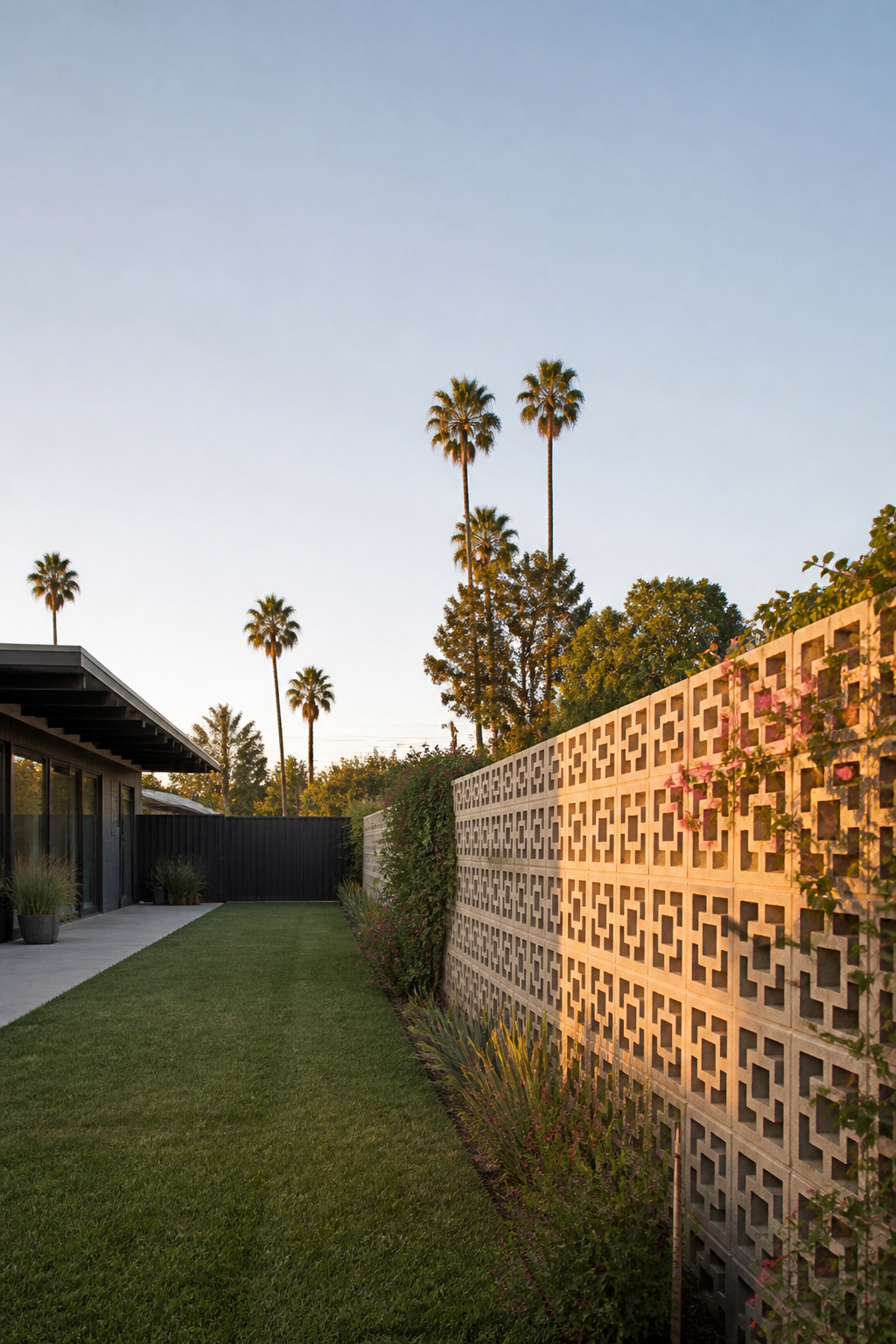
Fence blocks carry a heavier load than their decorative cousins, and the difference starts underground. Where a breeze block screen might rest on a compacted gravel bed or a shallow concrete pad, a freestanding fence needs a footing rated for wind load, the same calculation a solid masonry wall would face.
The concrete foundation runs deeper and wider, tied with rebar that extends up into the block cores. Without that continuous reinforcement, a tall run of open-pattern blocks turns into a sail the first time a storm rolls through. I watched a neighbor learn this the hard way after a summer squall pushed his three-month-old privacy wall off its footing; the pad had been thick enough for looks, but never engineered for lateral force.
Grout fills every core in a fence block, and vertical rebar links footing to cap. The block itself is denser, too, often rated for structural use rather than the lighter decorative mix. That extra concrete and steel adds cost and digging time, but skipping it means building something you will rebuild.
Cinder Blocks
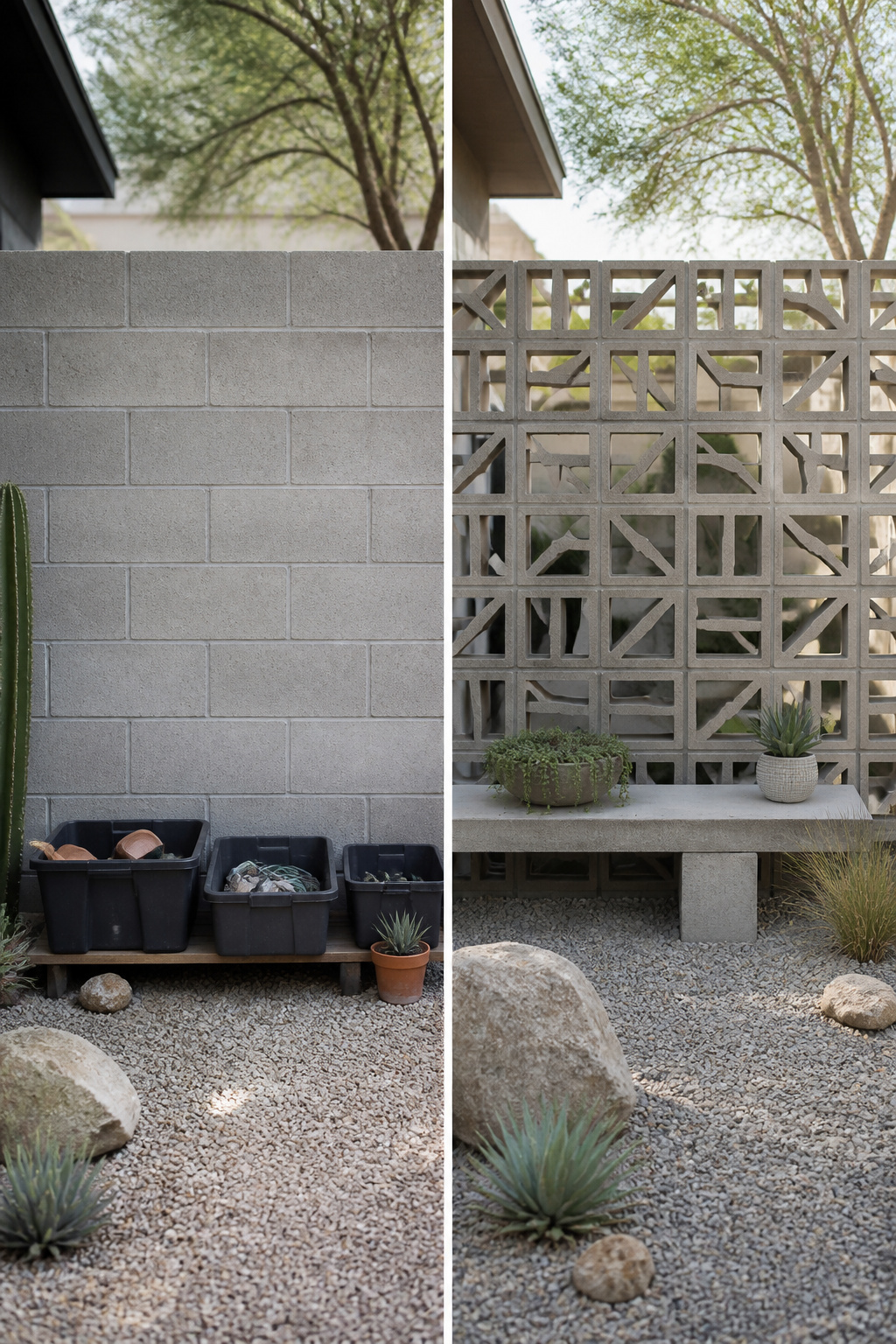
Cinder blocks are the utilitarian cousin that gets mistaken for decorative breeze blocks, and the difference matters once the wall is up. True cinder blocks are heavier, built for structural loads, and carry a flat or lightly textured face with no pattern cut through them. They were designed to bear weight, not to cast shadow or let air pass. The confusion starts at the name: in the United States, CMU blocks are commonly called cinder blocks, and they are also known as breeze blocks, a term derived from breeze, referring to the small cinders and cinder-dust that are created by partially burned coal. However, breeze blocks also refers specifically to decorative blocks used on exterior walls to allow the breeze through.
In the United States, breeze blocks also refers specifically to decorative blocks used on exterior walls to allow the breeze through, which were an important feature of Mid-Century Modern design.
That distinction is what saves your weekend project. On the pallet, cinder blocks show solid faces or uniform vent holes sized for mortar and rebar, never a cloverleaf or geometric screen pattern. In the yard, lift one: a standard cinder block runs heavier than a decorative breeze block of similar size because the material is denser and the wall thickness greater. Using cinder blocks for a decorative screen wall kills the look. You get a prison-yard slab instead of filtered light and moving shadow, and the weight demands a footing engineered for bearing, not just a garden-bed edge. If the block in your hand feels like it could hold up a garage, it is not the one for your patio screen.
Cloverleaf Blocks
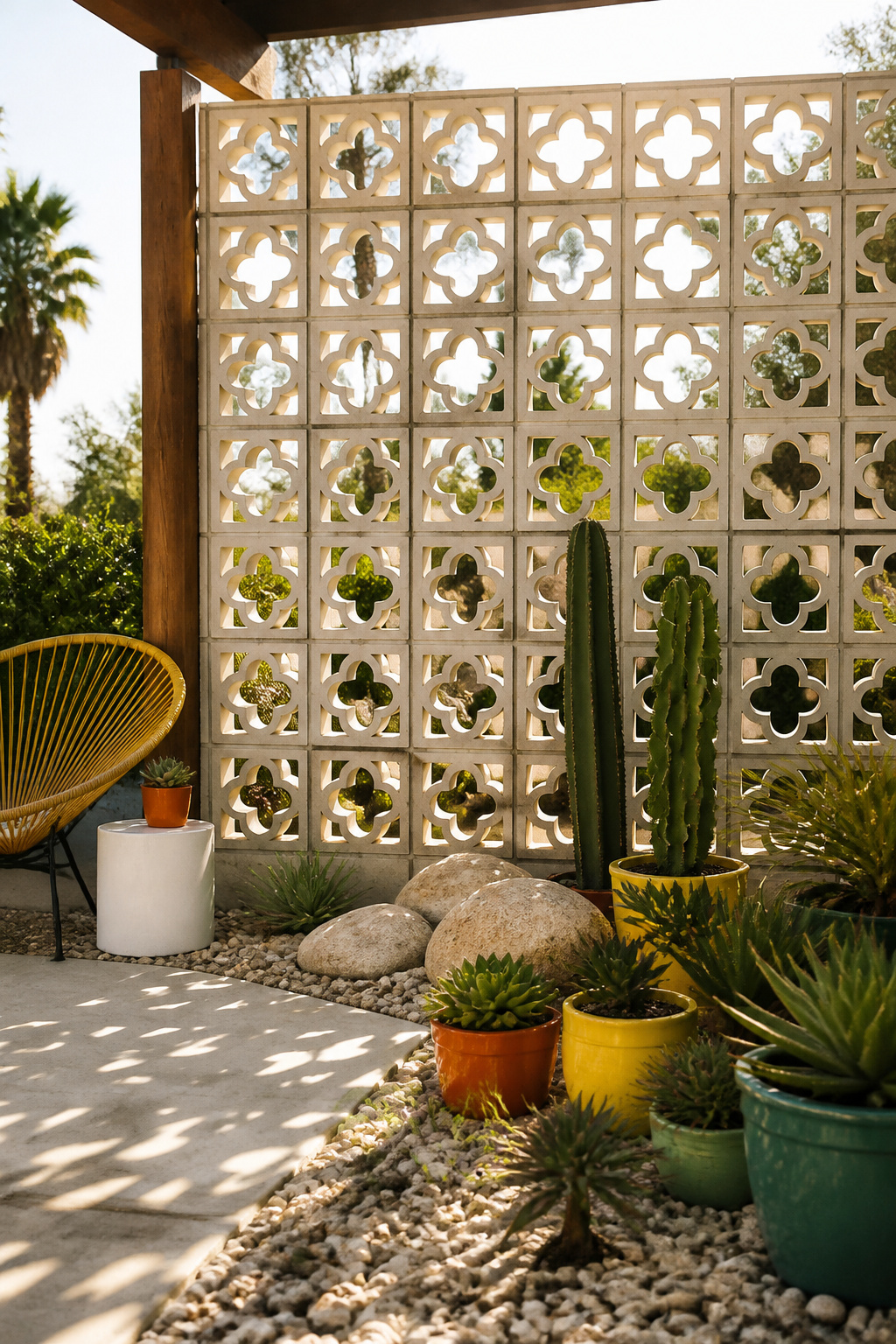
The cloverleaf pattern reads mid-century modern faster than any other breeze block design, at least in the American Southwest and Florida where it turned up on carports, patio screens, and motel facades from the late 1950s through the 1960s. Edward Durell Stone’s early use of ornamental screen block set the template, and manufacturers raced to cast their own versions until the look tipped from stylish to overdone sometime in the late 1960s or early 1970s.
What brought it back, starting in the 2010s, was less nostalgia than photography. The cloverleaf’s negative space catches light and shadow in a way that flat walls never manage, which means it performs on Pinterest the same way it once did on a Palm Springs driveway. A single panel can carry a photo, so homeowners who want the hint of a breeze block wall without a full courtyard project can get the effect with four or six blocks and a weekend.
Current reproductions vary more than people expect. Some are cast thick and coarse, closer to the original 1960s weight; others use finer sand aggregate and hydraulic presses to come out thinner, smoother, and lighter. Depth matters if you are planning a freestanding screen, and casting quality shows once the block is lit from the side. If the surface looks pitted or the pattern edges seem soft in the supplier’s photo, they will not improve in your yard.
Rectangular Blocks
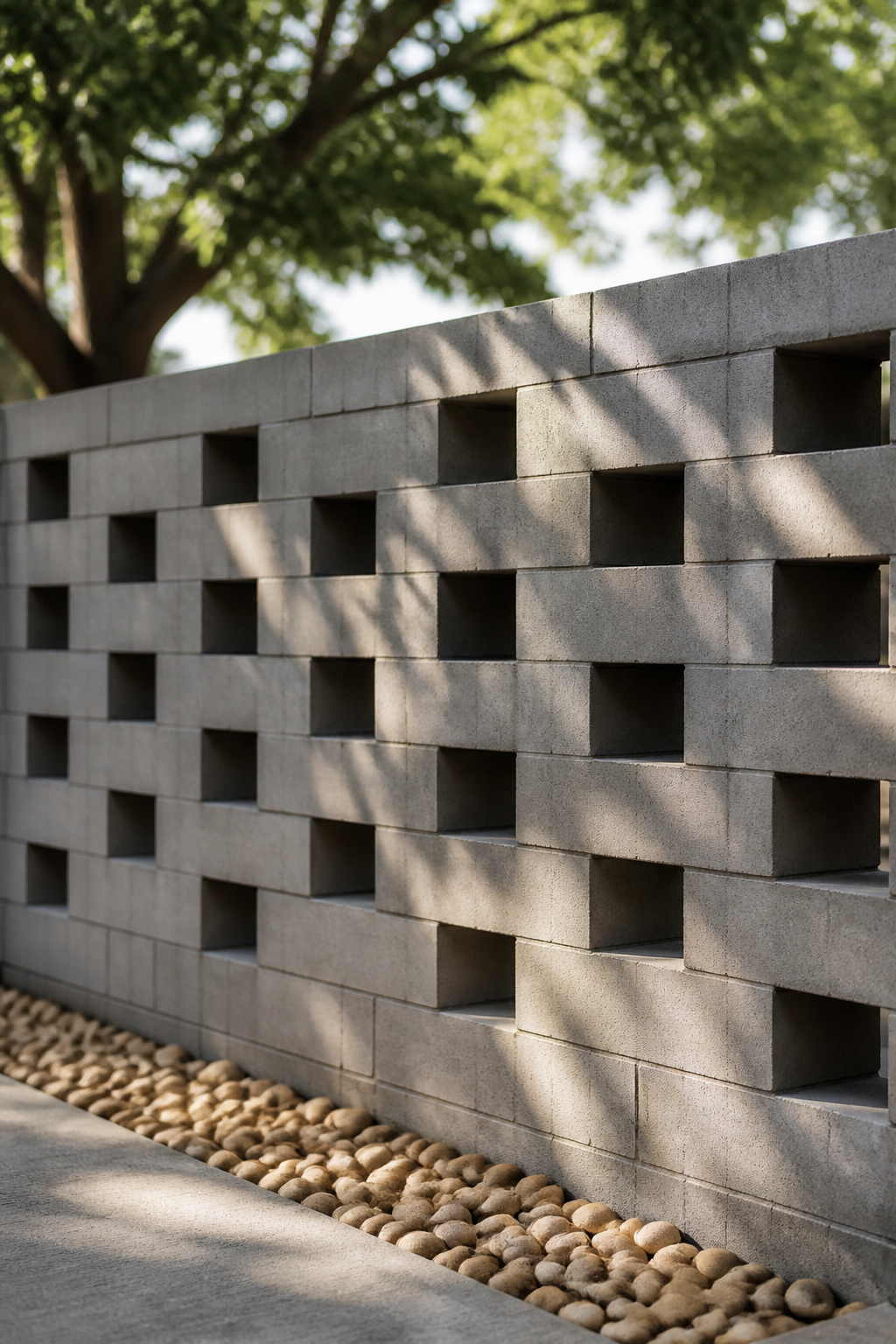
Rectangular blocks trade the snowflake and cloverleaf patterns for simple horizontal slots, and that plainness is exactly what makes them useful. A1 Block Corp. and Carroll’s Building Materials both stock the same basic 4-by-8-by-16-inch format with variations like the double X, double Y, or double rectangle, all running about $7 to $9 per block in natural gray from Villa Lagoon Tile’s stocked lines like the Elba or Corsica. Those small slots still let air and light through, but the wall reads as texture rather than decoration, which suits a modern patio screen or a garden backdrop where you want the planting to stay the star. I would not use them for a feature wall in a mid-century revival; the vintage projects want the ornamental punch. For renters or first-home owners building on a weekend, rectangular blocks also stack faster and waste less time on alignment, since every course looks the same from any angle. The tradeoff is personality. If the goal is breeze-block function without breeze-block nostalgia, this is the shape to start with.
Materials and What They Cost
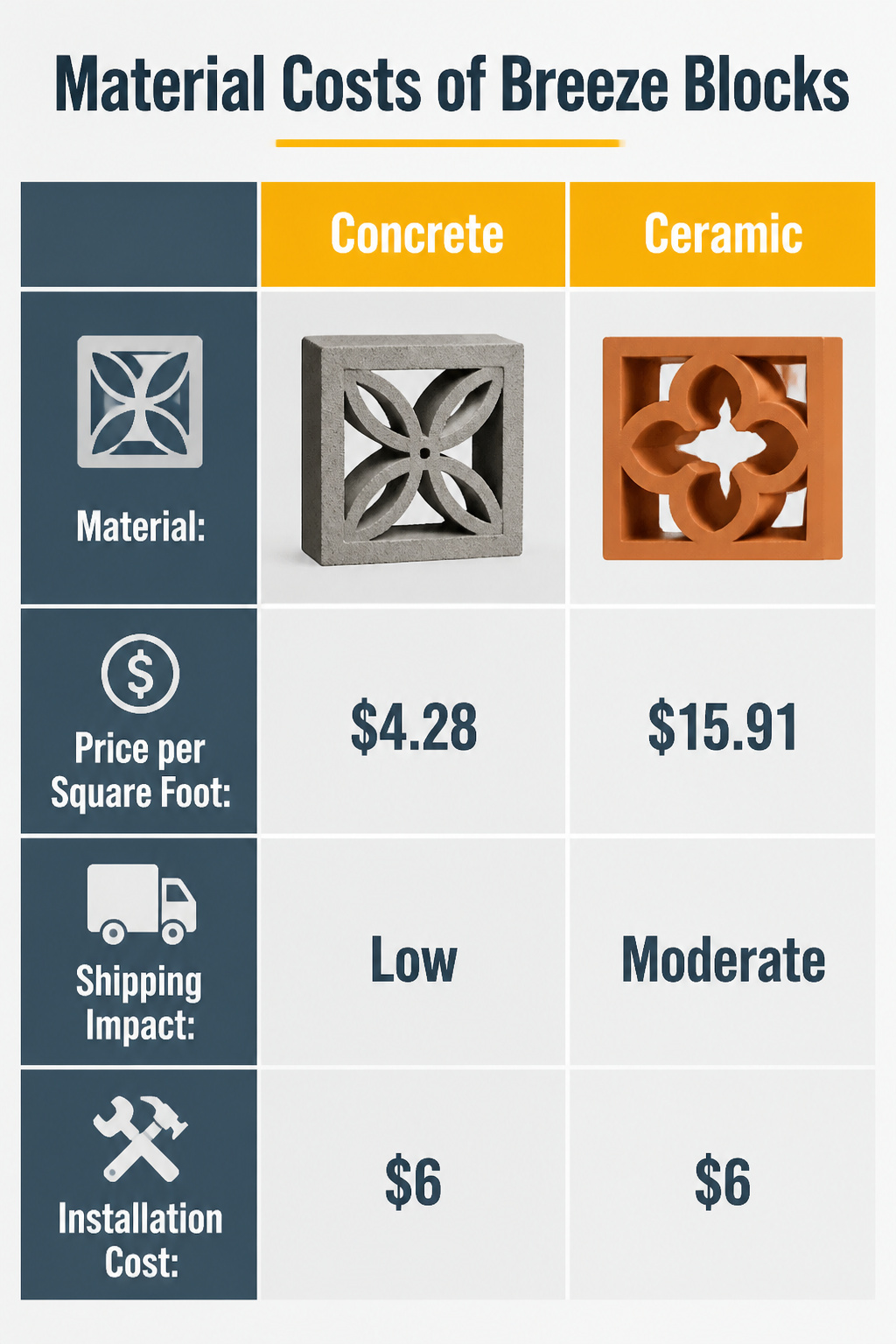
Concrete, ceramic, and glass are the three compositions that show up in the current market, and the spread between them is wider than I expected. Prices run from $4.28 to $37.99 per square foot, with plain concrete at the low end and prepainted or specialty blocks pushing toward the top. One installer reported labor at about $6 per square foot, which sits on top of whatever material you choose.
Regional stock matters more than the material itself. A cloverleaf or windbreaker pattern common in Phoenix might need freight added to reach Ohio, and that shipping can erase the savings on a $4.28 block fast. Terracotta two-block designs from specialty suppliers land in the middle around $15.91 per square foot, while caps and rounded shapes for finishing edges run higher, sometimes past $55 per square foot. Checking what ships from a warehouse near you before falling for a style is the move that saves the budget.
How I Install Them Without the Wall Falling Over
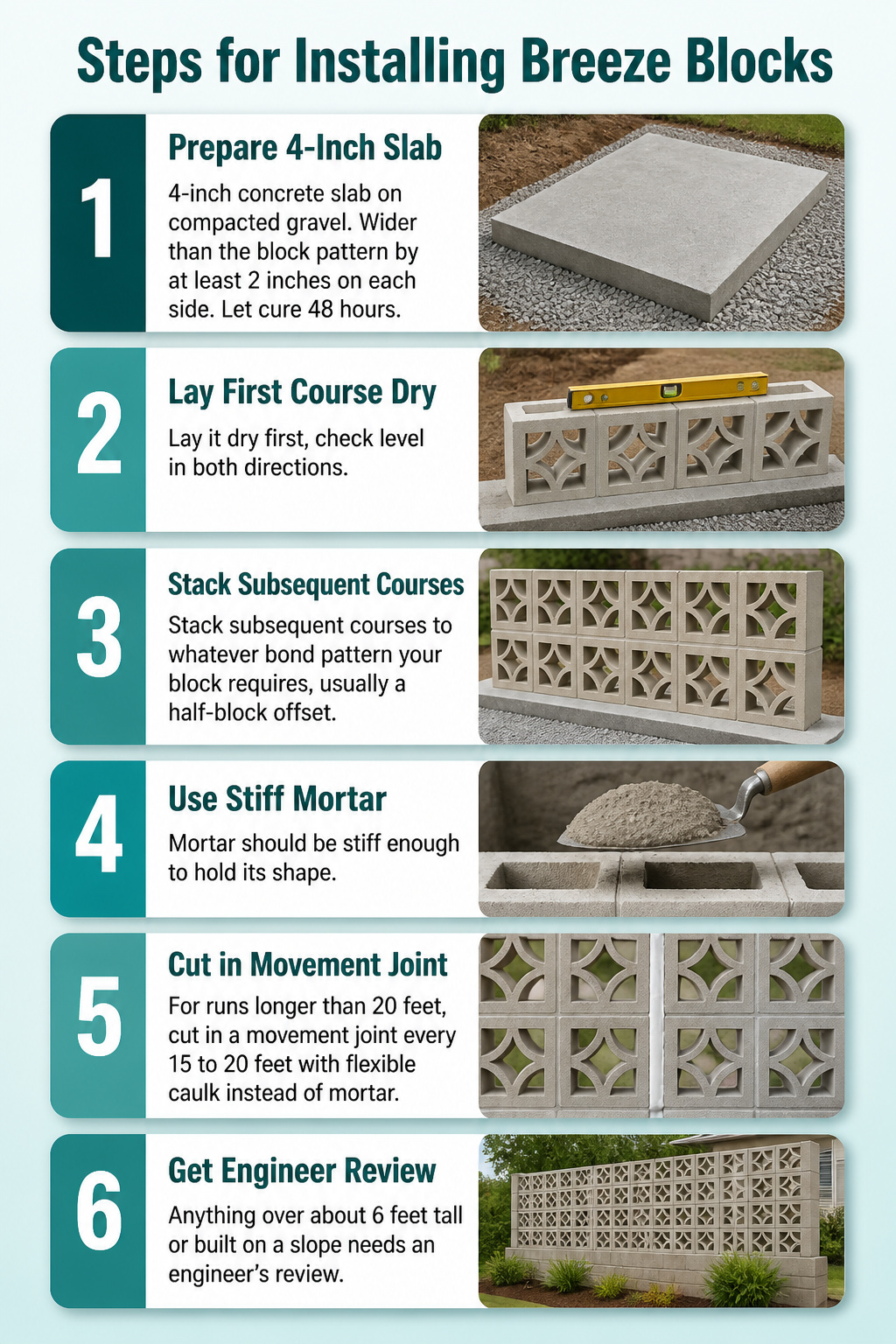
Breeze blocks are non-structural, which means the wall carries no load but still needs to stay upright on its own. The footing is where most weekend builds fail: a 4-inch concrete slab on compacted gravel, wider than the block pattern by at least 2 inches on each side. Let that cure 48 hours before you touch it.
The first course sets everything. Lay it dry first, check level in both directions, then butter the footing with mortar and tap each block home. Once the base is true, stack subsequent courses to whatever bond pattern your block requires, usually a half-block offset so the vertical joints never line up.
Mortar should be stiff enough to hold its shape. Too wet, and it squeezes out the holes and ruins the pattern. Too dry, and the next course won’t settle in.
For runs longer than 20 feet, cut in a movement joint every 15 to 20 feet with flexible caulk instead of mortar. The block will expand and contract more than you expect.
Anything over about 6 feet tall or built on a slope needs an engineer’s review. These blocks are ornamental; a tall screen wall in wind is a sail that wants to tip.
Where to Find Them Now
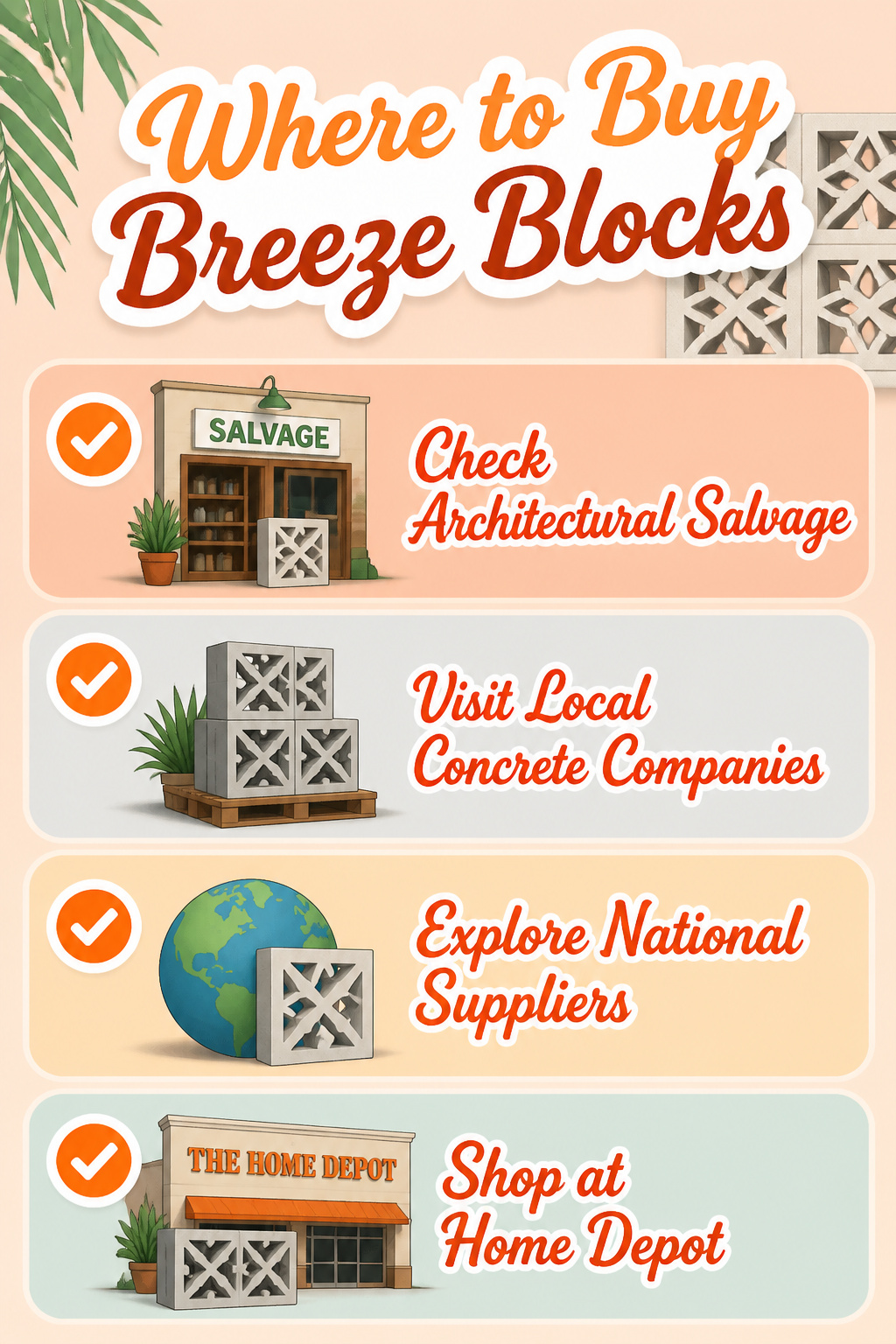
The revival has pulled new producers into the market, but authentic mid-century patterns now carry lead times that can stretch several months. Villa Lagoon Tile stocks more than forty patterns for quicker shipment across all fifty states, Puerto Rico, and the Caribbean, while their special-order line expands to seven colors. Regional operations, some running since the 1950s and 1960s, still account for much of actual production. Home Depot carries one basic option, though the vendor seems to shift year to year.
My own search runs in three stages. Architectural salvage gets the first call, since old stock sometimes surfaces at prices below new manufacture and carries the softer edges of original casting. If that fails, regional concrete products companies are the next stop; many will ship beyond their immediate territory if asked. National specialty suppliers fill the gaps for specific patterns like the Large Windbreaker Ninety or the rounded caps that finish a freestanding wall cleanly. Expect to pay around $24 per piece for the Windbreaker Ninety in natural white, with caps running $7.99 to $12.50 depending on diameter.
Frequently Asked Questions
What is a breeze block?
A breeze block is a decorative concrete block, usually about one foot square, with patterned openings that let air pass through while screening light and sightlines. These are non-structural blocks meant for looks and airflow, not for holding up weight. The same block goes by many names, including screen blocks, solar screen blocks, decorative concrete blocks, fence blocks, architectural blocks, pattern blocks, screen bricks, and vented blocks.
Where can I buy breeze blocks?
Breeze blocks can be found through architectural salvage yards, regional concrete products companies, and national specialty suppliers like Villa Lagoon Tile, which stocks more than forty patterns for quick shipment across all fifty states. Home Depot carries one basic option that shifts year to year. Authentic mid-century patterns often carry lead times of several months, so checking regional stock near you before committing to a style can save on freight costs.
How much do breeze blocks cost?
Prices run from $4.28 to $37.99 per square foot, with plain concrete at the low end and prepainted or specialty blocks pushing higher. Labor adds about $6 per square foot on top of material costs. Specific examples include rectangular blocks around $7 to $9 each, the Large Windbreaker Ninety at $24 per piece, and caps running $7.99 to $12.50 depending on diameter. Terracotta two-block designs land near $15.91 per square foot, while specialty finishing shapes can exceed $55 per square foot.